


THE BEGINNING: ₹5,000 AND A RELENTLESS BELIEF
Picture this: Bombay, 1985.
No smartphones. No trading apps. No 24-hour news channels screaming stock tips at you.
If you wanted to buy a share back then, you didn’t tap a screen. You had to physically go to the Bombay Stock Exchange, a loud, sweaty room where men shouted orders and waved their hands like they were in a street fight. It was an exclusive club, and outsiders weren’t exactly welcome.
Into this chaos walked a young Chartered Accountant. He didn’t have a rich dad. He didn’t have a fancy hedge fund.
He had exactly ₹5,000 in his pocket.
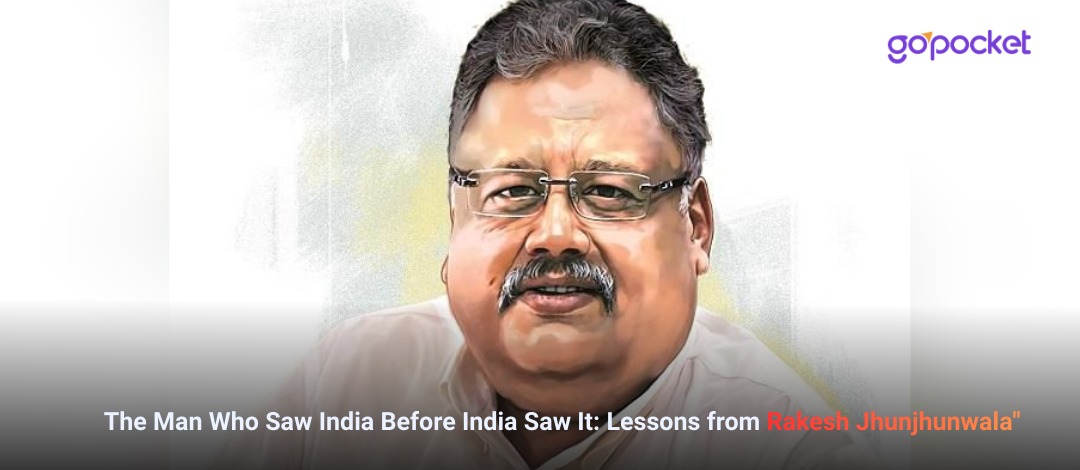
That man was Rakesh Jhunjhunwala.
Now, most people back then would have put that ₹5,000 straight into a safe, boring Fixed Deposit. But Rakesh? He didn’t want "safe." He wanted a piece of the action. He believed in the India story before anyone else even knew there was a story.
Over the next 40 years, he turned that tiny sum into a multi-billion dollar empire, earning the legendary nickname: The Big Bull.
But here’s the real question: How do you turn pocket change into a fortune without insider tips or a crystal ball? And more importantly, what can you steal from his playbook today?
WHO WAS THE MAN BEHIND THE MYTH?
Rakesh Jhunjhunwala (1960–2022) wasn’t just a guy who got lucky with stocks. He was the ultimate believer in the India story.
People often called him the "Indian Warren Buffett," but to those who followed him closely, he was simply RJ.
Here’s the fascinating part about RJ: he lived a double life in the markets.
• By day, he was a Trader: He bought and sold fast, riding the daily waves of the market to pay the bills and generate cash.
• At heart, he was an Investor: He used that cash to spot diamonds in the rough and held onto them for decades.
He didn’t just pick companies; he picked a country. While others were sceptical, RJ bet everything on the idea that India was destined to become an economic superpower.
He didn’t just buy stocks. He bought India. And boy, was he right.
THE STRATEGY: HOW TO THINK LIKE THE BIG BULL
If you strip away the billions and the fame, Rakesh Jhunjhunwala’s investment strategy boils down to five core principles that any retail investor can apply:
1. The Long Game: Wealth isn't created by buying on Tuesday and selling on Thursday. It's created by holding for ten years.
2. High Conviction Bets: When he was sure about a company, he didn't just dip his toes in; he dove in. He believed in concentration, not over-diversification.
3. Scalable Businesses: He looked for companies that could grow 10x or 100x-businesses with a huge "runway" ahead of them.
4. Unshakeable Optimism: He was perpetually bullish on India. Even when the economy looked bleak to others, he saw opportunity.
5. Emotional Iron: He had the stomach to watch his portfolio drop 30% without panicking.
THE PORTFOLIO OF A LEGEND: KEYHOLDINGS
Rakesh Jhunjhunwala didn't buyhundreds of stocks. He bought a few great ones and held them forever. Here is asnapshot of some of his most famous investments that defined his career.

THE TITAN STORY: A MASTERCLASS IN PATIENCE
If you want to understand Rakesh Jhunjhunwala’s genius, you only need to look at one stock: Titan.
Today, Titan is a retail giant. But back in the early 2000s? It was a mess. The company was fighting labour unions, drowning in debt, and its stock price was in the gutter. Nobody wanted it.
But RJ saw something everyone else missed.
The Big Idea: He knew Indians loved gold. But buying gold back then was shady-you went to a local jeweller and hoped you weren't getting ripped off. RJ bet that as Indians got richer, they would stop trusting the "family jeweller" and start trusting big, clean brands like Tanishq (owned by Titan).
The Guts: He didn’t buy Titan for a quick 20% profit. He bought it because he believed the average Indian was about to start spending serious money.
The Patience: Here’s the crazy part: The stock didn’t just go up. It crashed-a lot.
• It crashed in 2008.
• It tanked in 2013.
• It plummeted during the 2020 pandemic.
Most people would have panicked and sold. RJ held on.
His mantra was simple: "Buy right and sit tight."
That patience turned a risky bet into one of the greatest wealth creators in Indian history. He didn’t just buy a watch company; he bet on the Indian consumer, and he won big.

HANDLING THE CRASH: PSYCHOLOGY OVER STRATEGY
The difference between a good investor and a great one isn't intelligence-it's temperament.
Market crashes are emotional events. When the Nifty falls 1,000 points, news channels scream "Crisis!" and investors panic-sell to save what's left.
Rakesh Jhunjhunwala did the opposite. He famously said, "Respect the market. Have an open mind. Know what to stake. Know when to take a loss. Be responsible."
He viewed volatility not as a risk, but as an opportunity. When others were selling in fear, he was often buying with both hands, knowing that markets eventually recover. He understood a fundamental truth: "You cannot make money in the stock market if you are not willing to lose money."
BEYOND STOCKS: THE AKASA AIR BET
Even in his final years, RJ wasn't done taking risks. In 2021, he co-founded Akasa Air.
Critics were confused. Aviation is a notoriously difficult industry-high fuel costs, thin margins, and brutal competition. Why would a smart investor put money there?
Because, once again, he was betting on a structural trend. He saw that millions of Indians were moving from trains to planes. He saw a gap in the market for a low-cost carrier. He wasn't looking at the difficulties of 2021; he was looking at the demand of 2031.
ACTIONABLE LESSONS FOR BEGINNERS
You might not have crores to invest, but the principles remain the same. Here is your checklist:
• Start Early: RJ started with ₹5,000. The amount matters less than the time you give it to grow. "Give your investments time to mature. Be patient for the world to discover your gems."
• Ignore the Noise: Don't let daily news headlines dictate your long-term financial decisions. "Emotional investment is a sure way to make a loss in stock markets."
• Buy Quality: Focus on companies with clean management and scalable business models. Remember his golden rule: "Never invest at unreasonable valuations. Never run for companies that are in the limelight."
• Sit Tight: The hardest thing to do in investing is nothing. Once you buy a good company, let compounding do the work.
FREQUENTLY ASKED QUESTIONS (FAQS)
Q: Why is Rakesh Jhunjhunwala called the Big Bull of India?
A: He earned the title because he was consistently optimistic (bullish) about the Indian stock market and economy, even during tough times.
Q: What was Rakesh Jhunjhunwala’s biggest investment?
A: His stake in Titan Company is considered his crowning achievement, generating thousands of crores in wealth over two decades.
Q: Did Rakesh Jhunjhunwala ever make mistakes?
A: Yes, frequently. He openly admitted to bad trades and losses. He believed that making mistakes was part of the game; the key was to learn from them and not repeat them. As he put it: "Mistakes are your learning ground. The day I stop making mistakes, I will stop learning."
Q: What was his net worth when he passed away?
A: At the time of his passing in 2022, his net worth was estimated to be around $5.8 billion (approx. ₹46,000 crore).
THE FINAL REFLECTION
Rakesh Jhunjhunwala didn’t just buy stocks. He bought into a dream.
He saw rising incomes when others saw poverty. He saw consumer aspiration when others saw stagnation. He saw a superpower in the making when others saw a struggling developing nation.
And he acted on it before it was obvious to everyone else.
Today, information travels at the speed of light. Markets are louder than ever. But the fundamentals of wealth creation haven't changed. It still belongs to those who can hold their conviction longer than others can hold their fear.
Maybe investing isn’t about predicting the next quarter's earnings. Maybe it’s about identifying the next decade's story.
Rakesh Jhunjhunwala believed in India before it was fashionable. The real question for us today is: What structural story are we overlooking right now?
Disclaimer: This article is for educational purposes only and does not constitute financial advice. Stock market investments are subject to market risks. Please consult a SEBI-registered financial advisor before making any investment decisions.
Disclaimer
What's Trending
Interim Budget 2024: Highlights
February 8, 2024
Master The Art Of Spread Trading In Options
August 15, 2026
Why Children Deserve to Learn ‘Money-Lessons’ in School | Gopocket
September 9, 2025
Candlestick Reversal Patterns (Part 2) for Beginners
March 7, 2026
Recent Blog


.jpeg)

Blog
Recent Blogs





Open your GoPocket Account within 5 minutes.
Have any queries?
Get support

Investing and trading is made simple, affordable and accessible for every Indian.



© Made with ❤️ in Coimbatore, India | Copyright © 2023 onwards, GoPocket.