
.jpeg)


In the 10th century, Arab merchants sailed from Muscat carrying frankincense, dates, and copper. They landed in Calicut, traded for cotton and spices, and sailed back. Oman and India have been doing business for over a thousand years.
Fast forward to 2026. The ships are container vessels. The frankincense is now polyethene. And instead of a handshake on a beach, the two countries just signed a 400-page agreement that removes customs taxes on 98% of goods traded between them.
It's called the India–Oman CEPA. And it came into force on June 1, 2026 - quietly, without much fanfare, while most of us were catching up on the weekend.
Here's why you should care.
— The Setup —
Every time Indian goods cross into Oman, the Omani government charges a fee. It's called a customs duty — or import tax. Think of it as a toll on a highway. Before this deal, that toll was 5% on most goods. For some products, it was as high as 100%.
The result? Only 15% of Indian exports entered Oman without paying anything. The rest paid up — every single shipment, every year, without fail.
The India–Oman trade deal just changed that. From June 1, zero duty applies to 98% of Indian goods entering Oman. The toll booths are gone. And they're not coming back.

— The Twist Nobody Expected —
Here's where the story gets interesting.
You've probably heard of the Strait of Hormuz. It's a narrow waterway — only 33 kilometres wide at its tightest — through which 20% of the world's oil passes every single day. It connects the Persian Gulf to the Arabian Sea. Most Gulf countries depend on it entirely for their shipping.
In early 2026, that strait got messy. Regional tensions spiked. Insurance costs for ships passing through it jumped. Some routes got delayed. Some cargo got rerouted.
Oman, though? Oman is different. Its coastline faces the Arabian Sea directly. Its ports — Sohar, Duqm, and Salalah — don't need Hormuz at all. Ships from Mumbai can reach Duqm in about 48 hours. No risky passage. No chokepoint.
So when India signed the India-Oman FTA-style deal, it didn't just get a trade partner. It got a Hormuz-bypass into the Gulf — right when that bypass matters most.
Commerce Minister Piyush Goyal said it plainly: "Oman is not just a market for India. It's a launchpad."
— What This Looks Like in Real Rupees —
Let's make this concrete. Meet Priya — she runs a pharmaceutical export company in Hyderabad. She ships paracetamol tablets and diabetes medicines to Oman four times a year. Each shipment: ₹83 lakh.
Here's what her tariff reduction looks like:
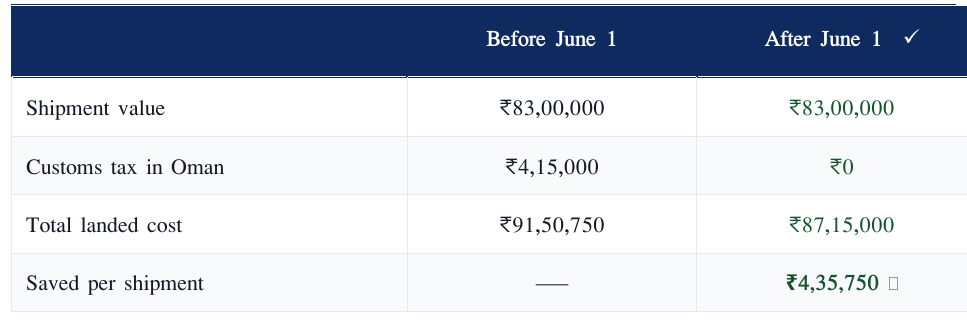
Four shipments a year. That's ₹17 lakh+ back in her pocket annually — without changing her product, her team, or her factory. She just ships the same thing, and now pays less to get it there.
That's what duty-free access feels like when you're the one writing the shipping invoice.
— The Most Surprising Part of the Deal —
Nobody put this in the headline. But it might be the most interesting detail in the whole agreement.
For ten years, Oman had a ban on exporting raw marble to India. Unpolished marble blocks — the rough stone that craftsmen in Rajasthan cut, shape, and polish for temples, hotel lobbies, and luxury homes — couldn't be shipped directly.
That ban is gone now. Craftsmen in Kishangarh, the marble capital of India, can source premium Omani stone directly. No routing through third countries. No middlemen adding markups. Just better stone at a lower price.
A 400-page trade deal. And buried on page who-knows-what: a lifeline for marble artisans in a small Rajasthani town. That's how these things work.
— So What Does This Mean For You? —
If you're an exporter:
Check your product's HS code — the 8-digit classification number. If it falls in the 98% that qualifies, get a Certificate of Origin from your Export Promotion Council. That's the document Oman customs needs to give you the Oman market access benefit. Without it, the old rate applies.
If you're a worker in manufacturing:
More orders from Oman = more production = more jobs. Textiles, gems, leather, pharma, seafood — these are labour-heavy industries. The deal makes Indian goods more competitive. That's good for the people who make them.
If you're an investor:
Pharma exporters. Logistics companies. Gems and jewellery firms. Engineering goods makers. All of them have a quiet new advantage in a market they couldn't access as cheaply before. It won't show up in next quarter's earnings. But it'll show up.
If you're just a curious reader:
Fertilisers from Oman get cheaper to import. That puts quiet downward pressure on farming costs. Which eventually nudges food prices. Slowly. Indirectly. But the direction is right.
— The Fine Print
• Not all 100% of products qualify — some chemical and agricultural lines are excluded or have limits.
• Your product must be genuinely made in India. Assembling imported parts here and calling it Indian-origin won't work.
• Textiles have a 5-year phase-in — the zero duty doesn't arrive all at once for every garment category.
• Early shipments may face extra scrutiny — customs officers on both sides are still learning the new system.

— What GoPocket Has to Do With Any of This —
Trade policy doesn't exist in a vacuum. The India–Oman CEPA affects which sectors grow, which companies benefit, and how that flows into the broader Indian economy and your investment decisions.
Understanding the connection between macro events — trade deals, central bank decisions, currency moves — and your money is exactly what GoPocket teaches. Not in MBA language. In the kind of language you'd use to explain it to a friend over chai.
If you want to get better at reading the economy and connecting it to your investments, GoPocket's free educational sessions are a good place to start.
— Until Next Time —
The India–Oman trade deal isn't flashy. It won't trend on Twitter. But trade agreements are one of the few things in economics where the effects are real, measurable, and lasting — even if they take years to fully show up.
The 10th-century Arab merchants who sailed to Calicut would probably find the numbers baffling. ₹17 lakh saved per exporter per year. Zero customs on 98% of goods. A Hormuz bypass hiding in plain sight.
But they'd recognise the idea.
Two countries. Old trust. New deal.
That's still how trade works.
Learn how global deals like this connect to your money.
GoPocket.in — free financial education for every Indian investor.
Investments are subject to market risks. Please read all scheme-related documents carefully before investing. This content is for educational purposes only and does not constitute investment advice. GoPocket is a SEBI-registered intermediary.
Disclaimer
What's Trending
The Evergreen Portfolio: Building a Retirement That Blooms
December 8, 2025
Recent Blog

.jpeg)

Blog
Recent Blogs





Open your GoPocket Account within 5 minutes.
Have any queries?
Get support

Investing and trading is made simple, affordable and accessible for every Indian.



© Made with ❤️ in Coimbatore, India | Copyright © 2023 onwards, GoPocket.