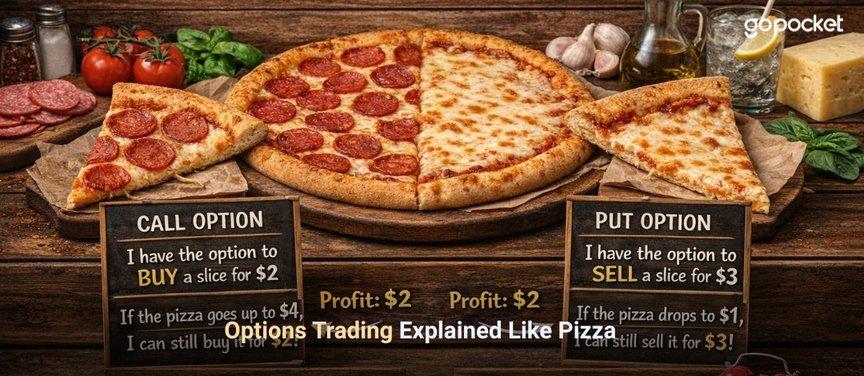
Options Trading Explained with Pizza
Raj was scrolling through his trading app on the first day of the new financial year — April 1, 2026 — when his phone blew up with notifications. Nifty had just opened 2.5% higher, and his colleague was talking about 'buying a call.' Raj had no idea what that meant. Sound familiar?
Good news: by the end of this article, you'll understand options better than most people who claim to trade them — and all it takes is a pizza.
What Exactly Is an Option Contract?
An option is a contract that gives you the right — but NOT the obligation — to buy or sell an asset at a specific price, on or before a specific date.
There are two types: Call Options and Put Options. Let's go to the pizzeria.
The Pizza Analogy: Calls and Puts Made Simple
Call Option = Booking a Pizza at Today's Price
Imagine Priya walks into GoPizzeria and says: 'I want to lock in today's price of ₹400 for a pizza, but I'll only pick it up next month.' The shop owner says, 'Sure, pay me ₹50 now as a booking fee.'
Next month, if pizzas cost ₹600, Priya smiles — she buys at ₹400 and saves ₹150 (after the ₹50 fee). If pizzas cost ₹300, she simply doesn't pick them up. Maximum loss? The ₹50 booking fee.
That booking fee? That's your option PREMIUM. The ₹400 price? That's the STRIKE PRICE. Next month? The EXPIRY DATE.
A Call Option = the right to BUY at a fixed price. You buy calls when you think the market will go UP.
Put Option = Insurance for Your Pizza Stock.
Now imagine Raj already owns 100 pizzas he bought at ₹400 each. He's worried prices might crash. So he pays ₹30 per pizza to get a guarantee: 'No matter what happens, I can sell these at ₹400 until next month.'
If prices fall to ₹250, Raj uses his guarantee and sells at ₹400 — saving ₹120 per pizza (minus the ₹30 fee). If prices rise to ₹600, he ignores the guarantee and sells in the open market. He loses only the ₹30 premium.
A Put Option = the right to SELL at a fixed price. You buy puts when you think the market will go DOWN.
Real Market Example: April 1, 2026
Today, Nifty 50 opened at 22,899 — up 567 points in a single day. Geopolitical tensions are easing, Asia is rallying, and everyone is cautiously optimistic.
Raj decides to buy a Nifty Call Option at a strike price of 23,000 expiring in late April. He pays a premium of ₹120. If Nifty crosses 23,120 before expiry, Raj makes money. If not, he loses only his premium — ₹120 × 50 lot size = ₹6,000 maximum risk.
Meanwhile, Priya, who holds Infosys shares, buys a Put Option at ₹1,700 strike as a hedge — just in case markets reverse suddenly.
Master The Markets With Gopocket
Key Terms You Must Know
• Strike Price — The fixed price at which you can buy or sell
• Premium — What you pay to enter the options contract
• Expiry — The date by which you must exercise or let go
• Lot Size — NSE fixes lot sizes (e.g., Nifty = 50 units per lot)
• ITM / ATM / OTM — In/At/Out of the Money; how close the strike is to the current price
• OI (Open Interest) — Total active options contracts in the market
Why Do People Trade Options?
Options let you control a large position with a small premium. A 50-unit Nifty lot worth ₹11.5 lakh can be controlled with just ₹6,000–₹15,000 in premium. That's the attraction — and the danger.
New SEBI rules, effective April 1, 2026, have tightened leverage: you now need 50% of your margin in cash. This is actually good for retail investors — it limits over-leveraging.
Important New Rule: STT Hike from Today
From today — April 1, 2026 — the Securities Transaction Tax (STT) on F&O has jumped 150%. Futures now attract 0.05% of notional value (up from 0.02%). This makes frequent options trading more expensive. Factor this into your strategy.
Should You Start Trading Options?
Options are powerful tools — not lottery tickets. If you're a beginner, start by understanding the basics, paper trading (simulate without real money), and only use capital you can afford to lose as a premium.
GoPocket's learning modules walk you step by step from zero to a confident F&O trader. Think of us as your pizza school.
Ready to trade smarter? Open your GoPocket account today at gopocket.in
⚠ SEBI DISCLAIMER: This article is for educational purposes only and does not constitute financial advice. Please consult a SEBI-registered advisor before making investment decisions.