
.jpeg)


Imagine you're in a lift. It opens on the ground floor. You step in. The door closes. The lift hums for a few seconds — and then stops. You're between two floors. The "up" button is glowing. So is the button for "down." Neither is winning.
That's exactly where the Indian stock market is right now.
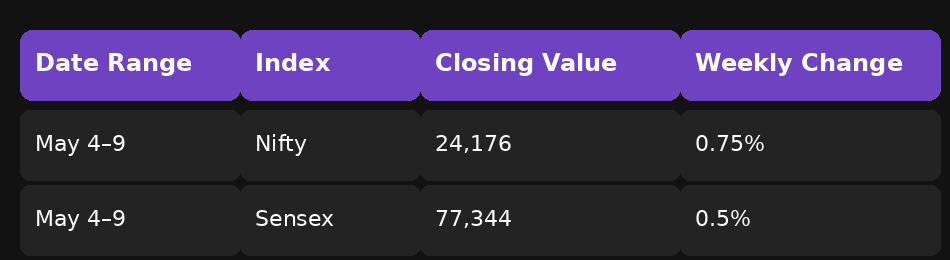
Last Friday, the Nifty closed at 24,176 and the Sensex at 77,344. Both lost a little ground on the day. But here's the funny part — for the whole week, both actually closed higher. Nifty was up 0.75%. Sensex up 0.5%.
How does a market go up over a week and still feel like it went nowhere? That's exactly the puzzle we're solving today.
Part 1: What Really Happened Last Week (May 4–9)
The Big Picture
Think of the headline indices like a slow elevator. The smaller stocks were the staircase, and the staircase was busier.
The "fear index" — basically a thermometer that tells us how nervous traders are — sat at 16.84. Not panicky. Not relaxed. Somewhere in the middle, like the weather in Bangalore.
Which Sectors Worked And Which Didn't
IT did well. The rupee got weaker, and a weaker rupee means Indian IT companies earn more in rupee terms from their US clients. Simple math.
Pharma quietly hit a new high. The whole pharma basket touched a 52-week peak. Investors are clearly comfortable with this corner of the market.
Banks had a bad week. SBI announced its quarterly results, and the numbers disappointed. The stock fell 6.6% on Friday alone. Other banks like HDFC, Axis and ICICI got dragged down with it, about 1–2% each.

The Heroes And Villains Of The Week
Heroes:
• Titan (the watch and jewellery maker) — up 4.86%. Their quarterly profit jumped 35%.
• Asian Paints — up 2.74%.
• Adani Ports — up 1.63%.
Villains:
• SBI — down 6.6%.
• HDFC Bank, Axis Bank — down about 1.8% each
HDFC Bank, Axis Bank — down about 1.8% each.
The Foreign Money Story
Here's a number that should change how you think about Indian markets.
Foreign investors have pulled out ₹1.92 lakh crore from Indian stocks since January. That's more than they sold in all of 2025. To put that in perspective, ₹1.92 lakh crore is roughly the entire annual budget of a mid-sized Indian state.
So why didn't the market crash?
Because Indian investors — through their SIPs, mutual funds, LIC and pension funds — have put in roughly ₹1.7 lakh crore in the same time. They've absorbed almost everything the foreigners dumped.
For the first time in years, Indians own more of the Indian stock market than foreigners. The neighbour bought the house back.

Rupee, Oil, and Gold
• Rupee at 94.58 against the dollar. A new record low. Translation: if you ordered something on Amazon US last week, it just got more expensive.
• Crude oil went on a wild ride. It shot up to $115 a barrel in the middle of the week (because of fresh US–Iran tensions) and then came back down to around $101.
• Gold hit a fresh high too — ₹1,52,041 per 10 grams. Silver did even better.
• Government bonds — the interest rate the government pays on its 10-year loan — stood at 6.96%. A small but important number we'll come back to.
What Happened Abroad
The US market had a good week. The S&P 500, Nasdaq and Dow all closed higher. Asian markets — Hong Kong and Shanghai — also gained. So India wasn't lagging behind the world; we were just busy digesting our own news.
Part 2: The Week Ahead — What To Actually Watch (May 11–15)
The Trapdoor Idea
The Nifty has a clear floor at 24,000 and a clear ceiling at 24,400. Imagine a ball bouncing between the floor and the ceiling of a room. That's what's happening.
If the ball breaks through the ceiling (24,400), it usually keeps going for a while — possibly to 24,800.
If it falls through the floor (24,000), it doesn't stop until 23,800 — and breaking that level usually means a quick 2–3% drop.
Our best guess for the week: the ball stays in the room. Mostly sideways. Slight upward lean.
Three Things Happening At Home This Week
1. Tuesday, May 12 — Inflation Data (CPI)
This is the biggie. CPI is basically a number that tells us how much more expensive your monthly groceries and rent have become compared to a year ago.
Last month's number was 3.40% — pretty mild. RBI (our central bank) likes this number to be near 4%.
If Tuesday's number stays soft (say, 3.2–3.5%), the market will start expecting another interest rate cut soon. That's good news for bank stocks, real estate, and car companies.
If it spikes (say, above 4%), the opposite happens.
This single number on Tuesday afternoon will set the mood for the rest of the week.
2. Thursday, May 14 — Wholesale Inflation Data (WPI)
This is similar to CPI but measures prices at factories instead of shops. It's like checking the temperature of the kitchen before the food reaches your table. A soft number here would confirm that inflation is genuinely cooling.
3. Last Few Q4 Results
The big earnings season is almost over. A handful of mid-sized companies still need to announce results. Watch for what management says about the future, not the past.
A Small IPO Opens This Week
RFBL Flexi Pack — a packaging company — opens its IPO from May 12 to May 14, at ₹47–₹50 per share. Worth a look if IPOs are your thing.
What's Happening Around The World
This week is packed globally:

The US inflation number on Tuesday is the second-most important event for India this week. If it's hot, the dollar gets stronger, the rupee gets weaker, and foreign investors sell more. If it's soft, the opposite — and our market gets a tailwind.
Sectors To Watch
Banks — Reading Tuesday's CPI. Soft = good for banks. Hot = bad. Simple as that.
IT — A weak rupee is a tailwind. But foreign investors have been selling IT all year, so rallies might get sold into.
Pharma — At record highs. The trend is your friend, but don't go chasing a parade.
Power, Capital Goods, Metals — Quietly, the only sectors that foreign investors actually bought in April. Worth watching.
Auto — A rate cut narrative helps cars and two-wheelers. Watch CPI.
FMCG — Waiting for the monsoon forecast. A good monsoon means villagers spend more on soap, biscuits and shampoo.
Mid-sized and small stocks — They led last week. As long as the fear index stays below 18, this can continue.
What About The Rupee, Oil And Gold?
Rupee — Likely to bounce between 94.20 and 95.20 this week. If it breaks 95, the market will get nervous.
Crude oil — Volatile. Anywhere between $98 and $108. Any Middle East news pushes it higher fast.
Gold — Still in a strong uptrend. Don't chase the peaks, but don't ignore them either. It's there for a reason — uncertainty.
Part 3: What Should You Actually Do?
If you have an SIP running, don't stop it. In fact, range-bound weeks like this are exactly when SIPs work the hardest. You buy more units when prices dip and fewer when they rise. The math is doing its job quietly.
If you have idle cash: Don't dump it all in on Monday. Split it into three or four parts and invest over the next month. With inflation data on Tuesday, why bet everything on one moment?
If you're a short-term trader: Respect the 24,000–24,400 range. Don't predict the breakout — wait for it to actually happen, then act.
If you've been losing sleep over foreign selling, Stop. Indian investors have absorbed nearly all of it. Our market has never been less dependent on foreign money than it is today.
If you're a fixed-deposit person: The 6.96% government bond yield is attractive. If you've been wondering about bond mutual funds or fixed-income options, this is a reasonable time to look at them.
You can track all of this — Nifty levels, sectors, foreign flows, the rupee, IPOs, your own portfolio — in one place on GoPocket. Built to keep this kind of weekly tracking simple, especially if you'd rather not keep five different websites open every morning.
What Could Go Wrong This Week?
Just so you're not caught off guard, here are five things that could break the calm:
1. Hot inflation in India on Tuesday → rate cut hopes die → bank stocks fall.
2. Hot inflation in the US on Tuesday → dollar gets stronger → rupee weaker → foreign selling picks up.
3. Crude oil shoots back to $110+ → imported inflation hits us harder.
4. A fresh geopolitical scare anywhere in the Middle East or East Asia.
5. A surprise bad result from a major bank or IT company.
None of these is predictions. They're just the road bumps to keep an eye on.
The One Number To Watch
Forget everything else. The single most important number this week is the inflation figure released on Tuesday afternoon.
Soft number = market drifts higher into the weekend. Hot number = market tests the floor.
Pour the chai. Don't react to the first 15 minutes of trading on Tuesday. The real direction usually shows up after the dust settles. Markets reward patience much more than reflexes.
Investments are subject to market risk. Please read all scheme-related documents carefully before investing. This blog is for educational purposes only and does not constitute investment advice. GoPocket is a SEBI-registered intermediary.
Disclaimer
What's Trending
Options Trading Explained with Pizza
April 1, 2026
Recent Blog


.jpeg)

Blog
Recent Blogs





Open your GoPocket Account within 5 minutes.
Have any queries?
Get support

Investing and trading is made simple, affordable and accessible for every Indian.



© Made with ❤️ in Coimbatore, India | Copyright © 2023 onwards, GoPocket.