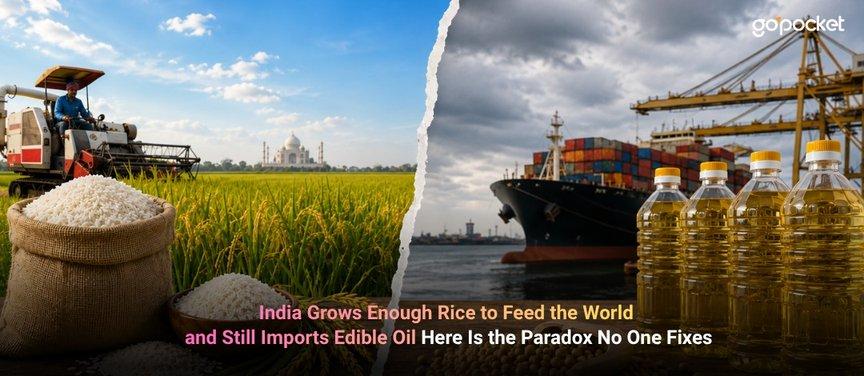
India Grows Enough Rice to Feed the World — and Still Imports Its Cooking Oil
Here’s the Paradox No One Fixes.
Walk into any Indian kitchen tonight. Look at two shelves.
The rice jar. And the oil bottle.
The rice was almost certainly grown here. The oil almost certainly was not.
That one small detail is a billion-dollar story about India. And it quietly holds a surprisingly useful lesson about your own money.
Two staples, two completely different stories
India is a rice superpower. We grow so much rice that we feed 1.4 billion people and still ship the extra abroad.
Cooking oil is the opposite story. We simply don’t grow enough, so we buy most of it from other countries.
Here is the contrast in one look:
Same country. Same farmers. Total self-reliance in one, near-total dependence in the other.
The number that should bother you
India buys close to 60% of its cooking oil from other countries.
That has a name: edible oil import dependency. It simply means how much of our oil we cannot produce ourselves and must bring in from abroad.
Look at the gap for 2025-26:
So most of the oil in your dal tadka, bhindi fry and weekend pakoras began life on a farm in another country.
And the edible oil import bill keeps getting heavier. In just the first six months of the 2025-26 oil year, the bill jumped 19%, to about ₹87,000 crore, up from ₹73,000 crore a year earlier.
Three simple reasons it is rising:
That last oneis why cooking oil prices in India have stayed stubbornly high.
So why can’t India just grow its own oil?
Fair question. If we can grow rice for the whole planet, why not oil?
The honest answer is that India never really tried, at least not the way it pushed rice and wheat.
In the 1960s and 70s, the Green Revolution, India’s big “grow more food” drive, poured almost everything into rice and wheat. Those farmers got guaranteed prices, government buying, cheap power and canal water. Oilseed crops like mustard and groundnut were pushed onto the leftover land.
That old choice still hurts us today. Here is why, simply:
Put all three together, and you get exactly what we have: a country that powers huge Indian rice exports, while quietly relying on palm oil imports for its own kitchens.
What does this cost ordinary people?
This isn’t a faraway trade statistic. It lands in your monthly budget.
When palm oil prices jump in Jakarta, or Argentina has a bad soybean crop, or the rupee weakens, cooking oil prices in India climb within weeks. A family in Coimbatore or Kanpur cannot control the Indonesian weather, but still pays for it at the kirana store.
And here is the money lesson hiding inside all of this:
When you depend almost entirely on one outside source for something you need, you don’t control the price. You just received it.
True for a country with a high edible oil import dependency. Just as true for a person.
Your money vs. the country, the same trap
The fix in both cases is the same simple idea. Don’t put all your weight on one leg.
Is anyone trying to fix the oil problem?
Yes. In 2024, the government approved the National Mission on Edible Oils – Oilseeds, which runs to 2030-31. In plain terms, it means better seeds for farmers, more processing units, and stronger market links. A parallel push has already brought more than 6 lakh hectares under oil palm.
The goal is to lift home-grown edible oil to about 25 million tonnes by 2030-31. That would cover roughly 72% of India’s needs and finally shrink the import bill.
It is a real plan, but a slow one. Oil palm trees take four to five years to bear fruit. This paradox won’t close this year, or next. Still, the direction has finally changed.
The takeaway for you
You can’t fix India’s cooking oil maths. But you can borrow the lesson.
Ask yourself one honest question. Where am I completely dependent on something I don’t control?
One income source. All your money in one place. Cash sitting idle while rising prices eat into its value. That is your personal “edible oil problem”, a quiet dependence that feels fine, right until prices move against you.
Master The Markets With Gopocket
The answer isn’t dramatic. It is just spreading out.
A healthy mix, with some money in shares, some in mutual funds, some in bonds and some in gold, behaves like a country that grows more of its own oil instead of importing all of it. No single shock gets to decide your whole outcome.
Quick note: a mutual fund simply pools money from many people and invests it across many companies, so your eggs aren’t all in one basket. That is why it is a sensible starting point for beginners.
If you want to see how these pieces fit together, GoPocket’s learning resources walk a regular salaried investor through diversification in investing, covering mutual funds for beginners, bonds, ETFs and more, all in everyday language. The aim is never to chase the single “best” thing. It is to stop depending on any single thing.
India will keep powering its rice exports. Hopefully, one day, it's cooking oil too.
Until then, the smart move is personal. Make sure your own financial pantry isn’t stocked from just one shelf.
Investments are subject to market risks. Please read all scheme-related documents carefully before investing. This content is for educational purposes only and does not constitute investment advice. GoPocket is a SEBI-registered intermediary.