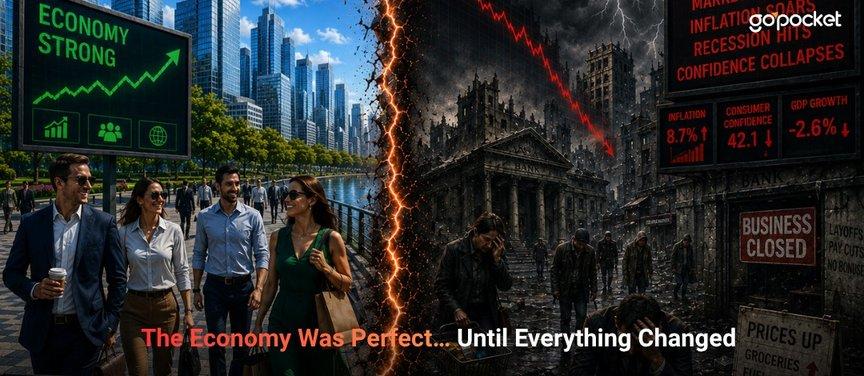
The Economy Was Perfect. Now It’s Complicated.
What FY27’s turbulence means for your money — and one new tool to manage it
Remember FY26? India was flying — 7.6% GDP growth, inflation at a cool 2.1%, and a steady rupee. Economists called it the Goldilocks economy: not too hot, not too cold. Just right.
Then a conflict broke out in West Asia. A key shipping route got blocked. Oil prices shot up. And just like that, the Goldilocks story ended.
“The Goldilocks story is over. We’re now in Cinderella territory — waiting to see how long before the carriage turns back into a pumpkin.” — Madan Sabnavis, Chief Economist, Bank of Baroda.
So, What Actually Happened?
The Strait of Hormuz — a 33 km stretch of sea between Iran and Oman — carries about 20% of the world’s daily oil. When tensions there flared up, it didn’t just make news. It made your grocery bill, petrol, and EMI more expensive.
Here’s how it rippled through:
• Oil hit ~₹100 per barrel (the govt budgeted for ₹80–90). The Centre cut fuel taxes to absorb the shock, losing ₹1.2–1.4 lakh crore in revenue — but fuel prices still rose.
• Inflation is back. The RBI now expects prices to rise 4.6% this year — more than double last year’s 2.1%. A weak monsoon is making food prices worse.
• EMIs may rise. The RBI was cutting rates through FY26. With inflation creeping up, rate hikes are back on the table.
• Government finances are stretched. The fiscal deficit is already at 4.4–4.5% of GDP, against a 4.3% target.
• Gulf remittances at risk. About 35% of India’s remittance income comes from Gulf countries — the same region now in turmoil.
India is still growing — the RBI forecasts 6.8% GDP growth for FY27. But it’s noisier, pricier, and harder to predict than last year.
Why Silver Is Getting Attention in FY27
While everyone watches Nifty and Bank Nifty, silver has quietly become one of the more interesting assets of 2026.
Silver isn’t just for jewellery — it’s used in solar panels, EVs, electronics, and medical devices. Three things are pushing its price right now:
• Inflation rising → people move money into hard assets like silver and gold
• Rupee weakening (thanks to expensive oil) → domestic silver prices go up even if global prices don’t
• India’s clean energy push → steady industrial demand for silver
Silver jumped 168% in CY2025. In a year of oil shocks and rupee pressure, it’s far from a quiet corner of the market.
Meet MCX Silver 100: A New Contract Built for Real Users
On June 1, 2026, MCX launched Silver100 — a futures contract for just 100 grams of silver, with actual physical delivery.
For context: the standard MCX silver contract is 30 kg. The mini is 1 kg. There’s already a 100g contract (Silver Micro), but it only settles in cash. Silver100 is different — if you hold until expiry, real silver changes hands.
Contract at a Glance
Delivery is not optional. Once you’re allocated as a buyer in the delivery window, you can’t back out. If you don’t want silver at an Ahmedabad vault, close your position before the last 3 days.
Who Is This Actually For?
Small Jewellers and Silversmiths
You buy 200–500 grams of silver regularly and know how fast prices can move. Silver100 lets you lock in a price in advance, in lot sizes that match your actual buying pattern — without the large capital a 1 kg or 30 kg contract demands.
MSMEs Using Silver as a Raw Material
Electronics makers, solar panel producers, silverware businesses — if silver is in your cost structure, price swings hit your margins. Now you can hedge in 100g blocks.
Retail Commodity Traders
If you already trade on MCX, Silver100 gives you a lower-ticket entry into silver around key macro events: RBI meetings, oil price moves, monsoon updates.
Smaller lot ≠ smaller risk. If silver moves 5%, your gain or loss is still 5% of your position. What changes is the capital required to enter.
How Hedging Works: A Simple Example
Ravi runs a jewellery shop in Jaipur and needs 500g of silver in 30 days. Current price: ₹1,000 per 10g. He’s worried it’ll jump before he can buy.
So he buys 5 Silver100 contracts (5 × 100g = 500g) on MCX.
• Silver rises to ₹1,100: His spot purchase costs more — but his futures contracts gained roughly the same. He paid what he planned.
• Silver falls to ₹900: He buys spot silver cheaper — but his futures lost roughly the same. He paid what he planned.
That’s the point. Hedging isn’t about making extra money. It’s about removing the nasty surprise of a 10% spike in something you have to buy anyway.
Real numbers will differ based on brokerage, GST, and the gap between Ahmedabad futures price and your local price. Always factor these in.
Stay Ahead with Continuous Learning
4 Things to Know Before You Trade
• New contract = thin liquidity early. Bid-ask spreads may be wide in the first few weeks. Don’t enter large positions until you see healthy open interest.
• Price is Ahmedabad-based. Your local silver price will differ from the MCX futures price (this gap is called basis risk). Your hedge won’t be a perfect match.
• Margins jump near expiry. Initial margin is 10%. In the last 3 days before expiry, it rises to 25%. Keep extra funds in your account.
• Know your exit before you enter. Will you roll to the next month’s contract or take/give delivery? Decide before you’re in the last 3 trading days.
The Bottom Line
FY26 was India’s near-perfect year. FY27 is messier — higher inflation, expensive oil, a cautious RBI, and global headwinds.
For small businesses and traders, the answer isn’t to panic. It’s to have better tools. MCX Silver100 is one of them: a 100g contract with physical delivery that finally makes silver hedging accessible for jewellers, MSMEs, and traders who were priced out of the larger contracts.
The carriage has turned back into a pumpkin. But with the right tools, you can still navigate FY27 with more control than you think.
Disclaimer
This article is for educational purposes only and does not constitute investment advice. Commodity futures trading involves leverage and the real risk of loss. Always verify current margin requirements with your broker and the latest MCX circulars before trading. GoPocket Invest Tech Private Limited is a SEBI-registered intermediary.