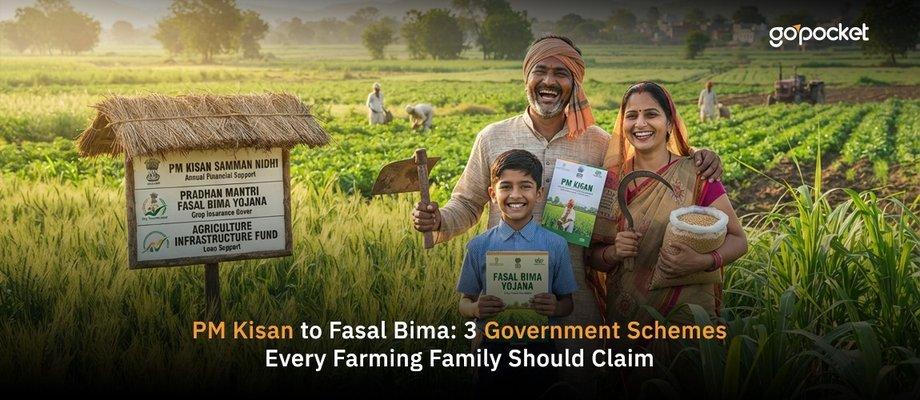
Somewhere in India right now, a farming family is struggling through a bad season. The rains came late. Input costs went up. The harvest wasn't what they planned. And they have no idea that the government has already set aside money specifically for them.
Not someday. Right now.
Three schemes exist today that can put thousands of rupees directly into a farmer's bank account, protect an entire season's crop for almost nothing, and give access to credit at interest rates lower than most city people get on their home loans. Most farming families know these schemes exist. Far fewer have actually claimed them properly.
If you have family in a village, share this with them. If you are that family, read this carefully. Because unclaimed benefits help nobody.
SCHEME 1:
PM Kisan Samman Nidhi, Rs.6,000 Every Year, Directly In The Bank
This one is straightforward. If your family owns cultivable land and farms it, the central government deposits Rs.6,000 every year into your Aadhaar-linked bank account. No middleman. No agent. No paperwork going to someone else first. The money arrives directly, in three installments of Rs.2,000 each, roughly every four months.
Since the scheme launched in 2019, the government has transferred over Rs.4.46 lakh crore to more than 9.44 crore farmer families across India. The 23rd installment was released in June 2026. If your family missed any installments, the most common reasons are an incomplete eKYC, an Aadhaar number not properly linked to the bank account, or a data mismatch in land records.
The fix is simple. Visit pmkisan.gov.in or any nearest Common Service Centre with an Aadhaar card and land documents. Complete the eKYC, which is now mandatory every year, either through OTP online or through biometric verification at a CSC centre. Once done, the next installment gets credited automatically.
Who cannot claim this: government employees (except Group D workers), income tax payers, doctors, lawyers, engineers, and elected representatives are not eligible.
Who absolutely should: every small and marginal farmer family that owns cultivable land and hasn't registered yet, or hasn't completed their latest eKYC.
One App. Endless Opportunities.
SCHEME 2:
PM Fasal Bima Yojana, Crop Insurance For Almost Nothing
Imagine paying Rs.2,000 and insuring a crop worth Rs.1 lakh. That's not a hypothetical. That's exactly what PM Fasal Bima Yojana offers.
Under PMFBY, farmers pay only 2% of the insured crop value for Kharif crops like paddy and maize, 1.5% for Rabi crops like wheat and mustard, and up to 5% for commercial and horticultural crops. The central and state governments pay the remaining premium, which can be anywhere from 10% to 18% of the insured value. The farmer gets the protection. The government absorbs the cost.
Since 2016, farmers have paid Rs.34,507 crore in premiums under this scheme. Against that, claims worth over Rs.1.72 lakh crore have been paid out. Read that again. For every rupee paid by farmers, five rupees came back in claims. That's how heavily subsidised this protection is.
What does it cover? Almost everything that can go wrong. Drought, floods, cyclones, hailstorms, pest attacks, unseasonal rain, and even post-harvest damage up to 14 days after the crop is cut. If a calamity hits, farmers must report crop loss within 72 hours through the PMFBY mobile app, by calling the helpline 14447, or by visiting their nearest agriculture office. Miss that 72-hour window, and the claim can be rejected.
To enroll: visit pmfby.gov.in, the nearest bank, or a Common Service Centre before the cutoff date for the current season. Farmers with crop loans from banks are often auto-enrolled, but since 2020, enrollment is voluntary, which means loanee farmers need to actively opt in too.
Important note: several states including Bihar and West Bengal have their own state-level crop insurance schemes. Farmers in those states should check with their local agriculture office to understand which scheme applies to them.
SCHEME 3:
Kisan Credit Card, Borrow At 4%, Not 24%
Here's the scheme that could change a farming family's financial life the most, and yet it's the one most people know the least about.
The Kisan Credit Card gives farmers access to a revolving credit limit based on their land holdings, crop pattern, and credit need. The interest rate is 7% per annum on loans up to Rs.3 lakh, and if the farmer repays on time, the government's interest subvention kicks in and brings the effective rate down to just 4%.
Think about what that means. A moneylender in a village charges 24% to 36% interest, sometimes more. A KCC gives the same farmer access to credit at 4%. The difference isn't just financial. It's freedom from the debt trap that has swallowed generations of farming families.
What can KCC credit be used for? Seeds, fertilisers, pesticides, equipment maintenance, post-harvest storage, and household needs between harvest seasons. The credit limit can go up to Rs.5 lakh for short-term agricultural loans, and up to Rs.2 lakh is completely collateral-free.
As of December 2024, over 7.72 crore farmers across India already hold KCCs, with Rs.10.05 lakh crore in credit extended. If your family doesn't have one, they can apply at any bank branch, through the Jan Samarth portal online, or through a nearest CSC centre. Documents needed: Aadhaar, land records, two passport photos, and a filled application form.
One extra benefit that most people miss: KCC holders often get automatic or priority enrollment under PMFBY crop insurance too, linking both protections together.
Invest Better by Learning More
The Bigger Picture
India's farming families contribute to feeding over 140 crore people. In return, these three schemes exist precisely because the government recognises that farming carries enormous financial risk, from uncertain weather to volatile market prices.
Claiming what's yours isn't charity. It's your right.
PM Kisan puts money in the bank every four months. Fasal Bima protects what you grow. KCC ensures you don't have to borrow from a moneylender to grow it in the first place. Together, they're a financial floor under every farming family in India. The only question is whether your family is standing on it.
If someone in your family hasn't claimed all three, this week is a good time to start.
GoPocket has spent over 14 years helping Indians, urban and rural, understand how to make the most of the financial tools available to them. Because the best financial decision is an informed one.
Disclaimer:
This blog is for educational and informational purposes only. Scheme eligibility, amounts, and deadlines may change based on government notifications. All figures are based on publicly available information as of June 2026, sourced from official government portals including pmkisan.gov.in, pmfby.gov.in, and published RBI and IBEF data. Readers are advised to verify current details from official government sources or consult relevant authorities before making any claims.