You've spotted a stock. It's been trending on Twitter. Your colleague mentioned it twice this week. The chart looks good. Your gut says go.
Stop.
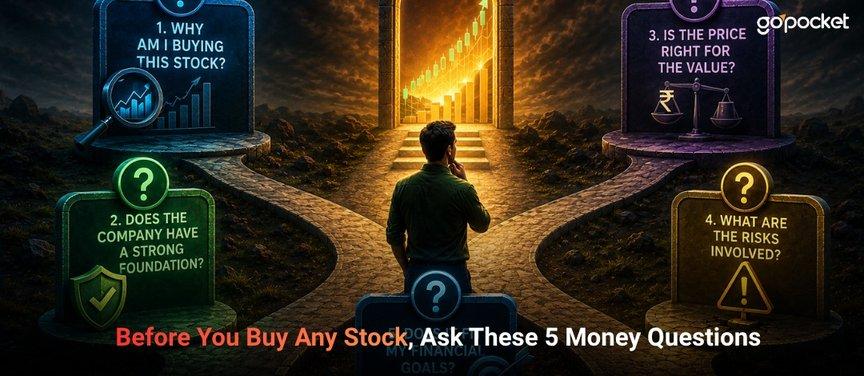
Before you open your trading, app and hit buy – take five minutes. Ask yourself these five questions. If you can't answer even three of them clearly, you're not buying a stock. You're making a bet. And there's a big difference between the two.
QUESTION 1:
Do You Actually Understand What This Company Does?
Not in a vague way. Not "oh it's a tech company" or "they're in pharma."
Can you explain – in two sentences – how this business makes money? Where does the revenue come from? Who are its customers? What would happen to it if its biggest competitor dropped prices tomorrow?
If you can't answer that, you don't own the business. You own a ticker symbol. And ticker symbols don't build wealth – businesses do.
Warren Buffett calls this your "circle of competence." He's spent decades refusing to invest in things he doesn't understand – and he's done okay for himself. The point isn't to know everything. It's to know enough to spot when something's wrong before the stock price tells you.
Simple test: explain the business to someone who knows nothing about markets. If they get it, you're good. If they look confused, keep researching.
One App. Endless Opportunities.
QUESTION 2:
Is The Company Actually Making Money – Or Just Making Headlines?
Revenue is not profit. Growth is not health. This distinction trips up more retail investors than almost anything else.
Pull up three years of financials – the profit and loss statement, the balance sheet, the cash flow statement. You don't need a finance degree to spot the basics. Is revenue growing? Is net profit growing alongside it? Is the company generating positive cash flow from operations, or is it burning through investor money to fund daily operations?
Two ratios worth knowing before any purchase. The P/E ratio – Price to Earnings – tells you how much you're paying for every rupee of profit the company earns. A P/E of 80 means you're paying Rs.80 for every Re.1 of annual profit. That might be justified for a fast-growing business. It might be completely unjustified for a slow one. Context matters.
The Debt-to-Equity ratio tells you how leveraged the company is. A D/E above 1.5 in most sectors deserves a closer look – it means the company owes more than it's worth in equity. Not always a dealbreaker, but always worth understanding. High debt is manageable in good times. In a downturn, it becomes a survival question.
QUESTION 3:
Who's Running This Company – And Do They Deserve Your Trust?
Management is everything. A great business with bad management gets destroyed. A decent business with exceptional management quietly becomes something extraordinary.
Look at what the promoters and top executives have done – not what they've said. Has the company delivered on past guidance? Has the promoter been increasing their stake in the company or quietly selling? Promoter buying is one of the strongest signals of internal confidence. Promoter selling at scale while publicly claiming everything is fine is a red flag worth taking seriously.
Check corporate governance too. Have there been regulatory penalties? Accounting irregularities? Auditor resignations? These things are all publicly available on BSE and NSE filings and take less than ten minutes to check. Most investors never bother. Those who do avoid some of the market's most painful surprises.
QUESTION 4:
What Could Actually Go Wrong?
This is the question almost nobody asks – and it's the most important one on this list.
Every stock has a risk section in its annual report. Most people skip it entirely because it's written in dry legal language and feels like a formality. Don't skip it. Read it. Because somewhere in there, the company itself is telling you what keeps its management up at night.
Ask yourself: if the worst-case scenario happens – a regulatory change, a new competitor, a global slowdown, a commodity price spike – how badly does this company get hurt? Does it have enough cash reserves to survive a bad year? Does it have pricing power, or will it be forced to absorb rising costs quietly?
The investors who survived the 2020 crash without panic selling weren't the ones with the best stock picks. They were the ones who'd already stress-tested their holdings before the market did it for them. Think about downside before you think about upside. Always.
Invest Better by Learning More
QUESTION 5:
Why Are You Buying This – And When Will You Sell?
This sounds obvious. It's almost never answered properly.
"Because it's going up" is not a reason. "Because my friend made money on it" is not a reason. "Because the chart looks good" is a trading reason, not an investing reason – and those require a completely different approach.
A real reason sounds like this: "This company is growing revenue at 18% annually, has zero debt, operates in a sector with high barriers to entry, and is currently trading 30% below its three-year average P/E due to a temporary sector-wide selloff." That sentence tells you what you believe, why you believe it, and implicitly – what would change your mind.
Which leads to the second part: when will you sell? Not if it falls 20% out of panic. Not if it rises 15% out of excitement. Set your exit criteria before you enter. If the thesis breaks – management changes, revenue drops unexpectedly, a better opportunity appears – that's your signal. Not market noise. Not a WhatsApp forward.
Buying a stock without asking these questions isn't investing. It's hoping. And hope, while a perfectly fine emotion, has a terrible track record as a financial strategy.
The good news? These five questions take maybe thirty minutes for any stock you're considering. Thirty minutes of real thinking versus months or years of watching a poor decision play out in your portfolio.
The best investors aren't the ones with the best tips. They're the ones who ask better questions before everyone else does.
Knowing what to ask is half the work. Understanding the answers is the other half – and that's were having the right information matters. GoPocket has been helping Indian investors make smarter, more informed decisions for over 14 years. Because the best trade you ever make starts long before you hit buy.
DISCLAIMER
This blog is for educational and informational purposes only. It does not constitute investment advice or a recommendation to buy or sell any securities. All ratios and financial concepts mentioned are for general educational understanding only.