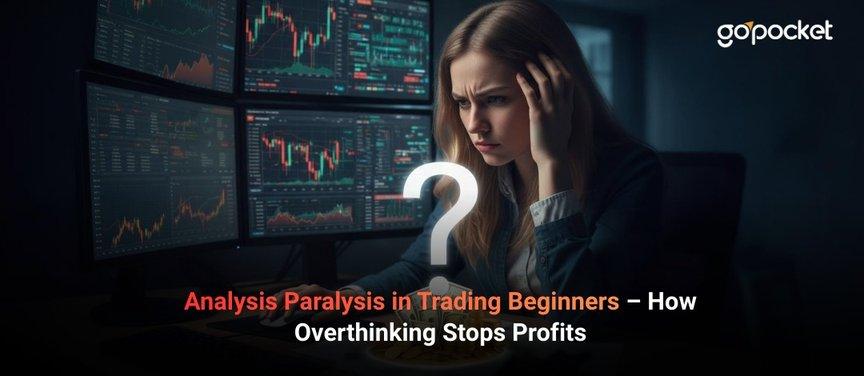
OVERTHINKING BEFORE TRADING? THIS IS HOW “ANALYSIS PARALYSIS” SILENTLY TRAPS BEGINNERS
STUCK BEFORE YOU START?
THE SILENT PROBLEM CALLED ANALYSIS PARALYSIS IN TRADING
You open the chart.
You check the indicators.
You open one more video.
Then one more article.
Then one more opinion.
And finally… You take no trade at all.
If this feels familiar, you are not lazy.
You are not slow.
You are facing something very real —
analysis paralysis in trading.
This is one of the most silent problems beginners face in trading. No one warns you about it. No one talks loudly about it. But it quietly stops thousands of people from ever moving forward, leading to beginner traders overthinking before they even place their first trade.
Let’s break this gently and clearly.
WHAT EXACTLY IS ANALYSIS PARALYSIS?
Analysis paralysis happens when:
• You overthink every decision
• You consume too much information
• You wait for a “perfect” signal
• You fear doing something wrong
So instead of taking one small, planned step in trading decision making…
you stay stuck in thinking mode.
You don’t lose money.
But you also don’t grow.
That pause may look safe.
But over time, it becomes a mental trap driven by overanalysis in the stock market.
A SIMPLE BEGINNER STORY YOU’LL RELATE TO
Imagine a new trader named Arjun.
He has:
• Watched many videos
• Followed many traders
• Learned some basics
• Saved a little money to start
One morning, he sees a stock setting up nicely.
His heart says, “This looks good.”
But his mind says:
“Wait… let me confirm with one more indicator.”
“Let me see one more expert view.”
“What if it reverses?”
“What if I lose my first trade?”
By the time Arjun feels “fully confident” —
the move is already over.
And once again, he says:
“Next time, for sure.”
This keeps repeating. Days pass. Confidence goes down.
Fear quietly grows — one of the most common beginner trading mistakes.
This is analysis paralysis in real life.
WHY BEGINNERS FALL INTO THIS TRAP
Analysis paralysis is not caused by lack of knowledge.
It is caused by too much unfiltered knowledge.
Beginners today face:
• Hundreds of strategies
• Too many indicators
• Too many predictions
• Too many opinions
When your brain sees too many paths at once, it freezes.
Not because all are wrong —
but because it doesn’t know which one to trust, creating emotional blocks in trading.
THE HIDDEN FEAR BEHIND ANALYSIS PARALYSIS
At the root, it is not about charts.
It is about:
• Fear of loss
• Fear of making a mistake
• Fear of looking foolish
• Fear of disappointing yourself
This explains why beginners fear trading even after learning the basics.
So, the mind chooses the safest option:
“Don’t act.”
But in trading, not acting is also a decision shaped by poor trading psychology for beginners.
WHY OVERTHINKING IS MORE DANGEROUS THAN A SMALL LOSS
A small planned loss teaches you something.
But overthinking teaches you nothing.
When you stay stuck:
• You doubt your ability
• You delay your journey
• You lose learning speed
• You depend too much on others
Slowly, trading stops feeling exciting…
and starts feeling stressful.
This is exactly what pushes many beginners away from the market — even before they truly begin.
Master The Market With Gopocket
THE SIMPLE SHIFT THAT CHANGES EVERYTHING
You don’t need:
• More indicators
• More strategies
• More videos
You need:
• One basic setup
• One simple plan
• One clear rule for entry
• One rule for exit
Even if the plan is not perfect —
execution will teach you faster than thinking ever will and improve trading decision making.
CONFIDENCE IS BUILT AFTER ACTION — NOT BEFORE
Many beginners believe:
“I will trade once I feel fully confident.”
But in reality:
You become confident after taking small, controlled actions.
Confidence is not a feeling.
It is a result of experience.
No experience – No confidence
No action – No experience
That loop is what analysis paralysis quietly breaks for those learning how to start trading confidently.
HOW BEGINNERS CAN SLOWLY BREAK THIS HABIT
Here are gentle, safe shifts:
• Reduce your indicators
• Limit the number of opinions you follow
• Decide your entry rules before market opens
• Accept that no trade is ever perfect
• Start with small, controlled risk
Progress begins the day you allow yourself to be a beginner — without pressure.
WHERE GOPOCKET APPEARS GENTLY
Many beginners struggle not because they lack intelligence, but because they lack structured guidance. When learning is guided step by step instead of scattered, clarity replaces confusion. This is why platforms like GoPocket focus on simplifying market learning and building confidence gradually — without overwhelming new traders dealing with analysis paralysis in trading.
FINAL THOUGHT THAT WILL FREE YOUR MIND
You don’t need to be perfect to start.
You only need to be consistent and calm.
Charts don’t punish beginners.
But fear of starting does.
Your growth in trading won’t begin with a “perfect setup.”
It will begin the day you stop waiting endlessly and take your first disciplined step.
Disclaimer:
This content is for educational purposes only and not financial or trading advice. Stock market trading involves risk, and losses are possible. Always do your own research or consult a qualified financial advisor before making any decisions. GoPocket and the author are not responsible for any losses.