


HOW THE UNION BUDGET IS BUILT: A SIMPLE GUIDE FOR EVERYONE
The Union Budget is the Government of India’s annual financial plan. In simple terms, it’s like the country’s income-and-expense statement for the year. It shows where the government gets its money from and how it plans to spend it.
At its core, the Union Budget 2026 has two sides:
• Receipts – money coming in
• Expenditure – money going out
All Budget announcements-tax changes, welfare schemes, infrastructure spending, and deficit targets-fit into this structure.

THE THREE GOVERNMENT FUNDS
1. CONSOLIDATED FUND OF INDIA
This is the main government account. All tax revenues, borrowings, and most other receipts go into this fund. Almost all government spending-salaries, subsidies, defence, infrastructure-comes from here.
Example:
The income tax you pay goes into this fund, and the highway built near your city is paid for from it.
2. CONTINGENCY FUND OF INDIA
This is an emergency reserve. The government can use it immediately without waiting for Parliament’s approval.
It is meant for unexpected situations like natural disasters or urgent security needs. Later, Parliament approves replenishing the fund.
Example:
Immediate relief after floods or cyclones.
3. PUBLIC ACCOUNT OF INDIA
This holds money that belongs to the public, not the government. The government only acts as a custodian.
Examples:
• Provident Fund (PPF) deposits
• Small savings schemes
• Security deposits
This money does not affect the fiscal deficit because it is not government income.

RECEIPTS VS EXPENDITURE
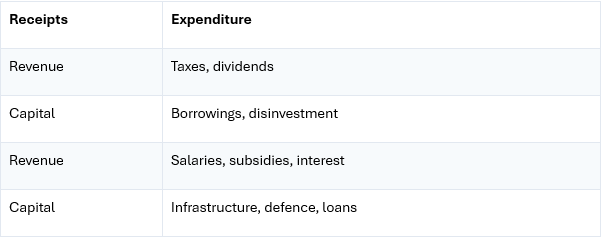
REVENUE RECEIPTS
The idea:
Regular income earned without borrowing or selling assets.
What it includes:
• Tax revenue: Income tax, GST, corporation tax
• Non-tax revenue: PSU dividends, fees, fines, interest on loans
Why it matters:
Strong revenue receipts allow the government to fund daily operations without debt. It reflects financial stability.
Example:
₹25 lakh crore (tax) + ₹3 lakh crore (non-tax) = ₹28 lakh crore
REVENUE EXPENDITURE
The idea:
Spending is needed to run the government daily. It keeps the system functioning but doesn’t create assets.
Examples:
• Salaries and pensions
• Interest payments
• Subsidies (food, fertiliser, fuel)
• Grants to states
Why it matters:
If this exceeds revenue receipts, the government borrows to pay routine bills-an unhealthy sign.
CAPITAL RECEIPTS
The idea:
Money raised by borrowing or selling assets.
Examples:
• Borrowings from RBI or banks
• Recovery of loans
• Disinvestment (selling PSU stakes)
Why it matters:
Useful for funding large projects, but excessive borrowing increases future repayment burden.
CAPITAL EXPENDITURE
The idea:
Spending that builds long-term assets and supports growth.
Examples:
• Roads, railways, airports
• Defence equipment
• Equity investment in PSUs
• Loans to states for infrastructure
Why it matters:
Capital spending boosts jobs, productivity, and long-term economic growth.
TAXES IN THE BUDGET
DIRECT TAXES
The idea:
Taxes you pay directly and cannot pass on.
Examples:
• Income tax
• Corporation tax
Why they matter:
They are progressive; higher earners pay more. Changes here affect disposable income and corporate profits.
INDIRECT TAXES
The idea:
Taxes are included in the price of goods and services.
Examples:
• GST (CGST, SGST, IGST)
• Customs duty
Key note:
GST replaced most older indirect taxes in 2017, though petrol and alcohol remain outside it.
Why they matter:
Easy to collect but affects everyone equally, making them regressive.
UNDERSTANDING BUDGET DEFICITS
REVENUE DEFICIT
When revenue expenditure exceeds revenue receipts.
Meaning:
Borrowing to pay daily expenses-financially weak.
FISCAL DEFICIT
The gap between total spending and total income (excluding borrowings).
Meaning:
Shows how much the government needs to borrow in a year. Moderate deficits help growth; high ones cause inflation and debt stress.
PRIMARY DEFICIT
Fiscal deficit minus interest payments.
Meaning:
Shows whether borrowing is for new development or just to pay old loans.
NON-TAX REVENUE
Income earned without taxing people.
Examples:
• PSU profits
• Fees and fines
• Interest on loans
• Foreign grants
Common confusion:
Disinvestment is not non-tax revenue-it is a capital receipt.
Why it matters:
Reduces dependence on taxes and borrowing.
GDP AND THE BUDGET
GDP is the total value of all goods and services produced in India in a year.
Why GDP matters:
• Deficits are measured as % of GDP
• Higher GDP growth means higher tax collections
• Budget targets depend heavily on GDP forecasts
Example:
If GDP is ₹300 lakh crore and fiscal deficit is ₹13.5 lakh crore, deficit = 4.5% of GDP.
FINAL THOUGHTS
The Union Budget is not just numbers-it’s a story of priorities: how the government earns, spends, borrows, and plans growth. Understanding these basics helps any citizen decode Budget Day headlines with confidence.
If you want to dive deeper, read the next GoPocket blog that builds on this topic:
What is the Interim Budget? How is it Different from the Union Budget?
https://www.gopocket.in/blog/what-is-the-interim-budget-how-is-it-different-from-the-union-budget
This blog explains budget-related concepts in simple language, similar to your explainer, and helps readers understand how the Interim Budget relates to the full Union Budget — a useful companion for beginners.
DISCLAIMER
This article is for educational purposes only and does not constitute financial, tax, or legal advice. Consult a professional before making decisions.
Disclaimer
What's Trending
The Hidden Story Behind Every Stock Price
September 13, 2025
Recent Blog


.jpeg)

Blog
Recent Blogs





Open your GoPocket Account within 5 minutes.
Have any queries?
Get support

Investing and trading is made simple, affordable and accessible for every Indian.



© Made with ❤️ in Coimbatore, India | Copyright © 2023 onwards, GoPocket.