
.jpeg)


This week in one line: Markets are shaky, only 3 trading days, no big moves expected unless oil or the Iran war situation changes. Keep SIPs running, stay cautious on new investments.
1. So, What on Earth Happened Last Week?
Last Monday, before most people had finished their morning chai, the stock market opened 600 points lower. The US-Iran war had taken a bad turn over the weekend. Oil prices jumped. Investors started selling.
By Tuesday and Wednesday, something shifted. The US announced it was pausing attacks. Oil prices fell. Markets bounced back hard. It felt like the worst was over.
Then Friday happened. Iran said the peace talks were meaningless. Oil surged again. Friday alone wiped out everything the market had gained on Tuesday and Wednesday. By closing bell: Nifty at 22,819, Sensex at 73,583. Both are down about 1.3% for the week. Five losing weeks in a row. The market has now lost 10.56% in a single month.
That whipsaw week is not unusual. It is exactly what a market looks like when one thing is calling all the shots.

2. What Is Driving the Market This Week?
Everything happening in Indian markets right now traces back to a single number: the price of oil. Oil is at its highest level in four years because of the war between the US and Iran that started on February 28. The Middle East is where most of the world's oil comes from, and a war there makes everyone nervous about supply.
India imports 85% of its oil from abroad. When oil gets expensive, two things happen: our import bill goes up, which hurts the economy, and the Indian rupee weakens because India needs to buy more dollars to pay for oil. The rupee hit Rs 94.81 per dollar last Friday, an all-time record low.
A weak rupee makes things worse in a loop. Foreign investors see the rupee falling and decide India is losing money for them, so they sell Indian shares. More selling means more pressure on the market. More pressure on the market weakens the rupee further. That loop has been running for five weeks now.
3. Someone Is Selling. Someone Else Is Buying. Here Is Who.
Large international funds from the US, Europe and Japan have been selling Indian shares for 19 days straight. In March alone, they sold Rs 1.1 lakh crore worth. Why? They think Indian stocks are expensive compared to markets like China and South Korea right now. Add a war and a falling rupee, and they are happy to leave.
Indian mutual funds, backed by your SIP money and insurance premiums, have been buying every single dip. Last week, they bought Rs 30,642 crore net. On Friday alone, while markets were falling, they put in Rs 3,566 crore. More than Rs 25,000 crore flows into Indian mutual funds every month through SIPs, and that money keeps coming regardless of what the market does.
Foreign investors are selling. Indian investors are absorbing it. That tug of war is why the market is falling but not crashing. The moment oil drops or the war situation improves, the foreign selling will ease, and domestic buying will push things back up.
4. Nifty Outlook: What to Expect This Week
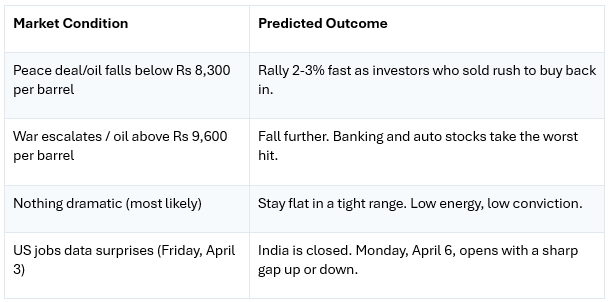
Short answer: Nifty likely stays between 22,500 and 23,200. No big directional move without a trigger. The most likely outcome is a flat, choppy week.
Only three trading days this week. Tuesday is Mahavir Jayanti, and Friday is Good Friday. Short weeks tend to be quieter but also more sensitive to surprises.
The one landmine to know about: the US government releases its monthly jobs report on Friday, April 3. That number moves global markets. But since India is closed that day, all the reaction piles up and hits when markets reopen on Monday, April 6. That opening could be a big gap in either direction.
5. Sector-by-Sector Outlook
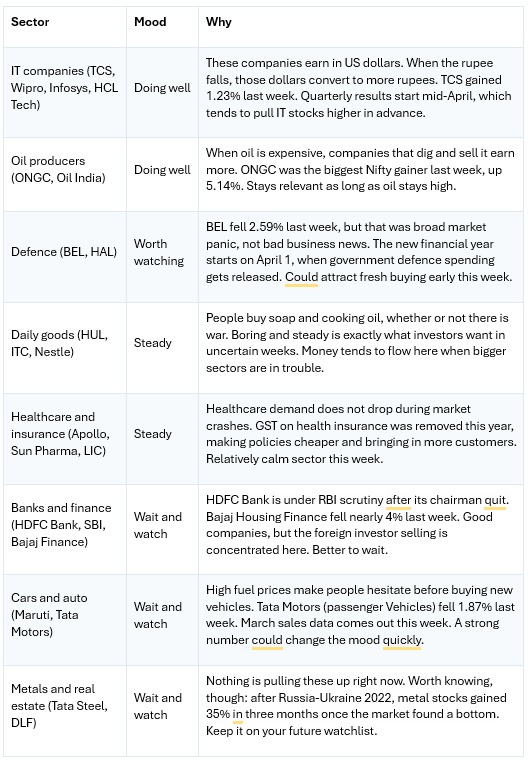
Not everything is in trouble. Some sectors are actually doing quite well, and a few are even gaining. Here is a simple breakdown.
6. Will It Get Better? History Has an Answer.
Nobody can tell you the exact date.
But we do have a useful comparison. In February 2022, Russia invaded Ukraine. Oil spiked. Foreign funds sold Indian shares. The rupee fell. Nifty dropped 11% in a month. Sounds exactly like now, right?
Here is what happened next. The market found its footing and then recovered sharply. Three months later: auto stocks were up 45%, metals up 35%, banking stocks up 30%. The people who kept their SIPs running and did not panic-sell were sitting pretty.
The recovery trigger this time is the same: oil falling or a peace deal. When either happens, expect a fast bounce. The investors who are still holding good stocks during this correction are the ones who will benefit.
One last thing worth knowing: India VIX is at 26.80 right now. VIX is basically a fear meter for markets. It was at 9 back in December — very calm. Now it has nearly tripled. A high VIX means big daily swings are expected. But there is a silver lining. Historically, when VIX gets this high in India, it usually means the worst of the selling is nearly over. High fear and market bottoms tend to arrive together.

7. Right. So What Should You Actually Do?
You have SIPs running.
Do nothing. Seriously. Your SIP is quietly buying more units at lower prices right now, which is exactly what it is designed to do. Every market crash in India since 1991 has bounced back. Do not stop your SIP, do not pause it, and please do not check your portfolio every few hours.
You have some extra money to invest.
Good time to invest, but do not put it all in at once. Spread it across 3-4 weeks in smaller portions. Nobody can pick the exact bottom. Spreading your entry means you buy at a few different prices, which works out well whether markets dip more or start recovering.
You are actively trading.
Keep bets smaller than usual this week. Only three trading days, a surprise US jobs number landing to close markets on Friday, and a potentially wild Monday, April 6, opening. IT stocks and ONGC are cleaner plays. Banking and auto are risky territories right now.
Key Events and Market Calendar

The Questions Everyone Is Googling Right Now
Why is the Nifty falling so much?
It all starts with oil. A war between the US and Iran that began on February 28 pushed oil prices to a 4-year high. India buys 85% of its oil from other countries, so expensive oil hurts us directly. It also weakens the rupee. And when the rupee falls, big foreign investment funds sell their Indian shares and move money elsewhere. That selling is what is dragging the market down.
Should I stop my SIP?
Please do not. When markets fall, your SIP automatically buys more units for the same monthly amount. Think of it like buying mangoes on sale. You get more for your money. Every major market fall in India since 1991 has recovered — 2008, 2013, 2020, 2022. The investors who stopped their SIPs during those crashes missed the recovery. Do not be one of them.
When will markets recover?
Honestly, no one can say exactly. But the 2022 Russia-Ukraine crash is the closest thing to this situation. Nifty fell 11% in a month back then, and then bounced back strongly over the next three months. The recovery came when oil prices started falling, and the war situation stabilised. The same thing will likely happen here. Stay invested and be ready.
One Last Thing
Five weeks of falling markets, a weak rupee, and rising oil — it’s not easy to look at your portfolio right now. But markets have recovered from every major crisis — 1992, 2001, 2008, and 2020. The investors who stayed calm and continued their SIPs came out stronger. Stay steady, keep new investments small this week, and take a breather. See you Monday.
Disclaimer:
This content is for educational purposes only, not financial advice. Please consult a SEBI-registered advisor before investing. Markets involve risks, and past performance does not guarantee future results.
Disclaimer
What's Trending
“Silver: The Hidden Gem of Investment You Can’t Ignore!”
September 26, 2025
Recent Blog


.jpeg)

Blog
Recent Blogs





Open your GoPocket Account within 5 minutes.
Have any queries?
Get support

Investing and trading is made simple, affordable and accessible for every Indian.



© Made with ❤️ in Coimbatore, India | Copyright © 2023 onwards, GoPocket.