India Just Lost Its Top 5 Stock Market Spot — Here’s What Actually Happened
Something happened this week that your WhatsApp groups are already forwarding with five fire emojis and zero explanation.
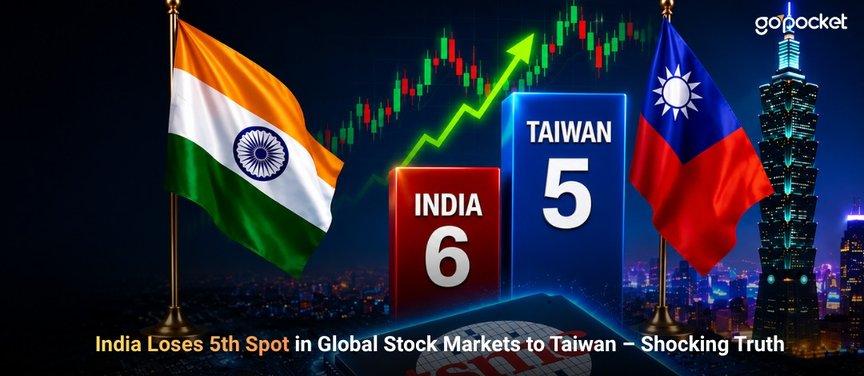
India just dropped out of the world's top 5 biggest stock markets.
We're now number 6.
The country that took our spot? Taiwan. A small island. Not a billion-person nation. Not a giant economy. Taiwan.
So what actually happened? Let's get into it.
What Are We Even Measuring Here?
Every company listed on India's stock exchanges has a total "price." Add them all up, and that's India's total stock market value.
Right now, India's total is around $4.92 trillion.
Taiwan's total? $4.95 trillion.
That tiny gap is all it took. Taiwan crossed the line. India slipped one spot.
The global ranking now: USA → China → Japan → Hong Kong → Taiwan → India.
One App. EndlessOpportunities.
One spot back. But why it happened is the real story.
It All Comes Down to One Company
There's a company in Taiwan called TSMC. Their job is simple — they make the tiny chips that go inside everything. Your phone. Your laptop. Every AI server on the planet. Every ChatGPT response you've ever seen ran on a chip made by TSMC.
Now here's what changed this year.
The whole world went crazy about Artificial Intelligence. Every country wants it. Every company is building it. And to build AI, you need chips — massive amounts of powerful, expensive chips.
Who makes those chips? TSMC.
So the world's biggest investors — giant funds from the US, Europe, Middle East — all poured money into Taiwan. TSMC's stock went up 49% this year alone. Taiwan's market shot up. And just like that, they passed us.
Where Did That Money Come From?
Here's what most people miss. When money flows into Taiwan, it has to come from somewhere.
Some of it came out of India.
Foreign investors — big overseas funds that invest in Indian stocks — pulled out over $20 billion from India this year. Roughly ₹1.7 lakh crore. Gone.
Not because India's economy is broken. Simply because the world's hottest investment theme right now is AI chips, and India isn't in that supply chain. India is brilliant at software and IT services — but the physical chips that AI runs on? That's Taiwan's territory.
Think of it like two food stalls at a street fair. One serves legendary biryani — consistent, reliable, always packed. The other just opened with a viral new dish everyone's talking about. Suddenly, everyone is at the new stall. The biryani place hasn't gotten worse. It's just not the trend this season.
India is the biryani stall. Still excellent. Just not the craze of this particular moment.
Invest Better by Learning More
There's More — Oil and the Rupee
Two more things hit India at the same time.
Crude oil is sitting at $110 a barrel right now, partly because of rising US-Iran tensions. India imports around 85% of its oil, so when global oil prices spike, our import bill explodes.
That pressure pushed the rupee to a record low — ₹96.88 per dollar this week.
Here's the sneaky part. When the rupee weakens, the dollar value of our stock market automatically falls — even if stock prices in rupees haven't moved much. It's like your salary staying the same in rupees, but the dollar suddenly becoming worth twice as much. In dollar terms, you look poorer. The same thing happened to India's market value.
So three things hit together: FIIs leaving + oil shock + weak rupee. That's why Taiwan was able to nudge past us.
Should You Be Worried?
Honestly? No.
India is still the 6th largest stock market in the world, out of nearly 200 countries. That's not a bad place to be.
Our economy is growing at 6.9% this year — one of the fastest among all major economies. China is slowing. Europe is struggling. India is still going.
And FIIs have left before. They left in 2022. In 2020. In 2018. Every time, they came back. Because India's long-term story — 1.4 billion people, rising incomes, growing middle class — doesn't change because of a global mood swing.
The One Thing To Take Away
Taiwan passed India not because India failed — but because Taiwan was perfectly positioned for this exact moment in history. The AI chip boom. A once-in-a-decade theme. And they owned it.
Every era has its theme. Right now, it's chips and AI. Before that, it was something else. After this, it'll be something new.
India's strength — domestic consumption, financial growth, infrastructure — is a slower, steadier wave. Less exciting in a news headline. More powerful over a decade.
If you're investing regularly through SIPs or mutual funds, keep going. You're playing the right long game.
And if moments like this make you second-guess yourself or feel confused about your money — that's exactly what GoPocket is here for. Not to tell you what to buy. But to help you understand what's actually happening, so no headline ever panics you again.
Investments are subject to market risks. Please read all scheme-related documents carefully before investing. This content is for educational purposes only and does not constitute investment advice. GoPocket is a SEBI-registered intermediary.