
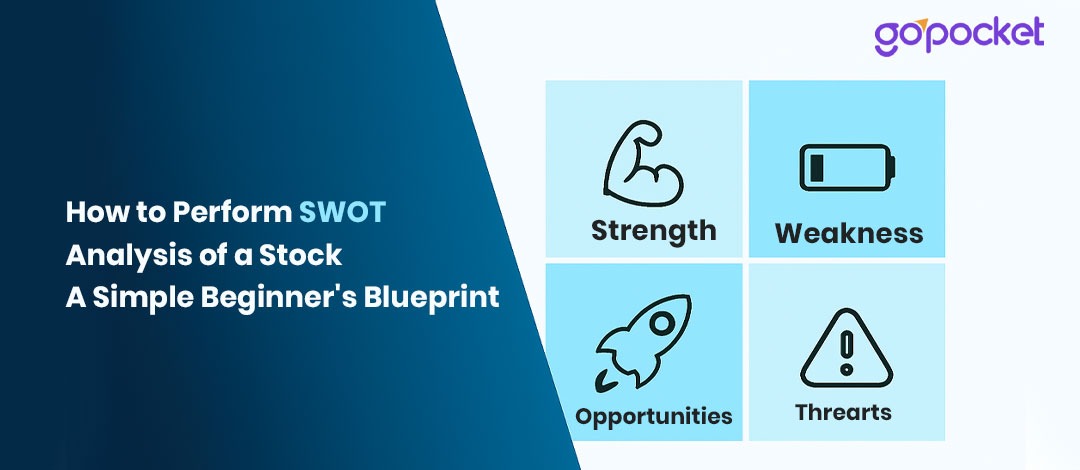


HOW TO PERFORM A SWOT ANALYSIS OF A STOCK?
A smart investor’s favourite check-up method – explained in plain English.
Have you ever bought a stock just because someone said, “This will fly soon”?
Or watched a trending stock crash right after you invested?
If yes, don’t worry – you’re not alone.
Most beginners buy stocks based on noise rather than knowledge.
And that’s exactly where SWOT Analysis of stocks becomes your superpower.
Think of it like a health check-up for any company before you invest.
It tells you what’s strong, what’s weak, what’s possible, and what can go wrong.
Let’s break it down simply – no jargon, no confusion.
WHAT IS SWOT ANALYSIS IN STOCKS?
SWOT = Strengths, Weaknesses, Opportunities, Threats
When applied to a stock, SWOT helps you understand:
• What the company is doing well
• Where it is struggling
• What bright future possibilities it has
• What external dangers could impact your returns
your money using investment research methods, and how to evaluate a company before investing.
1. STRENGTHS OF A STOCK (WHAT MAKES IT POWERFUL?)
Strengths are the internal positives of a company – the things it controls and excels at.
1. Strong Financial Health
Healthy revenue growth, profits, low debt, steady cash flow – these show the company is stable and dependable.
2. Competitive Advantage
Brands like Titan, Asian Paints, or HDFC Bank thrive because they have something unique: trust, scale, brand loyalty, or technology.
3. Experienced Leadership
Good management can turn even slow-moving companies into market champions. Poor management? Even great companies fail.
4. Strong Market Position
If a company is a leader in its sector or controls a major market share, it signals stability and long-term potential.
In short, Strengths tell you why the company is a safe and smart bet and support better stock market analysis for beginners.
2. WEAKNESSES OF A STOCK (WHERE IT STRUGGLES?)
Weaknesses are internal problems that may slow down growth or reduce returns guide you in how to analyse a stock more confidently.
1. High Debt Levels
Too much borrowing can crush companies during tough times. Debt becomes a warning sign.
2. Falling Sales or Profits
Declining numbers = declining confidence. If a company is not growing, your investment may not grow either.
3. Poor Management Decisions
Frequent leadership changes, bad acquisitions, or a lack of direction are red flags.
4. Dependence on One Product or Region
If one product fails or one region suffers, the entire company struggles.
Weaknesses highlight the hidden risks that beginners often miss.
3. OPPORTUNITIES OF A STOCK (THE GROWTH TRIGGERS)
These are external factors that can help the company grow faster.
1. Expanding Market Demand
A company riding a booming sector (EVs, renewable energy, healthcare, fintech) naturally gains growth opportunities.
2. Government Policies & Incentives
Favourable policies (PLI schemes, subsidies, tax benefits) can boost certain sectors tremendously.
3. New Products, Innovation or Technology
Companies launching innovative products or adopting new tech often unlock new revenue streams.
4. Expansion into New Regions
Entering new cities, countries, or markets can drive strong future growth.
Opportunities show you how big the company can become through strategic stock market analysis for beginners.
4. THREATS OF A STOCK (WHAT COULD GO WRONG?)
Threats are external risks that may affect the company’s growth.
1. Strong Competition
If new or aggressive competitors enter the market, they can take customers away.
2. Changing Regulations
A single new rule or compliance requirement can increase costs or reduce profits.
3. Economic Slowdowns
Inflation, recession, and global events – all can impact sectors like real estate, IT, and exports.
4. Technological Disruption
Companies that fail to evolve with technology often fall behind.
Threats remind you to stay alert. Even the strongest company can struggle due to external shocks, which reinforces how to evaluate a company before investing.
WHY SWOT ANALYSIS MAKES YOU A SMARTER INVESTOR
Because it helps you see the full picture, not just the market hype.
SWOT makes your stock-picking process:
• Clearer
• More confident
• More logical
• Less emotional
Instead of guessing, you understand:
1. “Is this stock strong enough?”
2. “Is it financially healthy?”
3. “Does it have a growing future?”
4. “What can affect it negatively?”
This clarity leads to better decisions – and better wealth-building using beginner stock analysis and investment research methods.
A SMALL TRICK TO MAKE YOUR SWOT MORE POWERFUL
After doing SWOT, ask yourself one final question:
“Will this company still be relevant 5 years from now?”
If the answer is YES, the stock may be worth your time.
If the answer is NO – avoid it.
Long-term confidence comes from long-term clarity.
A GENTLE GOPOCKET TOUCH
If you ever feel unsure while analysing a stock, GoPocket’s insights, research-friendly tools, and beginner-support system can make your journey easier and more confident.
You don’t have to analyse alone – guidance makes a huge difference.
FINAL THOUGHT
You don’t need to predict the market.
You just need to understand the business you’re investing in.
SWOT Analysis is simple, powerful, and beginner-friendly – and once you start using it, you’ll never pick a stock blindly again with any stock picking guide.
on Invest smart. Invest informed.
Disclaimer
What's Trending
What is F&O Trading?
May 17, 2024
Recent Blog


.jpeg)

Blog
Recent Blogs





Open your GoPocket Account within 5 minutes.
Have any queries?
Get support

Investing and trading is made simple, affordable and accessible for every Indian.



© Made with ❤️ in Coimbatore, India | Copyright © 2023 onwards, GoPocket.