


LET’S START WITH A QUESTION THAT MIGHT SURPRISE YOU:
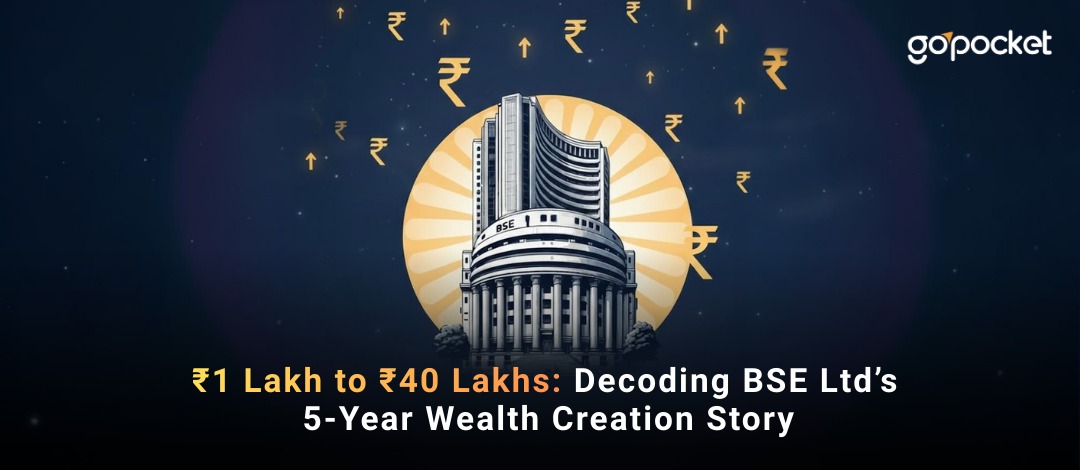
How does a company that most people associate with tickers, trading screens, and stock charts turn ₹1 lakh into ₹40 lakh in just five years?
No consumer brand.
No flashy headlines.
No viral hype.
Just a quiet, old institution that most of us only notice when the market drops.
The answer? It started long before five years ago- and it’s at the heart of the BSE wealth creation story.
A 150-YEAR-OLD INSTITUTION
The Bombay Stock Exchange (BSE) was founded in 1875 as The Native Share & Stock Brokers’ Association - making it Asia’s oldest stock exchange.
For decades, BSE wasn’t about growth or wealth creation. It was about trust, rules, and infrastructure. And in markets, infrastructure compounds quietly - unnoticed - until suddenly, it matters a lot.
The first big leap came in 1995, when BSE launched BOLT (BSE On-Line Trading).
Trading floors gave way to electronic systems. What seems obvious today was revolutionary then. Overnight, BSE transformed from a physical marketplace into a technology-driven platform, capable of scaling with India’s growing economy.
By 2015, BSE’s median response speed was 6 microseconds, ranking it among the fastest exchanges globally.
Speed matters. Reliability matters more. Together, they create scale, which is critical for an exchange to handle millions of trades every day.
SENSEX: INDIA’S ECONOMIC MIRROR
While BSE was building infrastructure, its flagship index - the Sensex - quietly mirrored India’s growth story.
Over 39 years, the Sensex delivered a CAGR of ~13.4%, while India’s nominal GDP grew at ~12.97%.
Coincidence? Not really.
It demonstrates that markets move in tandem with the economy, rather than independently of it. And BSE, as the infrastructure, enabled millions of investors to participate, instead of chasing short-term returns.
CRISES TESTED THE SYSTEM - AND STRENGTHENED IT
Growth was never linear. Some shocks shook investors and tested the exchange:
• 1992: Harshad Mehta scandal
• 2000: Dotcom bubble
• 2008: Global financial crisis
• 2020: COVID-19 crash
Each time, markets looked broken.
But here’s the thing: over 40 years, the Sensex delivered positive returns in ~75% of calendar years. Factor in dividends through the Total Return Index (TRI), and positive years jump to ~79%.
After every crash, the market didn’t just recover - it surged to new highs.
For BSE, crises weren’t failures. They were proof that the system worked. Investors kept trusting it, and participation grew steadily.

INVESTORS LEARNED TO PLAY THE LONG GAME
Over the last decade, investors stopped chasing the “next big stock” and started asking:
“How can I safely participate in the market?”
The results are clear:
• By September 2025, Sensex Index Funds and ETFs managed ₹2.25 lakh crore.
• Sensex derivatives became one of the fastest-growing in the world.
This wasn’t about speculation. It was about scale. And scale flows directly through exchanges like BSE.
BSE KEPT EVOLVING
BSE didn’t just sit back. It kept adapting:
• 2003: Adopted free-float index methodology
• 2005: Became a corporate entity
• 2012: Launched SME platform
• 2017: Listed itself publicly
• 2018: Introduced the Startups platform and commodity derivatives
Each step diversified revenue and increased relevance. When volumes rise faster than costs, value compounds - a defining trait of the BSE infrastructure business model.
SENSEX MILESTONES SHOW ACCELERATION [1986-2025]
The Sensex growth tells its own story:
1990: Crossed 1,000
• Slow, steady growth.
• Economy opening; few investors; basic infrastructure.
2006: Crossed 10,000
• Growth picks up.
• IT & finance boom; BSE goes digital; foreign investors join.
2021: Crossed 50,000
• Exponential growth.
• Reforms, digital infrastructure, and retail participation surge.
2025: Crossed 85,000
• BSE gains operating leverage.
Post-2014 reforms, digital infrastructure, and rising participation speed up the growth curve.
For BSE, faster growth = operating leverage, meaning value appears quickly for shareholders.
VOLATILITY WAS ACTUALLY A FRIEND
Short-term swings were wild - one-year rolling returns ranged from –52% to +99%.
For investors, it's scary.
For exchanges, profit-generating activity. More trades. More derivatives. More participation.
Volatility = noise for portfolios,
But oxygen for platforms.
HOW ₹1 LAKH BECAME ₹40 LAKH
It wasn’t overnight. It wasn’t hype.
It happened because of a rare combination:
• A 150-year-old institution
• Trust in market infrastructure
• Technology-driven scale
• Exploding retail participation
• Passive investing at scale
• Accelerating market growth cycles
BSE didn’t chase trends.
It became the system through which trends flowed.
And the numbers prove it.

What stands out: profits grew much faster than revenue.
That’s operating leverage in action.
In simple words:
The same machine started running faster-and most of the extra money dropped straight to the bottom line.
RECENT HISTORICAL PRICE LEVELS
52-week high: ~₹3,030 per share (achieved in 2025).
52-week low: ~₹1,227 per share (in early 2025).
Over the past 1 year, the stock has shown significant appreciation (e.g., ~+38–56% for a 52-week span) according to different listings of past performance.
THE BIGGER PICTURE
BSE Ltd’s 5-year wealth creation story isn’t just about five years.
It’s about decades of groundwork meeting the right moment.
Just like the Sensex is a financial biography of India, BSE Ltd is a biography of India’s market maturity - quietly written, trade by trade.
Most wealth stories focus on what moved. This one focuses on what made the movement possible.
Sometimes, the biggest winners aren’t the loudest. They’re the ones keeping the market running.
FINAL THOUGHT:
India’s wealth creation isn’t just about fast returns. It’s about infrastructure, trust, participation, and patience. BSE Ltd shows that the quiet work behind the scenes often creates the biggest impact.
DISCLAIMER:
Markets are volatile. Past performance is not indicative of future results. This content is for education and information only and does not constitute investment advice.
Disclaimer
What's Trending
India’s Bond Revolution: Where Stability Meets Strategy | GoPocket
November 18, 2025
GoPocket View: Indian Markets Outlook for Holiday Week (Dec 22–26)
December 24, 2025
Recent Blog


.jpeg)

Blog
Recent Blogs





Open your GoPocket Account within 5 minutes.
Have any queries?
Get support

Investing and trading is made simple, affordable and accessible for every Indian.



© Made with ❤️ in Coimbatore, India | Copyright © 2023 onwards, GoPocket.