Here's a strange question: when was the last time you actually decided to spend money, rather than just... watched yourself do it?
Not the grocery run. Not the EMI. The other kind — the 11 pm order you didn't plan, the “small treat” that became a full haul, the upgrade you swore you weren't going to make and made anyway. If you're being honest, most of it didn't feel like a decision. It felt like something running on autopilot.
That's not a willpower problem. That's a paperwork problem — except the paperwork is invisible.
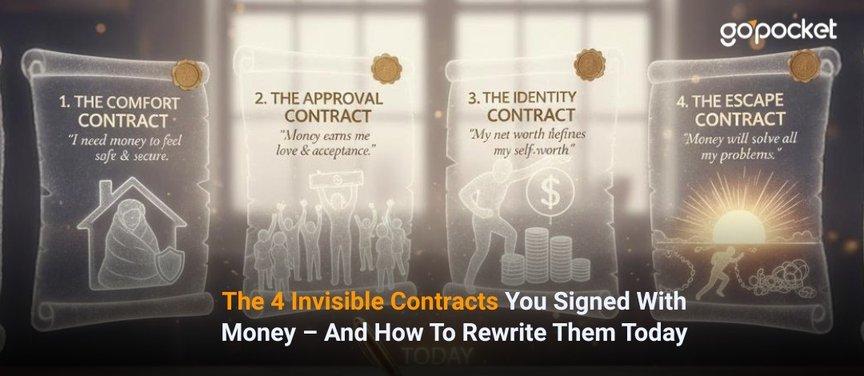
Somewhere between your first pay cheque and today, you signed four contracts with money. Nobody handed you a pen. Nobody asked for a signature. But you've been honouring every clause anyway, and they've been quietly steering your bank balance for years.
Let's find out which ones you signed.
Key Takeaways
● Most “bad with money” behaviour isn't a math problem — it's four unconscious contracts running in the background of every spending decision.
● The Comfort Contract turns your card into emotional first-aid the moment stress shows up.
● The Approval Contract makes you spend for an audience that, statistically, forgets what you bought within a week.
● The Identity Contract inflates your lifestyle the instant your salary does — the textbook definition of lifestyle creep.
● The Escape Contract is the most expensive of the four, because it isn't about the purchase at all. It's about the problem you're avoiding.
● You can't rewrite a contract you haven't noticed you signed. Recognition is 80% of the fix.
Contract 1: The one that turns your phone into a therapist
Here's the twist: the first contract wasn't signed in a moment of weakness. It was signed the very first time you felt truly independent — the first payday, the first taste of “nobody can stop me from buying this.”
That feeling never fully leaves. It just goes underground and resurfaces as: “I had a bad day, let me order something.” “I'm stressed, I need to go out.” “I'm tired, I deserve a treat.” Every one of those sentences is the Comfort Contract talking, not you.
The tell is the sequence, not the purchase. Bad mood, then swipe, then a few hours of genuine relief, then a slightly hollow regret once the high fades. If that loop sounds familiar, you've been honouring this contract for a while.
The rewrite: “Money can comfort me — but it doesn't get to run the show.” Build a bench of free alternatives before the next bad day arrives: a walk, a call to a friend, five minutes of just sitting still. The goal isn't to treat yourself. It's to stop outsourcing your mood to your ca
Contract 2: The one signed on someone else's behalf
Twist number two is the uncomfortable one: this contract was never really about you. It was co-signed by family, friends, and a scrolling feed of other people's highlight reels.
It shows up as branded purchases that feel like maturity, gifts that stretch past what you can afford, and outings you say yes to because saying no feels like exile. None of it is really about the item. It's a security deposit paid to stay “in.”
Here's the part that should sting a little: research on memory consistently shows people forget specific gifts and purchases within days, but remember exactly how someone made them feel for years. You've been overpaying for a ledger nobody else is even keeping.
The rewrite: “Approval is earned by character, not by spending.” The moment you stop performing for an audience, spending quietly starts belonging to you again — often for the first time since you started earning.
Contract 3: The one your pay slip keeps renewing
This is the contract that renews itself automatically, and it's the reason a raise so rarely feels like extra money. The moment income goes up, lifestyle goes up right alongside it — economists have a name for this: lifestyle creep. You just call it “living a little better.”
The internal script sounds harmless: “I'm earning more, why not upgrade?” “I deserve better now.” Multiply that by every raise, every bonus, every promotion, and you get the twist nobody warns you about: your savings rate can flatline permanently, even while your income chart keeps climbing.
The rewrite: “My identity grows from my choices, not my purchases.” Anyone who locks in their savings rate before upgrading their lifestyle gets to enjoy the next upgrade without the guilt tax attached.
Contract 4: The one hiding behind every “add to cart”
Save the sharpest twist for last: the most expensive contract on this list has almost nothing to do with money. It's a decoy.
The Escape Contract activates whenever there's a conversation you don't want to have, a stress you don't want to sit with, or a comparison you don't want to make. Instead of facing any of that, the brain reaches for something that feels like action: a purchase, a subscription, a short trip, a late-night scroll-and-buy session. It works, for about an hour. Then the original problem is still exactly where you left it, plus a new bill.
Most “I don't even know where my money went” moments live inside this exact loop.
The rewrite: “Money is for building my future, not for escaping my present.” Keep a short list of non-money escapes ready before you need them — a walk, journaling, an actual conversation. Money goes back to being a tool. It stops being a hiding place.
The real twist
None of these four contracts made you irresponsible. They made you normal — every one of them is a documented, common pattern in how people relate to money, not a personal character flaw. The only real mistake is leaving them unread, running silently in the background for years while you blame your salary for a behaviour problem.
Once you can name which contract is driving a purchase in the moment it's happening, the spell weakens almost immediately. That's the whole unlock: not more discipline, just better recognition.
Knowledge Is the Foundation of Investing