Freeze. No... not your screen. Your finger.
The one hovering over the Buy button.
The market is swinging. Headlines are louder than ever. Your portfolio has suddenly become the most-opened app on your phone. One notification says "Golden Opportunity." Another predicts a "Major Correction." Everyone seems to have an opinion.
But before you make your next move, let me ask you something.
Are you reacting to the market... or responding with a plan?
Let's meet two investors.
Same Market. Same Morning. Two Very Different Decisions.
Arun woke up to a sea of red on his screen.
Without thinking twice, he refreshed his portfolio again. And again. Every market update felt like a personal warning. One social media post convinced him to sell. Another told him to buy something else immediately. By lunchtime, he had already made four different decisions—all driven by fear.
Across the city, Meera saw the exact same market.
The same falling prices.
The same alarming headlines.
The same uncertainty.
She didn't ignore the market. She observed it. She reviewed why she had invested in the first place, reminded herself of her financial goals, and chose to stick to the plan she had created when emotions weren't in control.
By the end of the day, both investors had experienced the same market.
Only one had experienced unnecessary stress.
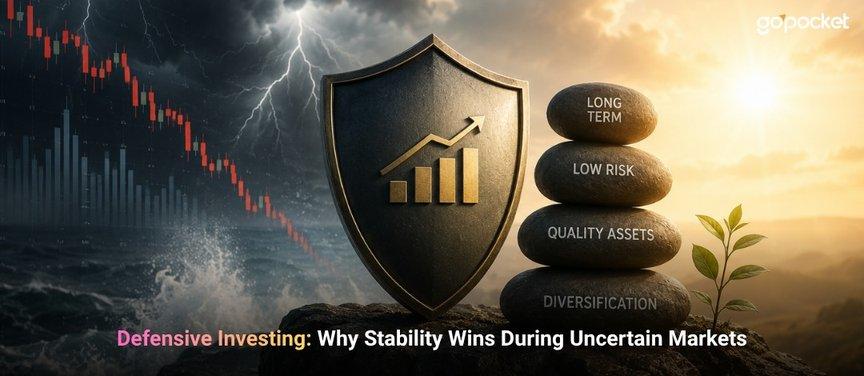
This Is What Defensive Investing Really Means
Many people think defensive investing means avoiding the market or sitting quietly until everything becomes normal again.
Not quite. Think of it like driving through heavy rain. You don't abandon your journey. You don't press the accelerator harder either.
You slow down, stay alert, and focus on reaching your destination safely.
That's defensive investing.
It isn't about fear. It's about discipline.
It's choosing stability over impulsive decisions when uncertainty becomes part of the journey.
One App. Endless Opportunities.
Here's The Truth Nobody Likes To Admit
Volatile markets don't just test your investments. They test your behaviour. When prices move sharply, emotions usually move even faster.
Fear whispers, "Sell before things get worse."
Greed interrupts, "Buy before you miss the recovery."
Noise shouts, "Everyone else knows something you don't."
But discipline quietly asks just one question:
"Has your long-term goal actually changed?"
That single question can prevent many emotional decisions.
Pause For A Second...
Imagine your investments decline over the next few weeks.
What's your first instinct?
• Refresh your portfolio every few minutes?
• Trust every market prediction on social media?
• Sell everything because everyone else seems worried?
• Or go back to the investment plan you made before the volatility began?
The market doesn't decide your next move. You do.
Stability Isn't Boring. It's Powerful.
People often celebrate dramatic investment stories. The overnight success. The perfect trade. The lucky prediction. What rarely makes headlines is the investor who stayed patient, followed a disciplined strategy, and quietly continued building wealth over time. Yet those stories are often the ones that matter most.
Defensive investing isn't exciting because it isn't designed to create excitement. It's designed to create resilience.
Sometimes, protecting your capital during uncertain periods can be just as valuable as growing it during favourable ones.
What Defensive Investors Usually Focus On
Instead of chasing every market movement, defensive investors often focus on questions like these:
• Am I investing according to my financial goals?
• Is my portfolio diversified appropriately?
• Have I invested only the money I can keep invested for my planned time horizon?
• Am I making this decision based on research or emotion?
Notice something? None of these questions ask, "What is everyone else doing?"
Because successful investing isn't a competition against strangers. It's a commitment to your own financial journey.
Invest Better by Learning More
The Market Will Always Have Noise
Markets react to many things economic data, company earnings, global events, inflation expectations, policy announcements and investor sentiment.
You cannot control any of them. But you can control how you respond.
That's where defensive investing quietly stands apart. It doesn't promise certainty. It prepares you for uncertainty.
One interesting thing about uncertain markets is that they often reveal the difference between confidence and conviction. Confidence comes from seeing markets rise. Conviction comes from understanding why you invested in the first place. When prices climb steadily, almost every investor feels confident. But when markets become unpredictable, only those with a clear purpose are able to stay composed.
Defensive investing encourages you to replace short-term excitement with long-term clarity. Instead of asking, "What should I do today?" it reminds you to ask, "Does today's market change my long-term goal?" Most of the time, the answer is no. And that simple realization can help you avoid decisions driven by temporary emotions rather than lasting financial objectives.
One Last Thought Before You Close This Blog
The next time the market becomes unpredictable, remember Arun and Meera. They saw the same charts. The same headlines. The same volatility. The only difference was their mindset. Uncertain markets don't always reward the fastest decision.
Quite often, they reward the most thoughtful one. Because stability isn't about avoiding every market movement. It's about avoiding decisions you'll regret once emotions settle.
If you're building your investment journey, don't just look for information. Build a strategy that matches your goals, risk tolerance and time horizon. With the right planning, the market's loudest days don't have to become your most stressful ones. Sometimes, the smartest investment move isn't chasing every opportunity.
It's staying true to the plan that brought you into the market in the first place.
Disclaimer
This blog is for educational and informational purposes only. Investments are subject to market risks. Please read all scheme-related documents carefully before investing.