
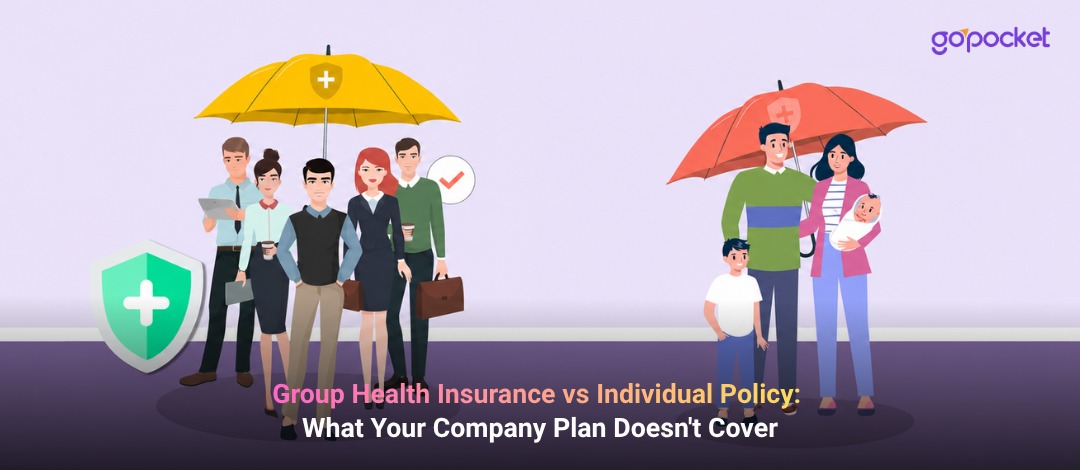


Group Health Insurance vs Individual Policy
What Your Company Plan Doesn't Cover
"Don't worry — my company already provides health insurance."
Karthik said those words confidently for nearly seven years.
And honestly? He wasn't wrong. His group health insurance was real, useful, and gave him genuine peace of mind. Every year he received an insurance card. Every time colleagues discussed coverage, he smiled and moved on.
Then life changed — as it always does.
He got married. His parents started needing more medical attention. Then came a career opportunity he couldn't refuse. He switched jobs.
During the gap between employers, a medical situation arose. For the first time, Karthik sat down and asked a question he had never thought to ask before:
"What exactly does my company insurance cover — and what doesn't it?"
The answer surprised him. And if you're a salaried employee, it might surprise you too.
What Is Group Health Insurance?
Group Health Insurance is a policy your employer purchases for its workforce. Instead of you buying individual coverage, the company negotiates a plan that covers all employees — sometimes with the option to include family members.
The benefits are real and immediate:
• Coverage begins quickly upon joining
• Premium is usually paid by the employer
• No lengthy underwriting for the individual
• Simple enrollment process
For many young professionals, this is their first experience with health insurance — and it works well. But there is one detail that matters enormously:
Group health insurance is tied to your employment. Not to you.
What Is an Individual Health Insurance Policy?
An Individual Health Insurance Policy is purchased by you, belongs to you, and travels with you.
You choose the insurer. You decide the coverage amount. You pay the premium. And most importantly — whether you switch jobs, take a career break, start a business, or retire, the policy continues as long as you renew it.
The difference sounds small. Its implications are significant.
Group vs Individual: A Clear Comparison

5 Things Your Company Plan May Not Cover
Not all group policies are equal — but there are common gaps every employee should know about.
1. Coverage Ends When Employment Ends
This is the most important gap. If you leave a job, retire, or face a gap between employers, your group coverage changes or disappears. This isn't a flaw — it's simply how it's designed. But it means you should never assume you're continuously protected.
2. The Coverage Amount May Not Keep Up with Your Life
When you're 24 and single, a modest cover feels sufficient. But healthcare costs rise. Family size grows. The company-set sum insured — which you didn't choose — may not grow with your needs.
3. Your Parents May Not Be Included
Many employees discover this only when they need it most. Some employer plans include parents; others offer optional parental coverage at extra cost; many don't include parents at all. If you have ageing parents, this is a critical gap to check now — not later.
4. Benefits Can Change Year to Year
Employers periodically review and renegotiate insurance arrangements. The policy terms, insurer, and coverage structure this year may be different next year. You have no control over that decision.
5. You Have Limited Say in What's Covered
With group insurance, coverage decisions are made at the organizational level. With an individual policy, you can design coverage around your specific health history, family situation, and financial plan.
So Is Group Health Insurance Bad?
Absolutely not. For millions of families, group health insurance is a valuable — sometimes critical — financial safety net. The point isn't to criticize it. The point is to understand its role.
Think of group insurance as a strong foundation. The question every employee should ask is: Is this foundation enough for where my life is headed?
The answer is different for everyone.
Why Individual Coverage Becomes Important
As responsibilities grow, many people start wanting something that company benefits can't offer: continuity. A policy that doesn't pause when a career does. Coverage that scales as a family does.
Individual health insurance isn't a replacement for group coverage. For many people, it's an additional layer — a complement that fills the gaps.
Questions Every Employee Should Ask Today
• What is my current group coverage amount?
• Does my policy cover my spouse and children?
• Are my parents included?
• What happens to my coverage if I switch jobs?
• Has my life changed significantly since I first enrolled?
These aren't alarming questions. They're responsible ones. Asking them now, rather than during a medical emergency, is the difference between clarity and surprise.
What Karthik Learned
Karthik still values his company's health insurance. He's grateful for it. But today he sees it differently — not as the only layer of protection in his financial life, but as one important piece of a larger plan.
He understands where it helps, where it doesn't, and why insurance decisions need to evolve as life does.
Your first job, your marriage, your children, your parents' healthcare, your career transitions — they all change over time. The coverage that felt complete yesterday may deserve a second look today.
That's not because something is wrong. It's because life keeps moving forward.
At GoPocket, we believe financial awareness starts with understanding. Whether it's insurance, investments, or long-term planning — informed decisions always outperform assumptions. The clearer your picture today, the more confident you can be about tomorrow.
Disclaimer
What's Trending
Rs.1 Crore in 5 Years? Only If You Understand This First
December 22, 2025
Recent Blog


.jpeg)

Blog
Recent Blogs





Open your GoPocket Account within 5 minutes.
Have any queries?
Get support

Investing and trading is made simple, affordable and accessible for every Indian.



© Made with ❤️ in Coimbatore, India | Copyright © 2023 onwards, GoPocket.