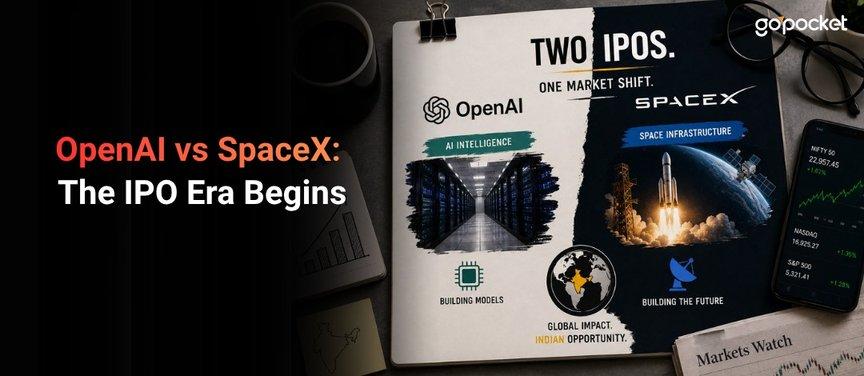
The $2.75 Trillion IPO Wave: What OpenAI and SpaceX Mean for Your Money
Two of the biggest private companies in the world are heading to the public market — and they’re asking for a combined $2.75 trillion.
That’s OpenAI and SpaceX. One builds ChatGPT. The other launches rockets and Starlink satellites.
Both are planning an IPO. Both are losing billions. And both could change how you think about investment in 2026.
Let’s break it down — with some context, some story, and a clear action plan.
1. What’s Actually Happening? The Basics
An IPO means a private company sells shares to the public for the first time. Anyone with a demat account can buy the stock.
OpenAI is targeting an IPO in late 2026 or early 2027. Expected valuation: $852 billion to $1 trillion.
SpaceX has already filed. First trading day: June 12, 2026. Ticker: SPCX. Goal: raise $75 billion at a $1.75 trillion to $2 trillion valuation.
If both succeed, it would be the largest IPO cycle in history. For perspective, the entire Indian stock market is worth about $5 trillion. These two companies alone want half of that.
Now here’s the catch: Neither company makes a profit yet.
2. The Story Behind the Numbers
OpenAI’s story
Think back to November 2022. ChatGPT launches. In 5 days, 1 million people will use it. Today, 500 million people use it monthly.
That growth costs money. A lot of it. OpenAI lost $14 billion last year. Why? The computers that run AI are expensive. They run 24/7. They need massive data centres and thousands of NVIDIA chips.
OpenAI told investors it needs $200 billion more just to keep building. So it has two choices: keep raising private money, or go public and let the market fund it.
Then there’s the Elon Musk twist. He co-founded OpenAI, left, then sued them. He claimed they “betrayed the nonprofit mission.” The court dismissed it on a technicality. Microsoft keeps its 27% stake. The IPO plan moves forward.
SpaceX’s story
In 2002, Elon Musk started a rocket company. Everyone laughed. Rockets exploded. Money burned.
Today, SpaceX is the world’s most valuable private company. Why? Two reasons:
1. Starlink: Internet from satellites. Over 10 million subscribers. Real revenue. 63% margins. If broadband doesn’t reach your town, Starlink might be the answer.
2. Reusable rockets: SpaceX lands rockets back on Earth. That cut launch costs by 90%. NASA is now a customer.
But here’s the number that makes finance professionals pause: SpaceX wants a valuation of 93x sales.
What does that mean? If a store makes $100 in sales, the market is saying it’s worth $9,300. NVIDIA, the hottest AI stock, trades at 35x. The average big US company trades at 7x.
So you’re not just buying today’s rockets. You’re buying a future that includes “orbital AI data centres are listed,” “100-terawatt solar farms in space,” and “Mars colonies.”
One more twist: Elon Musk will keep 85% voting power after the IPO. He’s CEO, CTO, and Chairman. If this works, he could become the first trillionaire in history.
3. Why This Isn’t Just a US Story — The Global & India Impact
You might think, “I don’t plan to buy SpaceX stock. Why should I care?”
Because global markets are connected. When $2.75 trillion of new IPOs hit, money has to come from somewhere.
Global impact:
When large IPOs list, global funds often sell other holdings to participate. That can pull money out of emerging markets temporarily. June 2026 could see higher volatility across the board.
India impact:
1. IT stocks: TCS, Infosys, Wipro all pitch “AI services” now. If OpenAI’s IPO says AI firms are worth $1T, sentiment for Indian IT stocks could improve. If OpenAI struggles post-listening, the “AI theme” may cool off.
2. Space & defence stocks: If SpaceX is worth $2T, investors start looking for “the next SpaceX.” That means more attention on MTAR Tech, Data Patterns, HAL, and BEL. Expect headlines. Expect volatility.
3. Starlink in India: SpaceX wants to expand Starlink globally. With $75B from an IPO, they’ll accelerate. That’s good for rural connectivity. It could also mean more competition for Airtel and Jio.
4. FII flows: Foreign investors may reduce positions in Nifty 50 stocks in June to free up cash for SPCX. Your SIPs might see a rough patch. That’s normal during mega-IPOs. Stay consistent.
5. Should You Invest? The GoPocket Framework
Not every IPO is a buy. Not every story becomes a good investment. Use these three filters:
Filter 1: Do you understand the business?
Can you explain what SpaceX does in 30 seconds? Can you explain why OpenAI loses $14B? If not, it’s okay to watch from the sidelines. Warren Buffett’s rule: “Never invest in a business you cannot understand.”
Filter 2: What’s your allocation?
Story stocks like these should be a small part of your portfolio. A common rule: 1% to 5% max. The rest stays in diversified index funds and debt. That way, even if you’re wrong, your financial goals stay on track.
Filter 3: What’s your exit plan?
Before buying any IPO, answer this: “If SPCX falls 30% in the first month, I will ___.”
Sell? Hold? Buy more?
If you don’t know the answer now, you won’t know it when the stock is down 30%, and Twitter is panicking.
Important reality check: You may already have exposure. If you own a Nifty 50 index fund, you own Microsoft. Microsoft owns 27% of OpenAI. You don’t always need the IPO to participate in the theme.
6. What To Do Before June 12, 2026
1. Don’t rush: IPOs are exciting on day one. But data shows 45% of hyped IPOs trade below their listing price 3 years later.
2. Watch, then decide: Let the stock trade for a month. See where it settles. See what management says on the first earnings call.
3. Stick to SIPs: Mega-IPOs create noise. Your SIP doesn’t need to react to noise. Stay on your dates.
4. Check your IT exposure: If 40% of your portfolio is already in IT stocks, adding OpenAI isn’t diversification — it’s concentration.
The one metric that matters long term: Free cash flow. Can the company turn revenue into profit consistently? Until OpenAI and SpaceX do that, you’re buying potential, not performance.
Master The Markets With Gopocket
7. Final Take
OpenAI and SpaceX are incredible companies. They’ve changed how we use AI and how we think about space.
But an incredible company ≠ incredible investment. At least, not at any price.
$2.75 trillion is a lot of expectation. The market will decide if it’s justified.
Your job isn’t to predict that. Your job is to have a plan, a limit, and the discipline to follow it.
Master The Market With GoPocket
Track global IPO news, FII data, Nifty option chains, and sector moves — all in one app. Real-time data. Low brokerage. Zero hype. Because the market rewards patience, not panic.
Disclaimer: This content is for educational purposes only and does not constitute investment advice. IPOs involve substantial risk, including potential loss of principal. Market data as of May 22, 2026, from public filings and news sources. Please consult a SEBI-registered advisor before investing. Investments in the , securities market are subject to market risks; read all the related documents carefully before investing. GoPocket is a SEBI-registered intermediary.