A short story to start
You are 27. You earn ₹85,000 a month. You pay rent, run a household, send a sibling some pocket money, and somehow still SIP ₹5,000 every month.
Without realising it, you already run a small business. Let's call it You Inc.
Revenue: your salary. Expenses: rent, EMI, groceries, and school fees. Runway: How many months can You Inc. survive if revenue stops tomorrow?
Every well-run startup in India has a treasury policy — a simple rule about how to protect the cash that keeps the lights on. You Inc. needs one too.
The critical illness vs health insurance debate is literally that question, just dressed up in insurance vocabulary.
The two products most people mix up.
We hear "health insurance" and assume it is one product. It is two products doing two completely different jobs.
Health insurance is reimbursement-based. You walk into a hospital, and the insurer settles the bill (usually cashless). You rarely touch the money. It covers what is on the bill — room, ICU, surgery, medicines, and follow-up. The day you walk out, the policy is done helping you.
This is the policy that pays the hospital.
Critical illness insurance is benefit-based. A doctor diagnoses you with one of the listed conditions — a major heart event, cancer, kidney failure, stroke, or organ transplant — and the insurer pays a lump sum directly into your bank account. No bills. Just the cash.
You can spend it on anything: EMI, rent, a second opinion, six months of groceries while you focus on recovery.
This is the policy that pays You Inc.
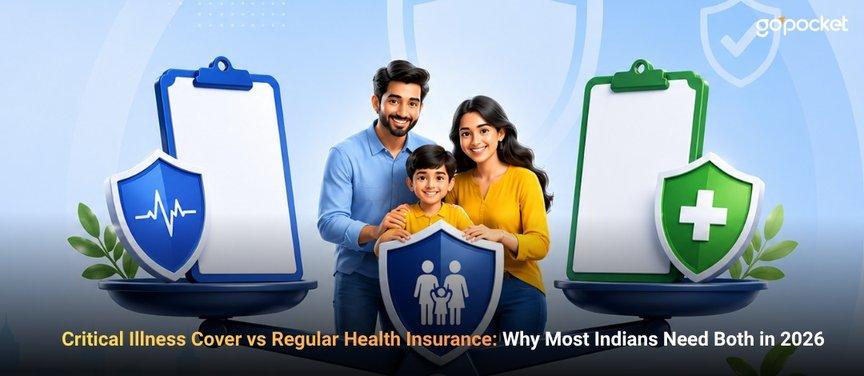
Health insurance pays the hospital. Critical illness pays You Inc. That single line is the entire reframe.
Quick side-by-side
Critical illness is the cheapest layer.
You'd think the policy that hands you ₹25 lakh in cash on diagnosis would cost a fortune. It doesn't.
A healthy, non-smoking 30-year-old in India can typically buy a ₹25 lakh standalone critical illness cover for ₹6,000–9,000 a year. Roughly ₹500–750 a month. Cheaper than a gym membership in most metros.
The math is simple. Most people are not diagnosed with one of the listed illnesses in any given year, so the insurer's expected payout per policy is low. They price accordingly.
You Inc. gets a runway protector for the price of two Zomato dinners a month.
Your employer's cover is not your full plan.
The second misread. Most people think, "My company gives me ₹5 lakh group health, I'm sorted."
You are not.
From a CFO's view, that is a single-vendor, non-portable line of credit. The day you change jobs, freelance, or take a sabbatical, it vanishes. Your treasury policy should always sit in You Inc.'s name.
The 2026 You Inc. treasury — four layers
The cleanest way to think about insurance is to picture four layers, each doing one job, none stepping on another.
Layer 1 — Hospital line (₹10–15 lakh base health policy). Daily-driver hospital cover. Handles everyday admissions — a kid's dengue, a parent's knee surgery, a maternity stay. Cashless across major hospital networks.
Layer 2 — Surge protection (₹25–50 lakh super top-up). Kicks in after your base cover crosses a threshold called the deductible (the bill amount above which the top-up activates). The cheapest way to add a big number to your hospital cover since you only pay a premium for the part above the threshold.
Layer 3 — Runway protector (Critical illness — 24× your monthly take-home). The income-side layer. Its job is not to pay the hospital. Its job is to keep You Inc. running while you focus on recovery. If you take home ₹1 lakh a month, that is a ₹20–25 lakh CI cover. Simple multiplier.
Layer 4 — Founder key-person cover (Term insurance — 10–15× annual income). In a startup, the company insures its founder because the founder is the company. Same logic here. Term insurance pays your dependents if you are no longer around. Critical illness pays you while you are. Siblings, not substitutes.
What does the full You Inc. treasury cost?
Real rupees. No hand-waving.
That is roughly ₹2,600–3,700 a month for a full four-layer treasury that protects everything You Inc. has built.
(Premium ranges are illustrative for a healthy non-smoker. Real quotes depend on insurer, age, smoking status, sum insured, and underwriting.)
The CFO sizing rule —three numbers, one weekend
Open a notes app. Write down three numbers about You Inc.
1. Monthly take-home — what actually lands in your account after tax and PF.
2. Monthly fixed obligations — EMI + rent + school fees + essential running cost.
3. Runway in months — how many months your current savings cover those obligations if revenue stops tomorrow.
If your runway is under 12 months, your CI cover is doing serious work. Size it at 24× your monthly take-home.
If your runway is 12+ months, you are partly self-insured. You can size CI at 12–18× and still sleep well.
For the hospital line, match your city's planned-hospitalisation cost (₹10–15 lakh in most metros). Add a surge top-up of ₹25–50 lakh on top.
Three numbers. One weekend. Sorted.
Mistakes the founder always regrets
A short list, because the wrong moves repeat themselves.
• Treating employer cover as your full plan. Single-vendor and non-portable. Always own a personal policy.
• Picking the cheapest CI plan without checking the illness list. Premiums look similar; coverage doesn't. Compare the number of conditions and how each is defined.
• Bundling CI as a rider on a life insurance policy. Standalone CI usually covers more illnesses and offers larger sums insured. Riders are convenient, not better.
• Waiting until 40 to buy CI. Premiums roughly double between 30 and 45, and underwriting tightens every year.
• Skipping the policy wording. Read two pages — the covered illness list and the survival period clause. Skim the rest.
Where GoPocket fits
GoPocket's insurance vertical is built around exactly this layered idea — health, critical illness, term, and group cover, all visible side by side, with riders, sub-limits, waiting periods, and claim settlement ratios shown in plain English instead of agent-speak.
Two CI plans rarely differ in price. They differ in how many illnesses are covered, how each is defined, and what the survival period is. A clean comparison surface shows you those.
Decode the Markets with GoPocket
That is the only GoPocket plug-in in this piece.
Your Q2 board meeting (with yourself)
Pick one evening this week. Call it the Q2 2026 board meeting for You Inc.
Open your existing health insurance policy PDF on your phone. Check three things — sum insured, room rent limit, and whether critical illness is included as a rider or sitting outside the policy entirely.
If the runway-protector layer is missing, you now know the layer and roughly how big it should be. Pull one comparison quote, even if you don't buy this week. The quote alone teaches you more about your gap than another Instagram scroll will.
You don't need more insurance. You need a treasury policy.
You Inc. has been operating without one for too long. Fix that this quarter.
For educational purposes only. Not investment or insurance advice. Insurance products are subject to underwriting and policy terms; please read all policy-related documents carefully before purchasing. Consult an IRDAI-registered insurance advisor or SEBI-registered financial advisor for personalised guidance. GoPocket is a SEBI-registered intermediary.