



BUILD WEALTH IN YOUR 20s (INDIA): A SIMPLE, PRACTICAL GUIDE
WHY THIS MATTERS
Your 20s often come with modest salaries, rising expenses, and plenty of FOMO. Investing feels like something to worry about later-after income improves or life feels stable.
But this decade gives you one advantage you’ll never get back: time.
When money compounds over decades, even small monthly investments can grow into meaningful wealth. You don’t need a big salary, perfect timing, or market expertise. You need early action, a simple plan, and consistency.
This guide explains why your 20s are the best time to invest, what to do first, and how to invest simply using Indian instruments-without hype or shortcuts.
1) WHY TIME BEATS MONEY
Compounding means your returns start earning returns. The longer your money stays invested, the faster growth accelerate-this is the core of long term wealth creation in India.
ILLUSTRATIVE EXAMPLE:
• SIP: ₹5,000 per month
• Assumed return: 12% per year (long-term equity expectation; not guaranteed)
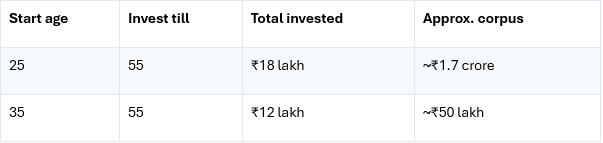
The same SIP, with the same return assumption, can lead to very different outcomes depending on when you start. This clearly shows how ₹5,000 SIP can build wealth over time.
Bonus: Increasing your SIP by 10% every year as your salary grows can significantly raise the final corpus—even if you start small.
Returns are illustrative. Equity expectations ~10–12%; inflation ~5–6%.
2) BUILD THE FOUNDATION FIRST
Before chasing returns, create financial safety.
Emergency fund (non-negotiable)
• Target: 3–6 months of expenses
• Where: Savings account, sweep FD, or liquid mutual fund
• Why: Emergencies shouldn’t force you to sell investments or use credit cards
Example:
Monthly expenses ₹30,000 → Emergency fund ₹90,000–₹1.8 lakh
Returns are secondary; liquidity matters more.
Health insurance
• Cover: ₹5–10 lakh individual policy
• Why: Employer cover is often insufficient
• Tax: Premiums may qualify under Section 80D (subject to FY/regime)
One medical emergency can wipe out years of savings.
Term life insurance
Buy term insurance only if someone depends on your income.
• Cover: ~10–15× annual income
• Advantage: Cheapest when bought young
Clear high-interest debt
High-interest debt quietly destroys wealth.
Priority order:
1. Credit cards
2. Personal loans
3. Car loans
4. Home or education loans (lower urgency)
Pay minimums on all loans, then attack the highest-interest loan first.

3) INVESTING FRAMEWORK FOR YOUR 20S
With long-term goals decades away, your portfolio can tilt towards growth. A simple asset allocation for your 20s in India helps manage risk without complexity.Simple allocation guide:
• 70–80% Equity (growth engine)
• 10–20% Debt (stability)
• Balance in cash/liquid (emergency buffer)
Review once a year. If equity rallies and exceeds your comfort level, rebalance into debt to manage risk.
4) KEEP INVESTING IN BORING
Simplicity improves consistency.
Equity options
• Low-cost index funds (Nifty 50, Nifty Next 50)- ideal for index fund investing in India
• ELSS funds (equity + tax benefit; 3-year lock-in)
Debt and safer options
• PPF / EPF / VPF for long-term, tax-efficient savings
• Debt mutual funds or FDs for short-to-medium goals
Optional diversification
• Gold exposure via SGBs or Gold ETFs
(use as a hedge, not a growth engine)
Avoid early on:
• Futures & Options or day trading
• Chasing last year’s best-performing funds
• Holding too many schemes (3–4 core funds are enough)
For most people, these are the best investments for beginners in India when kept simple.
5) SIPS AND AUTOMATION: WHERE WEALTH IS BUILT
Consistency beats intelligence.
• Start SIPs on salary credit day
• Automate debits so investing happens before spending
• Ignore short-term market noise-stay invested
Simple rule:
If your salary rises by 10%, increase SIPs by 5-10%.
Lifestyle stays stable while wealth accelerates.
6) TAXES
Use tax benefits-but don’t let taxes drive poor investment choices.
Always verify limits for the applicable Financial Year (FY) and your tax regime.
• Section 80C (Old Regime): ELSS, PPF, EPF (up to ₹1.5 lakh)
• Section 80CCD(1B): NPS (additional ₹50,000)
• Section 80D: Health insurance premiums
Capital gains basics:
• Equity mutual funds attract long-term capital gains beyond the holding threshold
• Debt fund taxation rules have changed-check current treatment before investing
7) RISK AND BEHAVIOUR
• Diversify across asset classes
• Keep costs low (check expense ratios)
• Stay invested during market corrections
• Control lifestyle inflation after raises
• Review annually-not daily
Your behaviour matters more than fund selection when you build wealth in your 20s in India.
8) GROW YOUR INCOME
Markets are unpredictable. Income growth is more controllable.
• Upskill in high-demand areas
• Switch roles strategically every 2–3 years
• Build side income through freelancing or consulting
Even ₹5,000 extra invested per month can significantly impact long term wealth creation in India.
9) A SIMPLE 30-DAY STARTER PLAN
Week 1: Track income, expenses, and debts
Week 2: Buy health insurance; start emergency fund
Week 3: Begin SIPs in 1–2 index funds
Week 4: Automate investments; set an annual review reminder
Final Thought
Wealth isn’t built by timing the market or earning a massive salary.
It’s built by starting early, staying consistent, and letting time work quietly in your favour.
Even small monthly investments, done regularly and increased slowly, can grow into something meaningful.
Keep it simple. Stay invested. Trust the process.
DISCLAIMER:
This content is for educational purposes only and does not constitute investment advice. Market returns are subject to risk. Please verify tax rules for the applicable financial year and consider consulting a SEBI-registered investment advisor before making decisions.
Disclaimer
What's Trending
NPS vs PPF: Which Is Better for Retirement?
June 30, 2026
Recent Blog




.jpeg)

Open your GoPocket Account within 5 minutes.
Have any queries?
Get support

Investing and trading is made simple, affordable and accessible for every Indian.



© Made with ❤️ in Coimbatore, India | Copyright © 2023 onwards, GoPocket.