
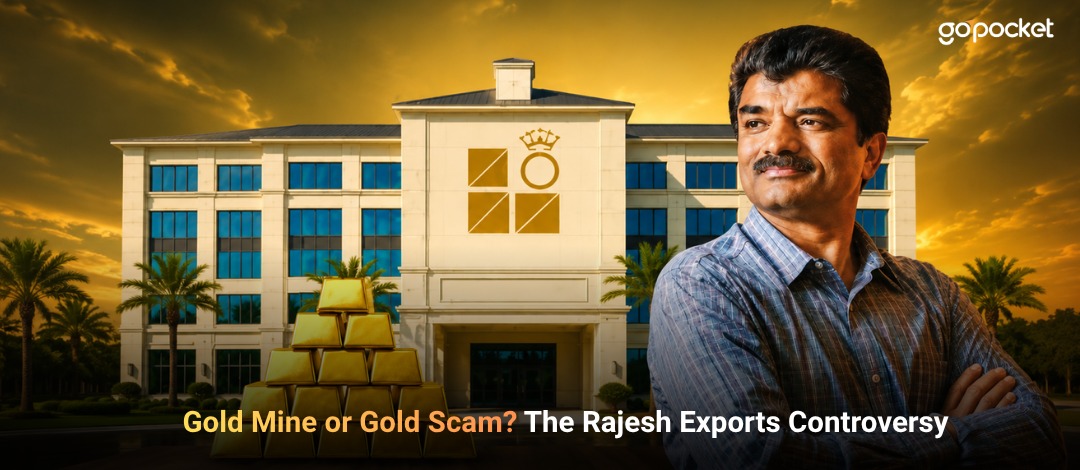


Nobody Asked.
Then SEBI Did. And a ₹15 Lakh Crore Lie Came Crashing Down.
Imagine you are buying groceries. The shopkeeper hands you a bill for ₹500. You pay without checking. Why would you? You trust the person across the counter.
Now imagine the same thing — but with crores. And lakhs of crores. And a company report that nobody bothered to cross-check for years.
That is the Rajesh Exports story.
On June 3, 2026, India's stock market regulator SEBI — the Securities and Exchange Board of India, the government body that protects investors and oversees stock markets — issued a ban order against Rajesh Exports and its owner Rajesh Mehta. The reason: the company may have been showing revenue it never actually earned. And the owner may have been using company funds for his own personal stock market bets.
Here is the full story
The Company With the Sky-High Numbers
Rajesh Exports was a Bengaluru-based gold jewellery company, listed on both the NSE and BSE. Being listed simply means its shares were available for anyone to buy — retail investors, mutual funds, institutions.
The company owned a Swiss gold refinery called Valcambi SA. Gold from across the world passed through Valcambi. It was a well-known name in global precious metals.
In its annual reports — the yearly financial document every listed company must publish — Rajesh Exports showed that 97% to 99% of all its revenue came from this one Swiss subsidiary.
What is a subsidiary? A subsidiary is a company that another company owns. When a parent company reports its total revenue, it adds its own earnings plus the subsidiary's earnings into one combined number — called a consolidated report.
The combined number was ₹15.15 lakh crore. Every year. In official reports. Filed with the exchanges. Available for any investor to read.
Nobody asked: can this be verified?
What SEBI Found When It Actually Looked
SEBI investigators did something straightforward. They tried to match Rajesh Exports' reported revenues with the actual records at the Valcambi level.
The numbers did not match.
SEBI's finding (June 3, 2026): The revenues declared in Rajesh Exports' consolidated reports could not be reconciled with records available at the subsidiary. In plain terms — the money they said they earned could not be traced to real transactions.
That is what is called a revenue misstatement — when a company reports more income than it actually generated.
This was the first problem.
The second one involved real money — moving to real places — in complete secrecy.
The Secret That Cost Shareholders ₹12,726 Crore
In Rajesh Exports' books, there was a company called Affluence. Transactions worth ₹11,488 crore were recorded between Rajesh Exports and Affluence over three years.
But here is where the story takes a sharp turn.
Affluence had no business relationship with Rajesh Exports. No contracts. No invoices. No client record. The company simply did not know Rajesh Exports existed as a client.
When SEBI traced what those transactions actually were, the trail led to Rajesh Mehta's personal trading account. The transactions in the books mapped to derivative trades — high-risk bets on whether stock prices would go up or down — placed by the owner for himself.
What is a derivative trade? A derivative is a financial contract where you bet on the movement of a stock or index. It is legal to trade derivatives — but using someone else's money (especially a company's money) to fund your personal derivative bets is not.
₹926 crore moved from Rajesh Exports' accounts without board approval, audit committee sign-off, or any disclosure to shareholders.
Of that, ₹339 crore went directly to accounts linked to Rajesh Mehta personally.
None of it was declared as a related-party transaction — the mandatory SEBI disclosure required whenever a company's money moves to its owner or connected persons.
The company's shareholders — the people who owned its stock — had no idea.
What It Cost the People Who Trusted the Reports
Rajesh Exports' stock had already fallen 45% in six months before SEBI's order was published.
The wealth lost by shareholders — retail investors, small savers, people who trusted a listed company on a regulated exchange — stands at an estimated ₹12,726 crore.
SEBI has now banned both Rajesh Exports and Rajesh Mehta from the stock market while the investigation continues.
The ban is a consequence. The losses, for most investors, are already done.
3 Questions Every Investor Should Ask Before Buying Any Stock
This story has a lesson buried inside it. Not for regulators — for you.
• Where is the revenue actually coming from? If most of a company's revenue flows from one overseas subsidiary, ask whether that can be cross-checked. Extreme concentration in a single source — especially one that's hard to verify — is worth investigating before investing.
• How is the promoter using company money? A promoter is the founding owner of a company. Check the annual report for related-party transactions — disclosures of money flows between the company and its owner. Missing disclosures or vague entries are red flags, not minor details.
• What does the auditor say — and not say? Every listed company's annual report has an auditor's section. An auditor is an independent accountant who verifies the numbers. If they have flagged anything — even carefully worded concerns — read that section carefully. It matters more than the headline revenue.
On GoPocket, our financial education resources teach you how to read annual reports in plain language — from understanding consolidated revenues to spotting governance issues before they make headlines. The best time to learn this is before you need it.
The Takeaway
Markets run on trust. Investors buy shares because they trust that the numbers in a company's reports are real.
When that trust is broken — when revenues are overstated, and company funds quietly move into a promoter's personal account — ordinary investors pay the price. Not the promoter. Not the institution. The person who saved, invested, and waited.
SEBI acted. But the ₹12,726 crore loss doesn't reverse when a ban order is published.
The ₹15 lakh crore question was always there. In every annual report. On every exchange filing. Waiting for someone patient enough to ask — is any of this real? Be that person, before you invest.
This article is based on SEBI's publicly available interim order dated June 3, 2026. All allegations are as stated by SEBI and are subject to ongoing legal process.
This content is for educational purposes only and does not constitute investment advice. Investments are subject to market risks. Please read all scheme-related documents carefully before investing. GoPocket is a SEBI-registered intermediary.
Disclaimer
What's Trending
The Hidden Story Behind Every Stock Price
September 13, 2025
Recent Blog


.jpeg)

Blog
Recent Blogs




Open your GoPocket Account within 5 minutes.
Have any queries?
Get support

Investing and trading is made simple, affordable and accessible for every Indian.



© Made with ❤️ in Coimbatore, India | Copyright © 2023 onwards, GoPocket.