



Last Thursday your portfolio dropped 1.4%.
You didn't sell anything. Your funds were fine. Nothing in the papers.
So who hit you?
Someone in America published a number the previous evening, while you were having dinner. You never heard about it. Your portfolio heard it by 9:16 AM.
Four American reports do this. Every month. You already know the short forms — FOMC, CPI, NFP, PPI.
Be honest. Could you explain even one of them at a chai break?
Let's fix that.
1. FOMC — basically America's RBI
You know how the RBI meets, changes the repo rate, and suddenly your home loan EMI moves?
Same thing. Different country.
Twelve people, eight meetings a year, one question: do US interest rates go up, down, or stay put?
So why does that reach your app?
When America raises rates, US government bonds start paying good money for almost no risk.
Now think like a foreign investor. You hold Indian stocks, and a safer American bond suddenly pays well. You sell here, you buy there.
That selling weakens the rupee and pulls Indian stocks down. Cut rates, and the money comes right back.
Catch it at: 11:30 PM IST. Thirty minutes later, the Fed chief takes questions — and that bit matters more, because it hints at the next meeting.
Don't listen to the number. Listen to the mood. Strict tone (news calls it hawkish) means rates stay high. Relaxed tone (dovish) means cuts are coming.
Right now: chief Kevin Warsh is tough on inflation. Rates have sat at 3.50–3.75% for five meetings straight. Nothing moved — but the tone stayed strict every single time, and a September hike looks likely.
He said nothing. The tone said everything.
IN ONE LINE: FOMC is America's RBI. Higher US rates pull foreign money out of India.
2. CPI — your kirana bill, American edition
Picture your monthly grocery bill. Same list, same shop, compared to last year.
That gap is inflation. CPI measures exactly that for America.
If CPI is 4%, the basket costs 4% more. Did your salary rise 4%? Usually not. That's the squeeze.
Why care? America wants CPI at 2%. Cross 3%, and they reach for the rate lever. It's been above 2% for over five years now.
Hotter CPI means stricter rates, a stronger dollar, and money walking out of markets like ours.
Quick catch: there are two CPI numbers. Headline includes food and fuel, so one oil spike distorts everything. Core removes both. The Fed watches core — same way you'd ignore one wedding month when judging your yearly spending.
What it looks like in real life: June CPI came in cooler than expected. That single number dropped July hike odds from over 40% to 31.5% in days.
IN ONE LINE: CPI is America's grocery-bill inflation. Cooler than expected usually means a happier opening here.
3. NFP — the monthly job count
First Friday, 6:00 PM IST. America announces how many jobs it added.
This is the loud one. Currency, stocks, gold, bonds — all of it jumps in the same second.
One thing everyone gets wrong: NFP does not skip government employees. Civilian government jobs are counted. What it skips is farm workers, domestic help, the self-employed, NGO staff and the military.
Why does it touch your SIP? The Fed reads it before deciding rates. Plenty of jobs means a strong economy, so rates stay high. Few jobs means stress, and a cut lands on the table.
The trick: don't look at the number. Look at the gap between it and what everyone predicted. Expected 1,80,000, got 80,000? Big miss, and rate-cut talk starts immediately.
Also glance at wage growth. Rising salaries mean more spending, which pushes prices up — so the Fed can stay strict even when the job count looks boring.
Real example: June NFP came in at 57,000 against an expected 1,10,000 — weakest in over a year. Within hours, hike odds collapsed, the rupee firmed, and Indian markets opened green.
IN ONE LINE: NFP is America's job count. The surprise versus forecast is what moves markets.
4. PPI — the mandi rate before it hits your shop
Tomato prices jump at the wholesale mandi today. Your vegetable vendor doesn't change his rate right away. But in two weeks? He will. He has no choice.
PPI is the mandi. CPI is your vendor.
PPI tracks what factories pay for raw material — steel, fuel, parts — before any of it reaches you. A steel plant pays more for iron ore, a car company raises prices, you pay more at the showroom. CPI reports it two to four months later.
What trips people up: PPI leads CPI by months in the real economy, but on the calendar it's published the day after CPI. So it's not a preview of tomorrow's CPI — it's a preview of CPI two or three months out.
• PPI and CPI rising together → trend is real
• PPI rising, CPI flat → price rise is on the way
• PPI cooling first → relief coming
Real example: April PPI rose 1.4% in one month — biggest jump since March 2022 — and 6.0% over the year.
IN ONE LINE: PPI is the wholesale mandi rate. It shows what CPI will look like months later.

Now here's the part nobody tells you
These four aren't separate events. They're one chain, and it only moves one way.
• PPI rises → factory costs go up
• CPI follows → shop prices go up
• FOMC reacts → US rates stay high
• Foreign money shifts → out of Indian stocks, into US bonds
• Rupee weakens → our markets wobble
• Your portfolio drops → on a random Thursday, for no visible reason
Knowing one is useful. Knowing the order is the advantage.
See a hot PPI print and think "prices rise, the Fed stays strict, foreign money may leave in a few weeks" — you're two steps ahead of the headlines.
You're not predicting anything. You just know what follows what.
Keep this handy
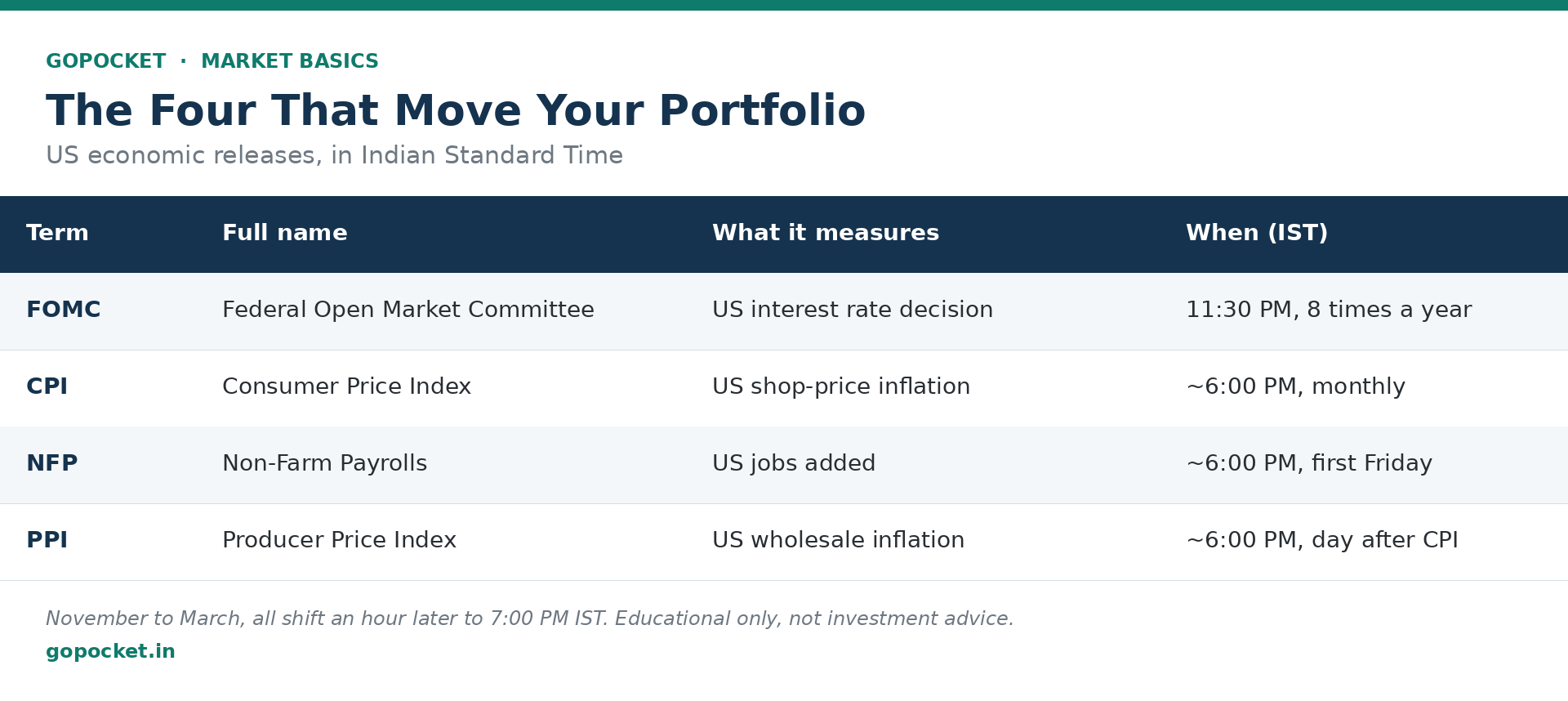
November to March, all shift an hour later to 7:00 PM IST.
So what should you actually do?
Nothing dramatic. Seriously.
Your SIP shouldn't change because America added fewer jobs last month. Long-term money grows by staying put, not by reacting to Thursdays.
But do one small thing. Put four dates in your phone: FOMC meeting, CPI day, first Friday for NFP, and the day after CPI for PPI. On each one, check one thing — higher or lower than expected?
Three months of that and red mornings stop feeling random.
Your portfolio was never moved by bad luck. It was moved by four reports on a fixed schedule.
Now you know their names.
GoPocket covers NSE, BSE and MCX — because these four American numbers move every Indian market you invest in.
Which of the four caught you off guard? Tell us in the comments.
Investments are subject to market risk. Please read all scheme-related documents carefully before investing. This article is for educational purposes only and does not constitute investment advice. Economic data cited is as reported in 2026 and should be verified against official BLS and Federal Reserve releases. GoPocket is a SEBI-registered intermediary.
Disclaimer
What's Trending
From News to Profits: Stock Tips for Smarter picks
July 31, 2025
Recent Blog


.jpeg)

Blog
Recent Blogs





Open your GoPocket Account within 5 minutes.
Have any queries?
Get support

Investing and trading is made simple, affordable and accessible for every Indian.



© Made with ❤️ in Coimbatore, India | Copyright © 2023 onwards, GoPocket.