


THE WEALTH COMPOUNDING STRATEGY HIDDEN INSIDE SMALL MONTHLY INVESTMENTS
FOUR PEOPLE. ONE COMMON EXCUSE. ONE HIDDEN OPPORTUNITY.
Nirmal had been working for just eight months.
His salary looked decent on paper, but by the time rent, groceries, travel expenses, mobile bills, and monthly commitments were paid, there wasn't much left. Whenever someone spoke about investing, he would smile and say:
"I'll start after my next salary hike."
Meena had a different story.
She managed household expenses carefully. Every month brought grocery bills, utility payments, school-related costs, and occasional medical expenses. To her, investing felt like something people did when they had "extra money."
Ravi was busy paying a home loan EMI.
Priya was supporting her parents while trying to build her own future.
Different people. Different responsibilities. Different financial situations.
Yet all four shared the same belief:
"Small amounts are not enough to build wealth."
At first, that sounds perfectly reasonable. After all, when people hear the word "wealth," they often imagine large investments, large incomes, and large financial decisions.
But what if the real wealth-building strategy isn't hidden inside large amounts at all? What if it is quietly hiding inside the small monthly decisions most people ignore?
That possibility changes everything. Because many people are not failing to build wealth due to a lack of money. They are failing because they underestimate the power of starting small.
THE MOST EXPENSIVE FINANCIAL MYTH PEOPLE BELIEVE
One of the costliest financial myths sounds surprisingly responsible.
"I'll start investing when I earn more."
Almost everyone has said it at some point. A fresh graduate says it. A young professional says it. Even experienced earners say it.
The problem is that higher income rarely arrives alone. When income grows, expenses often grow alongside it.
A better house. A larger EMI. More responsibilities. More lifestyle upgrades. More commitments. The salary increases. The investing journey remains postponed.
The perfect time that people are waiting for often never arrives. This is not because people are careless.
It is because they believe investing should begin only after life becomes financially comfortable. But real life doesn't usually work that way. There will always be something demanding attention or another expense waiting around the corner. And that is exactly why waiting can become a habit.
THE GROCERY BILL TEST MOST PEOPLE FAIL
Let's look at something familiar.
Most people can spend Rs. 100, Rs. 200, or even Rs. 300 on small purchases without giving them much thought.
A quick snack. An online delivery charge. A coffee. An impulse purchase added to the shopping cart.
None of these seems significant individually. Now imagine asking the same person to invest Rs. 1,000 every month.
Suddenly the reaction changes. "Will it really matter?" "Isn't that too small?" "Should I wait until I can invest more?"
It's interesting, isn't it?
People rarely question small spending. But they frequently question small investing. The issue is not the amount. The issue is perception. Small spending feels immediate and feels slow. And because the results are not visible instantly, many people underestimate its potential.
But there is a major difference. Money spent finishes its journey. Money invested begins one.
THE RS. 1,000 MISTAKES THAT FOLLOW PEOPLE FOR YEARS
One of the biggest mistakes people make is assuming that small investments don't matter. The problem with this line of thinking is that it overlooks something important. Most successful financial journeys do not begin with huge amounts.
They begin with consistency.
A person who invests Rs. 1,000 every month is doing more than moving money.
They are creating a habit, building discipline, developing financial awareness, and becoming comfortable with investing. These benefits are difficult to measure on a statement, but they often become incredibly valuable over time.
Many people spend years waiting to invest larger amounts. Meanwhile, someone else starts small and develops a routine. Years later, the difference is often much larger than expected. Not because the amount was huge. Because the habit became strong.
WHY SMALL INVESTMENTS HAVE A SECRET ADVANTAGE
Large investments receive attention. Small investments create momentum. And momentum is one of the most underrated forces in wealth creation. Think about exercise.
A person who starts with a simple twenty-minute walk often progresses further than someone waiting for the perfect fitness plan. Investing is similar. People who start small often find it easier to continue. People who wait for ideal circumstances often remain stuck in planning mode.
The hidden advantage of small monthly investments is that they lower the barrier to action. Starting becomes easier. Consistency becomes achievable. And once consistency appears, growth has a chance to follow. The first step is rarely the most impressive.
But it is often the most important.
THE REAL POWER IS NOT MONEY. IT IS REPETITION.
Most people focus on how much they invest. Very few focus on how often they invest. Yet repetition is where the real magic happens. Imagine planting a seed. The first day looks ordinary. The first month looks ordinary. Even the first year may not appear dramatic. But growth is happening beneath the surface.
Investing often follows the same pattern.
People expect visible results too quickly. When they don't see them, they lose interest. Those who stay consistent understand something different. They know that meaningful outcomes usually arrive after long periods of ordinary-looking effort. Small investments repeated every month create a rhythm. And that rhythm often becomes more powerful than occasional large contributions.
THE DAY WEALTH CREATION ACTUALLY BEGINS
Many people think wealth creation begins after reaching a specific income level. It doesn't. For most people, wealth creation begins on the day they stop waiting. The day they decide: "I may not have a huge amount, but I can start with something." That decision changes the entire mindset.
Instead of asking: "When should I begin?"
They start asking: "How can I stay consistent?"
That shift may seem small. In reality, it can transform the entire financial journey. Because wealth creation is rarely about one extraordinary decision. It is usually about ordinary decisions repeated consistently.
A SIMPLE ILLUSTRATION
Let's keep things simple.
Imagine two individuals.
Person A
Starts investing Rs. 2,000 every month today.
Person B
Decides to wait five years and invest a larger amount later.
Person B may eventually contribute more money. But Person A gains something difficult to recover.
Time.
Five extra years of learning, discipline, consistency & staying engaged with the investing journey. That advantage cannot be purchased later. Time once lost cannot be reinvested. And this is one of the biggest reasons small monthly investments matter.
THE HIDDEN COST OF WAITING
Most people understand the cost of spending.
Fewer people understand the cost of postponing.
Every year spent waiting is a year that could have been used to build habits, confidence, and consistency. This doesn't mean people should ignore their responsibilities.
Medical expenses matter. Family obligations matter. Household needs matter. Financial security matters.
The goal is not reckless investing.
The goal is avoiding the belief that investing can only begin after life becomes perfectly stable. Because for most people, life remains a work in progress. And that's perfectly normal.
Waiting for perfection often means waiting forever.
TWO FUTURES CREATED BY ONE DECISION
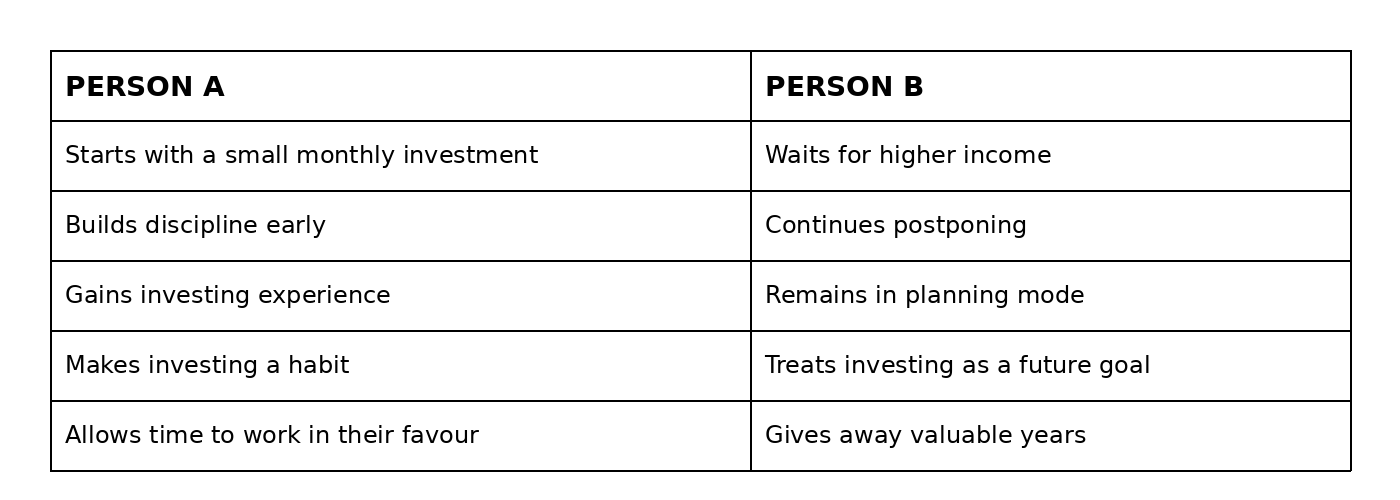
The difference may appear small initially. But wealth creation is rarely decided in the first few months. It is decided by what happens repeatedly over many years.
WHY ORDINARY PEOPLE OFTEN BUILD EXTRAORDINARY RESULTS
Many people believe wealth creation belongs only to high earners. Reality often tells a different story. Some of the most successful financial journeys are built by ordinary individuals making practical decisions consistently.
Not dramatic decisions. Not perfect decisions. Just consistent decisions. Month after month. Year after year. The reason this works is simple.
Consistency, Knowledge, Confidence & Good habits compound.
And eventually, financial progress compounds too. The outcome may look impressive from the outside. But the process behind it is usually surprisingly ordinary.
THE WEALTH STRATEGY NOBODY TALKS ABOUT ENOUGH
If there is one hidden strategy inside small monthly investments, it is this:
Make investing a behaviour, not an event.
Many people invest only when they receive a bonus. Or when they have excess cash. Or when market discussions become popular.
But long-term wealth creation often becomes stronger when investing becomes a recurring habit.
A habit doesn't depend on excitement.
A habit doesn't depend on headlines.
A habit that simply continues.
And that consistency creates opportunities that occasional actions often cannot.
SMALL STEPS. BIGGER POSSIBILITIES.
Today, starting an investment journey is more accessible than ever before.
The challenge is not always finding opportunities.
The challenge is believing that small beginnings are worthwhile.
Platforms that provide educational support, market access, and investment tools can make that journey easier. GoPocket, for example, helps individuals explore investment opportunities while learning and growing at their own pace.
The objective is not to invest huge amounts overnight. The objective is to begin.
To stay consistent. To allow time and discipline to work together.
Wealth creation is not reserved for people with massive incomes or extraordinary resources.
More often, it belongs to ordinary people who choose not to wait.
And perhaps that is the biggest lesson hidden inside small monthly investments.
Wealth rarely arrives as a breakthrough moment. More often, it arrives disguised as a small monthly decision repeated for years.
Disclaimer: Investments are subject to market risk. Please read all scheme-related documents carefully before investing. This blog is for educational purposes only and does not constitute investment advice. GoPocket is a SEBI-registered intermediary.
Disclaimer
What's Trending
How to Start SIP Investment Online in 5 Simple Steps
October 28, 2025
Why Futures Prices Don't Always Make Sense
August 13, 2026
Recent Blog


.jpeg)

Blog
Recent Blogs





Open your GoPocket Account within 5 minutes.
Have any queries?
Get support

Investing and trading is made simple, affordable and accessible for every Indian.



© Made with ❤️ in Coimbatore, India | Copyright © 2023 onwards, GoPocket.