


Scalping Trading for Complete Beginners: The Easiest Guide to Learn
If you have ever wondered how some traders make money in just seconds, you are looking at scalping. It is one of the fastest, most action-packed strategies in the stock market. But here is the good news: you do not need to be a financial expert to understand it. This guide breaks down scalping trading in the simplest way possible so you can decide whether it is the right strategy for you.
What Exactly Is Scalping?
Imagine you buy a bottle of water for ₹10 and sell it two minutes later for ₹11. You made ₹1 profit. Now do that 100 times a day — that is ₹100 profit. That is scalping in a nutshell.
In trading terms, scalping means buying a stock (or currency, commodity, or derivative), selling it within seconds to minutes, capturing a small profit, and repeating the process many times throughout the trading session. No complicated formulas. No big secrets. Just small profits, many times over.
A Real Example on NSE
You have ₹1,00,000 in your GoPocket trading account. You buy 40 shares of Reliance Industries at ₹2,500 per share. Thirty seconds later, the price rises to ₹2,502. You sell all 40 shares. Your profit: ₹80 in half a minute.
That sounds small, but multiply it: 10 such trades earn you ₹800; 50 trades earn ₹4,000; 100 trades earn ₹8,000 in a single day (before deducting brokerage and taxes)
Why Speed Matters
The word "scalping" comes from the idea of peeling off thin layers of profit. The faster you act, the more opportunities you capture before the price moves away. Hesitate for a few seconds and the opportunity may vanish. This is why a fast, reliable platform like GoPocket — with real-time price feeds and instant order execution on NSE and BSE — is essential for scalpers.
The Four Basic Steps of Scalping
• Step 1: Watch the Market — Open your GoPocket trading terminal. Study the stock’s price chart and look for short-term patterns.
• Step 2: Buy — When you spot a pattern suggesting the price is about to rise, place a quick market or limit order.
• Step 3: Wait (Just Seconds) — Hold your position for 10 seconds to 1 minute. Scalpers do not hold for hours.
• Step 4: Sell — As soon as the price moves up even slightly, sell and book your profit. Then repeat.
What Can You Scalp?
• Stocks: Large-cap Nifty 50 stocks (Reliance, TCS, Infosys, HDFC Bank, Tata Motors)
• Futures & Options: Nifty 50, Bank Nifty, or stock futures and options
• Commodities: Gold, Silver, Crude Oil on MCX via GoPocket
For beginners, equity scalping on high-liquidity Nifty 50 stocks is the best starting point. They have tight bid-ask spreads and predictable movements.
Advantages and Disadvantages
Advantages
• Instant Results: You know results within minutes, unlike long-term investing.
• Start Small: Begin with as little as ₹15,000–50,000.
• No Overnight Worry: All positions close before 3:30 PM IST — no overnight risk.
• Full Control: You make every decision yourself.
Disadvantages
• High Costs: Brokerage, STT, GST, and exchange charges on 100 daily trades add up fast.
• Screen Time: Requires 5–6 hours of screen time during market hours daily.
• Mental Fatigue: 50–100 rapid decisions per day is mentally exhausting.
• Tiny Margins: One bad trade can erase the profits of 10 good ones.
The Most Important Rule: Stop Loss
A stop loss is your safety net. You set a price that says, "If the stock drops to this level, automatically sell and limit my loss." For example, you buy Infosys at ₹1,500 and set a stop loss at ₹1,495. If the price falls, you lose only ₹5 per share instead of ₹30–50. Never skip this step. On every single trade, no exceptions.
How to Start Scalping: 5 Simple Steps
• 1. Practise First: Use a paper trading simulator for 1–2 months. Make 100+ trades with virtual money before risking real capital.
• 2. Choose 1–2 Stocks: Focus on one or two highly liquid Nifty 50 stocks. Learn their price behaviour intimately.
• 3. Open an Account: Create your free Demat and trading account with GoPocket. It takes minutes with Aadhaar-based e-KYC.
• 4. Start Small: Begin with ₹15,000–₹50,000. Only use money you can afford to lose.
• 5. Make Your First Trade: Buy 5–10 shares, wait for a small price rise, sell, and experience the rhythm.
10 Rules Every Beginner Scalper Needs
• 1. Always use a stop loss on every trade.
• 2. Keep profit targets small (₹50–200 per trade).
• 3. Trade only 1–2 stocks — do not scatter your attention.
• 4. Track every trade in a journal: what, when, why, and outcome.
• 5. Stop trading when tired — fatigue causes impulsive decisions.
• 6. Count all costs (brokerage + STT + GST) before you start.
• 7. Avoid leverage until you are consistently profitable.
• 8. Take a 15-minute break every 2 hours.
• 9. Set a daily profit goal and stop once you hit it.
• 10. Be patient — mastery takes 2–3 months minimum.
Common Mistakes to Avoid
Overtrading: You hit your target but keep going, then lose it all. Stop when you reach your daily goal.
Ignoring Costs: After brokerage, STT, and GST, your ₹2,000 profit may really be ₹800. Calculate costs first.
Skipping Stop Loss: "The price will bounce back." Often it does not. Always use a stop loss.
Holding Too Long: Waiting for a bigger move turns a winning scalp into a losing trade. Speed over greed.
Trading Emotionally: Revenge trading after a loss leads to bigger losses. Step away and return tomorrow.
Realistic Earnings
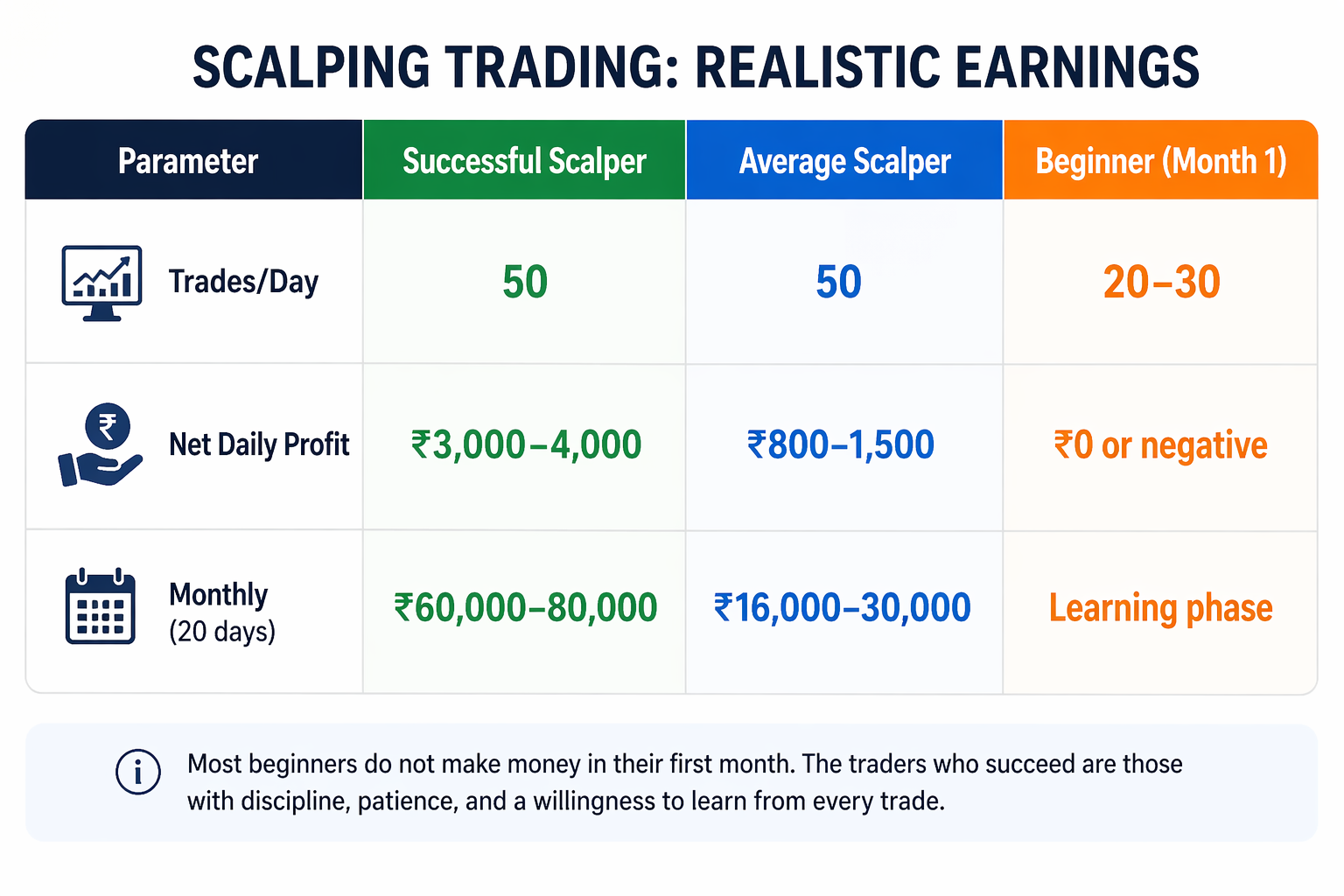
Most beginners do not make money in their first month. The traders who succeed are those with discipline, patience, and a willingness to learn from every trade.
Final Thoughts
Scalping is exciting and can be profitable, but it demands discipline, patience, and months of practice. If you are willing to put in the work, it can become a genuine source of income.
The goal is not to make ₹50,000 per day. The goal is to make ₹500–1,000 per day consistently. Start small. Learn slowly. Be patient. And never risk money you need.
Ready to start? Open your free Demat & trading account with GoPocket today.
www.gopocket.in/open-account-call-back
Disclaimer: This blog is for educational purposes only and should not be construed as financial advice. Investments in the securities market are subject to market risks. Read all related documents carefully before investing. Past performance is not indicative of future results. Trading involves substantial risk of loss and is not suitable for every investor. GoPocket does not guarantee any returns. Please consult a qualified financial advisor before making any investment decisions.
Disclaimer
What's Trending
Buy Property Or Buy A REIT? The Numbers May Surprise You
August 20, 2026
NPS vs PPF: Which Is Better for Retirement?
June 30, 2026
Recent Blog


.jpeg)

Blog
Recent Blogs





Open your GoPocket Account within 5 minutes.
Have any queries?
Get support

Investing and trading is made simple, affordable and accessible for every Indian.



© Made with ❤️ in Coimbatore, India | Copyright © 2023 onwards, GoPocket.