
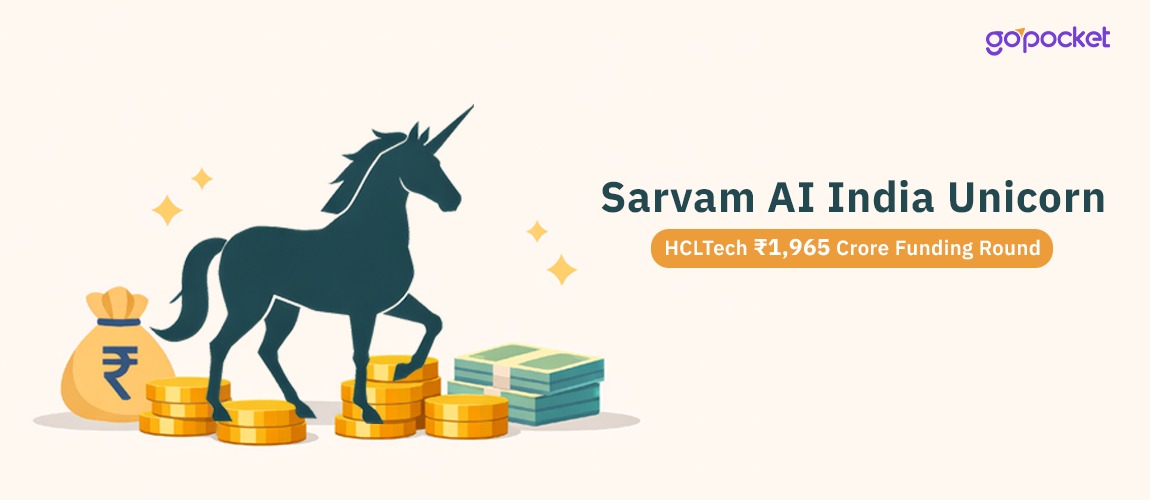


She Was Talking to an AI in Telugu. She Had No Clue. That Conversation Just Raised ₹1,965 Crore.
How Sarvam AI became India's newest unicorn — and what it quietly means for your investments.
Kavya is 58. No internet. No English. Lives in a small town in Andhra Pradesh.
Last year she got a call. The voice spoke Telugu — her words, her rhythm. It asked about her crops, her income, a government scheme she might qualify for.
She answered like it was a neighbour. It wasn't.
That call was built by Sarvam AI — India's full-stack homegrown AI company. On June 15, 2026, the same startup raised ₹1,965 crore and crossed a $1.5 billion valuation, making it India's newest AI unicorn.
So why should you care? Because this isn't just a tech story. It's a money story.
The AI Nobody Built for India — Until Now
Sarvam AI was founded by two IIT Madras researchers — Vivek Raghavan and Pratyush Kumar. Their question was simple and stubborn: why does every major AI tool work brilliantly in English and stumble the moment someone speaks Tamil or Gujarati?
So they built one that doesn't stumble.
Their homegrown large language model (LLM — the brain behind tools like ChatGPT) supports all 22 official Indian languages. It handles voice, text, documents, forms — the works.
The numbers running today: 20 lakh conversations daily, 3.5 crore pages digitised every month, 4.5 crore insurance policyholders reached, and — this one's wild — crop data collected from 1.7 crore farmers for the Ministry of Agriculture.
Farmers who've never used a smartphone. Talking to AI. In their own dialect.
HCLTech Just Wrote a ₹1,427 Crore Cheque. Here's Why.
The lead investor is HCLTech — 2 lakh employees, global clients, decades of enterprise deals. They put ₹1,427 crore in for a 10.46% stake. Bessemer Venture Partners, Khosla Ventures, and Peak XV came in alongside.
One year ago, Sarvam AI India's valuation was ₹1,635 crore. After this round: ₹12,500 crore. That's nearly 8x in twelve months.
HCLTech's bet isn't emotional. It's strategic. Its entire business — helping global corporations use technology — is about to be rebuilt on AI. If you own a stake in the company that builds India's AI stack, you're not chasing the wave. You're already on it.
Sarvam gets HCLTech's enterprise network in return. In startup language, that's distribution — the thing most companies spend a decade trying to build. They got it in one deal.
The Week Before This Deal, America Did Something Alarming.
One week before Sarvam's announcement, the US government restricted access to certain advanced AI models — blocking foreign users overnight, citing national security.
Indian companies that had built products on those tools? Locked out. No notice. No timeline.
"When the most important technology in the world is owned by another country, you are always one government decision away from being cut off."
— Vivek Raghavan, Co-founder, Sarvam AI
India is the second-largest AI market in the world. We use more AI tools than almost any other country. But we barely build any of it.
The IndiaAI Mission — a ₹10,372 crore government programme — picked Sarvam in April 2025 to build India's first sovereign AI model from scratch. Not fine-tuned from someone else's model. Built here. With Indian data. For Indians.
That's the real story. The funding is just the headline.

What This Means If You Invest in Indian Markets
HCLTech (NSE: HCLTECH) reacted positively when the deal broke. If Sarvam AI's models become standard in Indian banking, insurance, and government — HCLTech sits at the centre of every rupee of that spend.
One large fintech has already deployed Sarvam across a 3.5 lakh-strong salesforce — customer queries answered, deals closed, in the customer's own language. When banks and NBFCs scale this, margins improve. That shows up in quarterly results.
The IndiaAI Mission has ₹10,372 crore to deploy over five years. Sarvam is the chosen builder. That's not a pilot. That's a government revenue pipeline.
And if HCLTech sells Sarvam's models to its global clients, India goes from AI consumer to AI exporter — a shift not seen since the outsourcing wave of the 1990s.
The Part Nobody's Saying Loudly Enough
OpenAI, Google, and Meta are all building multilingual AI. Open-source models improve every month and they're free. Enterprise clients won't pay for Sarvam because it's Indian. They'll pay only when it's provably better.
And an 8x valuation jump in twelve months means the pressure to deliver is enormous. One slow quarter — or one competitor who cracks Indian language AI better — and the story changes.
The One Thing Worth Watching
You can't buy Sarvam AI shares — it's private. But watch HCLTech's next two earnings calls. Listen for AI services revenue. That's your signal.
Watch the IndiaAI Mission announcements. ₹10,372 crore will move through Indian companies over five years. Track who benefits.
And Kavya — the farmer who spoke to an AI in Telugu without knowing it? She isn't the point of this story. She's the proof of it.
Bottom line:
India's AI bet isn't about technology. It's about not being left behind when the next country decides to shut its valve.
Want to track how shifts like Sarvam ripple into your portfolio? GoPocket breaks down market-moving stories every week — no jargon, no noise.
People Also Ask
What is Sarvam AI India? An Indian startup building AI models from scratch in 22 Indian languages — used across banking, insurance, agriculture, and government services.
Is Sarvam AI an Indian AI unicorn? Yes. After its June 2026 Series B, Sarvam crossed a $1.5 billion valuation — ₹12,500 crore — making it one of India's only AI unicorns alongside Krutrim.
What is the IndiaAI Mission? A ₹10,372 crore government programme to build India's own AI infrastructure. Sarvam was selected to build India's first sovereign large language model.
Why does sovereign AI matter for India? When the US restricted AI model access in June 2026, Indian companies were locked out overnight. Sovereign AI means India owns and controls the tech — so nobody else controls your access.
How does Sarvam AI affect HCLTech investors? HCLTech invested ₹1,427 crore for a 10.46% stake. If Sarvam's models become standard in enterprise and government deployments, HCLTech gains a direct AI revenue stream across its global client base.
Disclaimer: Investments are subject to market risk. Please read all scheme-related documents carefully before investing. This blog is for educational purposes only and does not constitute investment advice. GoPocket is a SEBI-registered intermediary.
Disclaimer
What's Trending
NSE F & O Explained: How Traders Earn in Just 2 Hours a Day | GoPocket
September 15, 2025
Master The Art Of Spread Trading In Options
August 15, 2026
From News to Profits: Stock Tips for Smarter picks
July 31, 2025
Recent Blog

.jpeg)

Blog
Recent Blogs



Open your GoPocket Account within 5 minutes.
Have any queries?
Get support

Investing and trading is made simple, affordable and accessible for every Indian.



© Made with ❤️ in Coimbatore, India | Copyright © 2023 onwards, GoPocket.