
.png)


Ten shares that shouldn’t decide anything
A stock trades all day between ₹1,000 and ₹1,010. Crores of rupees change hands.
Then at 3:29 pm, someone sells 10 shares at ₹980.
Should those ten shares decide your mutual fund NAV tonight? Your portfolio value tomorrow? Your collateral worth?
Obviously not. And that single question is why the Indian stock market is changing how it computes the stock market closing price from August 3, 2026.
The change is called the Closing Auction Session (CAS) — and for a big list of stocks, trading will now stop at 3:15pm, not 3:30.
Quick answer: What is the Closing Auction Session?
The Closing Auction Session (CAS) is a SEBI-mandated end-of-day window, effective August 3, 2026, where all buy and sell orders are pooled and matched at one single “equilibrium price.” That price becomes the official stock market closing price, replacing the older VWAP method. In Phase I, CAS applies only to stocks with F&O contracts on both NSE and BSE.
Why the closing price matters more than you think
It isn’t just a number on a screen. It’s plumbing.
● Nifty and Sensex levels are built from closing prices
● Mutual fund NAVs are calculated from them — your SIP units depend on it
● F&O final settlement on expiry day uses the underlying’s closing price
● Your P&L reports and pledged collateral value are both anchored to it
A bad closing price isn’t cosmetic. It’s a wealth-transfer problem.
The old system: VWAP
Since the last traded price is easy to distort, exchanges used VWAP — Volume Weighted Average Price:
VWAP = Sum of (Price × Volume) ÷ Total Volume
Bigger trades count more, so ten stray shares can’t hijack the close. Sensible.
But here’s the catch: VWAP is an average of trades that already happened, scattered across time. A buyer at 3:04 and a seller at 3:19 never actually met.
And when a mutual fund needs to sell ₹200 crore near the close, it slices the order into hundreds of pieces — each one nudging the price down. Everyone gets a worse deal.
VWAP is a photograph of the past. CAS is a poll of the present.
CAS: from a queue to a town hall
Remember it this way.
Continuous trading is a queue. People arrive one at a time, deal, leave.
A closing auction is a town hall. Everyone walks into one room, states what they’d pay or accept, and one price is announced that lets the maximum number of people trade.
Which one gives you a more honest price?
This is why NYSE, LSE and most major global exchanges already run closing auctions. India is joining a standard, not inventing one.
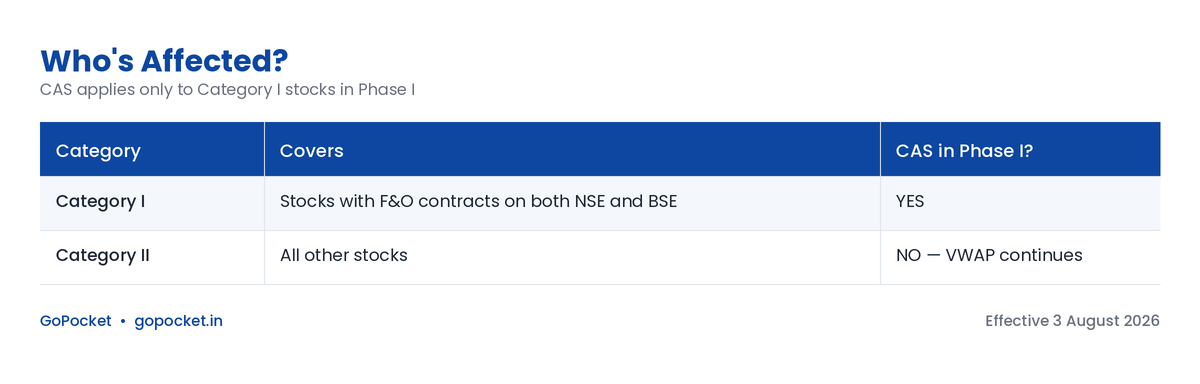
● CAS stocks: trading stops at 3:15 pm
● Non-CAS stocks: normal till 3:30 pm
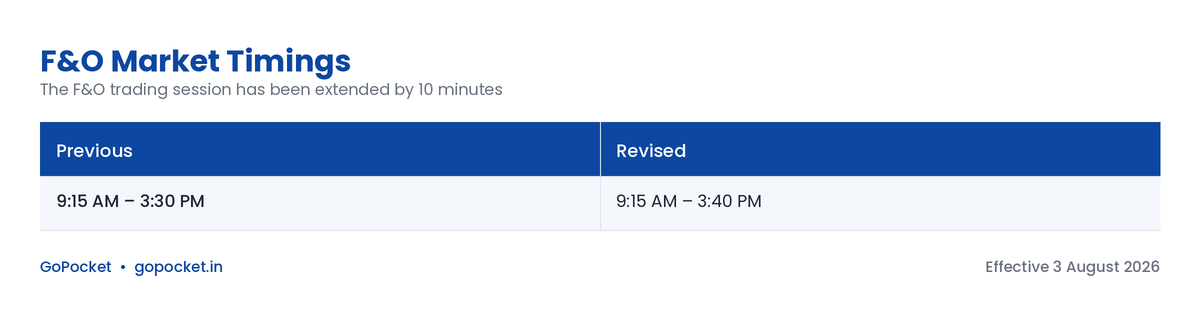
● Derivatives: open till 3:40 pm
For the first time, the cash and derivatives markets run on different clocks.
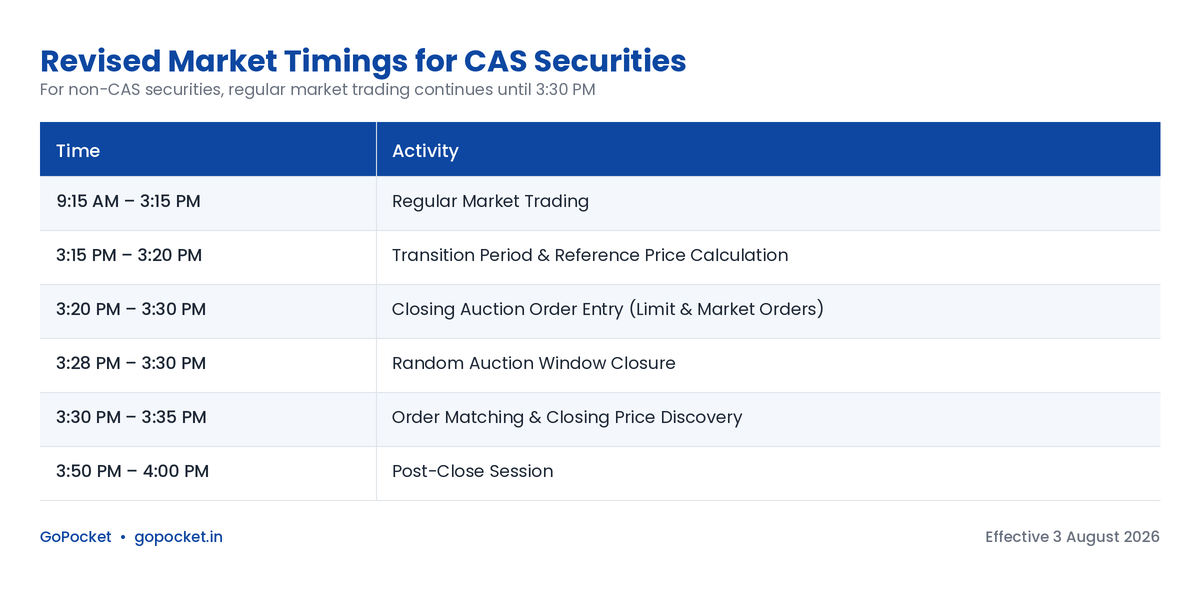
Smartest detail: the random close
Why does Session II end at a random second instead of exactly 3:30?
Because a fixed deadline invites gaming. Fast players would wait, watch the indicative price, then flood orders in the last 200 milliseconds to yank the close their way.
You can’t time a moment nobody knows. One small rule, a lot of retail protection.
How the equilibrium price is decided
Two common-sense truths:
● A buyer willing to pay ₹1,010 will happily buy at ₹1,005
● A seller willing to accept ₹1,000 will happily sell at ₹1,005
So the exchange asks one question: at which price can the most shares actually trade?
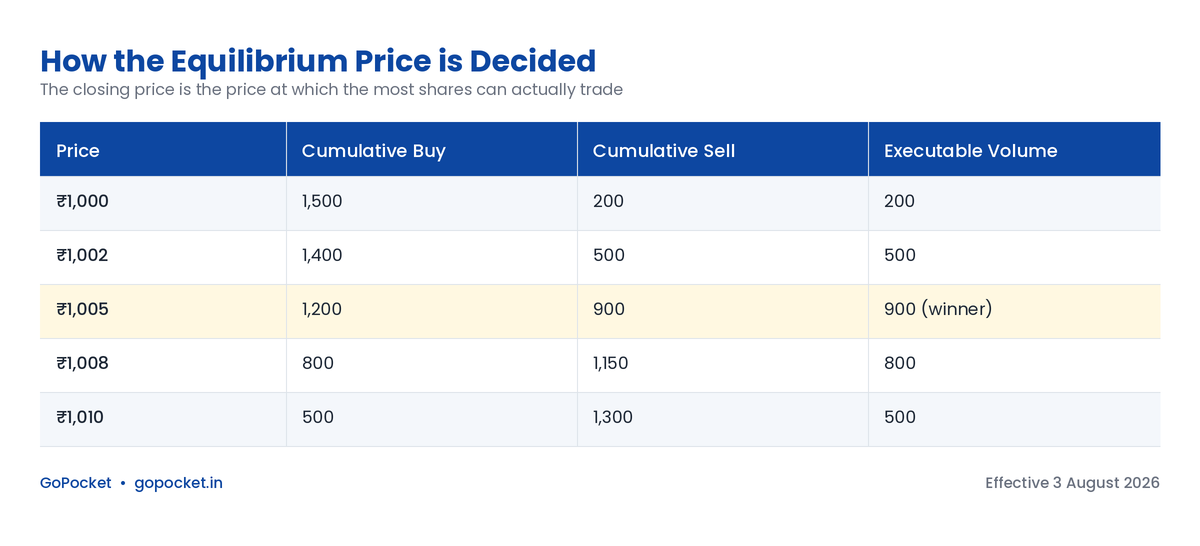
Executable volume is simply the lower of the two columns. ₹1,005 wins — that’s the closing price.
Tie-breakers: highest volume → smaller imbalance → closest to reference price. If no equilibrium price emerges at all, the reference price becomes the close.
So the closing price is now the price that makes the most people trade — not the price that happened to be last.
Revised Intraday Square-Off Timings
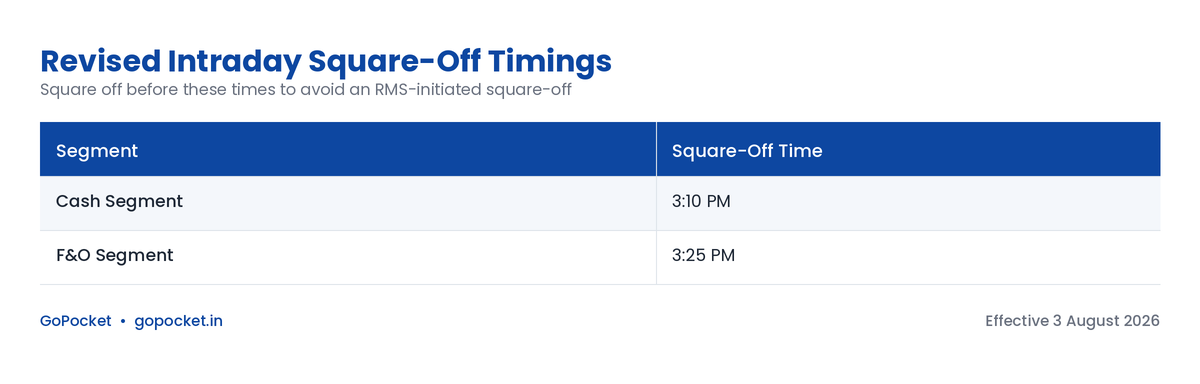
Kindly ensure that all intraday positions are squared off before the above timings to avoid RMS-initiated square-off.
F&O Market Timings
The F&O market trading session has been extended:
What Happens to Open Orders?
• Pending Limit Orders in CAS-eligible stocks will participate in the Closing Auction Session as per Exchange rules.
• Stop Loss (SL) and Iceberg Orders in CAS-eligible stocks may be cancelled at the commencement of CAS as per Exchange guidelines.
• GTT Orders for CAS-eligible stocks will be eligible for triggering only up to 3:15 PM. For non-CAS stocks, GTT orders continue until 3:30 PM.
• Futures orders placed outside the applicable ±3% CAS price band will be cancelled by the Exchange. This does not apply to Options orders.
Important:
We recommend reviewing your open orders before 3:15 PM each trading day.
Why CAS is a genuine upgrade
● Better price discovery — one pool, one price, everyone visible at once
● Cheaper large orders — big buyers and sellers finally meet
● Lower tracking error for index funds and ETFs — a quiet win for passive investors
● Harder to manipulate the close — random close + price band + single-price matching
● Live transparency during the auction
● Global alignment with how the world’s largest markets already work.
Disclaimer:
This blog is for educational purposes only; not investment advice. Investments in the securities market are subject to market risks. Timings and rules are as per publicly available SEBI and exchange communications and may change .
Disclaimer
What's Trending
Recent Blog

.jpeg)

Blog
Recent Blogs





Open your GoPocket Account within 5 minutes.
Have any queries?
Get support

Investing and trading is made simple, affordable and accessible for every Indian.



© Made with ❤️ in Coimbatore, India | Copyright © 2023 onwards, GoPocket.