
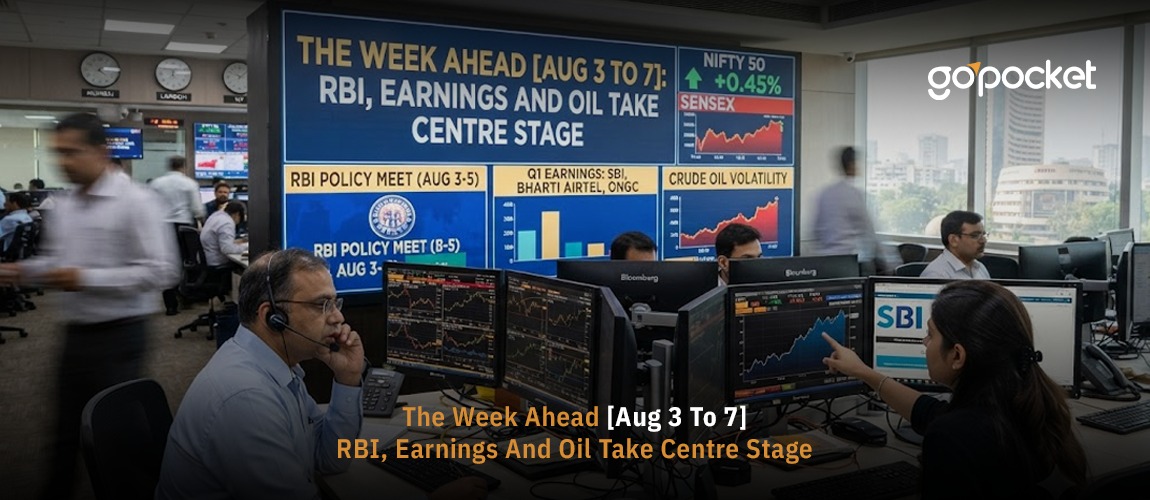


Monday has already given the Indian market a strong opening signal. The Nifty 50 climbed 0.67% to 24,546.80, while the Sensex gained 0.66% to 78,613.05 on August 3. A sharp fall in Brent crude, resilient corporate earnings and positive auto sales helped lift sentiment across Dalal Street.
But here is where the week gets interesting.
The market now has to digest an RBI policy decision, a heavy Q1 FY27 earnings calendar, changing crude oil expectations and global uncertainty linked to the US-Iran situation. The US Federal Reserve has also kept its policy rate at 3.5% to 3.75%, leaving global investors focused on inflation, growth and the timing of future rate moves.
So, where could the Indian market head between August 3 and August 7?
Rather than trying to predict a single direction, investors may be better served by understanding the forces that could push the market in either direction.
1. RBI Policy Is The Week's Biggest Domestic Trigger
The Reserve Bank of India's Monetary Policy Committee is meeting from August 3 to August 5, with the policy decision scheduled for August 5.
The market is widely expecting the RBI to maintain the existing policy rate, although the real focus may be on what the central bank says about inflation, growth, liquidity and external risks.
This distinction matters.
A rate decision itself may not surprise the market if a pause is already expected. The bigger market reaction could come from the RBI's assessment of inflation and the risks created by crude oil and geopolitical uncertainty.
For investors, the key question is therefore not simply:
"Will the RBI cut or hold rates?"
It is:
"What does the RBI's commentary tell us about the months ahead?"
A steady policy combined with confidence in domestic growth could provide stability to financial markets. On the other hand, a cautious tone around inflation or oil could keep investors defensive.
Banking, financial services, rate-sensitive sectors and the broader interest-rate-sensitive economy could therefore remain in focus through the week.
2. Q1 Earnings Are Moving From Numbers To Narratives
The earnings season is entering an important phase. More than 500 companies are scheduled to announce their June-quarter results this week, including heavyweight names such as State Bank of India, Bharti Airtel, Trent, Nykaa and Titan.
This means the market could see stock-specific movements even if the broader indices remain relatively calm.
But investors should look beyond the headline profit number.
A company's quarterly result can tell several different stories.
Revenue growth can show whether demand is holding up. Margins can reveal the impact of input costs. Management commentary can provide clues about future demand, expansion and business conditions.
This is particularly important in a market where expectations can already be high.
A company can report higher earnings and still see its stock react negatively if investors were expecting even more. Another company can deliver modest numbers but receive a positive response if the outlook improves. That is why this week's earnings calendar is not just about who reports.
It is about what managements say after reporting.
Bharti Airtel, Titan, SBI and Trent in Focus
Bharti Airtel is scheduled to announce its Q1 FY27 results on August 4, according to the company's published results calendar. Other major names such as SBI, Trent and Titan are also among the companies attracting investor attention this week.
The importance of these companies extends beyond their individual stocks. Their results can offer investors a broader picture of consumer demand, banking activity, telecom trends and discretionary spending.
In other words, earnings season is becoming a window into the health of India's economy.
3. Crude Oil Has Become The Market's Wild Card
If there is one global variable Indian investors should not ignore this week, it is crude oil.
India imports a substantial share of its crude oil requirements, making oil prices important for inflation, the rupee, corporate costs and the country's external balance. And oil has already changed the mood of the market.
Brent crude fell sharply on August 3 after signals of possible talks between the US and Iran. The decline supported Indian equities because lower crude prices can reduce pressure on India's import bill and inflation outlook.
But this is where investors need to be careful. Geopolitical headlines can change quickly. A further decline in crude could support sentiment. A sudden escalation in tensions could reverse that move just as quickly.
For the Indian market, therefore, crude is no longer just a commodity story. It is a macroeconomic signal.
4. The Rupee And Foreign Flows Need Watching
The rupee also enters this week with an important backdrop. According to Reuters, the currency recorded its strongest weekly gain since March, supported by RBI intervention and dollar inflows. At the same time, foreign investors have been selling Indian bonds, while remaining net buyers over the previous two months.
Why does this matter for equities?
Because currency movements, foreign flows and bond yields are closely connected to global investor sentiment. A relatively stable rupee can reduce pressure on imported inflation and improve overall market confidence. But if global risk sentiment deteriorates, emerging markets can still face sudden shifts in foreign capital. Investors should therefore watch the rupee alongside the Nifty rather than treating them as separate stories.
5. Global Markets Are Still Setting The Background Tone
The Indian market does not operate in isolation.
The US Federal Reserve has maintained the federal funds target range at 3.5% to 3.75%. The Fed has also noted that economic activity remains solid, while inflation is still above its 2% objective and uncertainty remains elevated.
The next major Fed minutes are due on August 19, so there is no fresh US rate decision during this week.
That shifts attention toward incoming economic data, US employment indicators, global bond yields and geopolitical developments.
For Indian investors, the takeaway is simple: global cues may not dominate every trading session, but they can quickly amplify domestic developments.
6. What Could Keep The Indian Market Supported?
The current setup has several positive factors.
• Strong domestic participation: Indian markets continue to benefit from domestic investor participation, which can provide a cushion when global flows become volatile.
• Earnings resilience: The Q1 season has so far produced a mixed but generally resilient picture, with several major companies delivering results that have avoided major negative surprises.
• Lower crude: The latest decline in oil prices is favourable for an oil-importing economy such as India.
• Domestic growth: The RBI's policy communication will be closely watched for its assessment of India's underlying economic momentum.
• Broad market participation: Monday's session saw gains across most sectors, while small- and mid-cap indices also advanced.
These factors could help the market absorb short-term shocks.

7. What Could Spoil The Party?
Markets rarely move on one factor alone. A sudden rise in crude oil would bring inflation concerns back into focus. A hawkish RBI message could pressure rate-sensitive segments.
Disappointing earnings from heavyweight companies could affect broader sentiment. And a fresh escalation in geopolitical tensions could trigger a risk-off move across global markets. There is also another important lesson from Monday. Not every stock participated equally.
While financial stocks and several sectors advanced strongly, individual companies also reacted sharply to company-specific developments. Zee Entertainment, for example, fell 11.3% following regulatory action reported on Monday. This is a reminder that even when the index looks healthy, individual stocks can tell a very different story.
The Investor's Checklist For August 3 To August 7
Instead of asking, "Will Nifty go up this week?", investors can track five questions:
1. What does the RBI say on August 5?
Watch the commentary, not just the rate decision.
2. What are heavyweight companies saying about demand?
Look beyond quarterly profit and focus on management commentary.
3. Where is crude heading?
A sustained decline could be supportive, while a sharp reversal could change the inflation narrative.
4. What is happening with the rupee and foreign flows?
These can provide clues about global risk appetite.
5. Are market gains broadening or becoming concentrated?
A healthy market is not simply about the index moving higher. Participation across sectors and market segments matters too.
The Bigger Picture
The August 3 to August 7 week is shaping up as a classic data-over-noise week. The Nifty has started strongly, but one good session does not define the entire week. The RBI could reshape interest-rate expectations. Earnings could determine stock-specific momentum. Crude could influence inflation expectations. Global developments could change risk appetite overnight.
That makes the week less about predicting the next market move and more about understanding what could cause it.
For investors, that is perhaps the most useful market outlook of all. Markets do not come with a weekly answer key. They come with signals. The smarter approach is to know which signals matter before reacting to the noise.
This week, keep the focus on RBI policy, Q1 earnings, crude oil, the rupee and global cues. A strong opening can create excitement, but informed decisions require looking at what is happening beneath the index.
Disclaimer :
For educational purposes only; not investment advice. Investments in the securities market are subject to market risks. Data is as of the publication date and may change.
Disclaimer
What's Trending
India Tax Guide 2026: New vs Old Regime Explained
March 19, 2026
What Makes Silver Prices Move & How to Invest Wisely
January 23, 2026
Recent Blog


.jpeg)

Blog
Recent Blogs





Open your GoPocket Account within 5 minutes.
Have any queries?
Get support

Investing and trading is made simple, affordable and accessible for every Indian.



© Made with ❤️ in Coimbatore, India | Copyright © 2023 onwards, GoPocket.