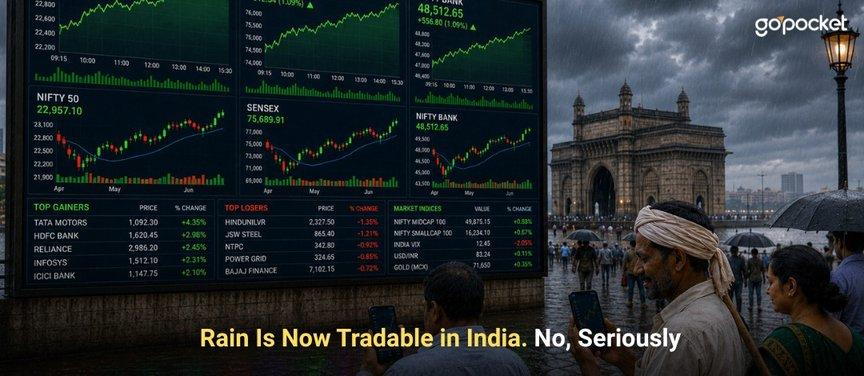
Rain Is Now Tradeable in India.
No, Seriously.
The Story
It's June. The monsoon is three weeks late.
Ravi runs a small mango orchard in Nashik. His seeds are in the ground, his loans are already drawn, and every morning he checks the sky hoping for clouds. Nothing.
A bad monsoon doesn't just hurt Ravi. It ripples — lower rural income, less spending in nearby towns, higher vegetable prices in city supermarkets, slower sales for FMCG brands. One late monsoon. A thousand economic consequences.
And here's the thing.
Until very recently, there was nothing Ravi — or any business in his position — could do financially to protect themselves from that kind of weather risk.
But India just changed that.
Meet RAINMUMBAI.
India's NCDEX — the same exchange where soybean and guar are traded — has quietly launched something extraordinary.
A futures contract. Whose underlying asset is... rainfall.
You can now, technically, trade the monsoon.
Before you close this tab — stay with us. This is one of the most fascinating financial stories of 2026. And once you get it, you'll never look at a cloudy sky the same way.
So, How Does This Work?
Let's start with the basics.
A derivative is a financial contract whose value depends on something else. Gold futures depend on gold prices. Oil futures depend on crude. Currency forwards depend on exchange rates.
RAINMUMBAI is a derivative whose value depends on how much it rains in Mumbai — compared to Mumbai's historical normal of 2,206.7 mm per monsoon season.
Every day of the monsoon, NCDEX records actual rainfall in Mumbai and compares it to the average for that date. More than normal? Positive score. Less than normal? Negative score. Add up all those daily scores across the full season. That final number is what the contract settles at.
Think of it like a running tally. Every rainy day above average adds points. Every dry day below average subtracts them. The season-end total decides who wins and who loses on the contract.
Your Investment Journey Starts Here
Okay… But Why Would Anyone Actually Need This?
Here's what most people miss.
Rain isn't just weather in India. It's an economic variable.
46% of India's workforce depends on agriculture. When the monsoon fails, farm incomes crash — and that crash ripples all the way to consumer spending, bank loan books, and FMCG quarterly results.
Power companies depend on reservoir levels. Dry season = low water = expensive electricity. Outdoor event businesses in Mumbai lose bookings every year to heavy rains. Port operations slow down. Supply chains back up.
Over the last 30 years, India has lost around $180 billion to extreme weather. Most of it? Absorbed silently. No insurance. No hedge. Just loss.
A rainfall futures contract is, at its simplest, a way to give businesses a financial cushion against something they couldn't control before.
An outdoor event company in Mumbai could buy a position that profits if the monsoon overperforms — so when rains cancel their July weddings, the contract gain partially covers the loss. A crop insurer hedges its payout exposure. A hydropower company plans for dry years.
That's hedging. That's what derivatives were invented for.
But Here's the Catch.
(There's always one.)
RAINMUMBAI tracks Mumbai's rainfall. Only Mumbai's.
If you're a farmer in Vidarbha, a textile mill in Coimbatore, or a hotel in Rishikesh, Mumbai's monsoon data doesn't really tell your story. The mismatch between what the contract pays you and what you actually lose is called basis risk. And it's real.
Think of it this way — one neighbourhood in Mumbai can be underwater while another stays dry. A contract tracking the whole city average may not reflect what you experienced. Scale that up across India, and the problem becomes obvious.
There's also the speculation question. Once any market opens, traders who have zero real weather exposure will arrive — purely to profit from price movements. That's not automatically bad (they add liquidity, which helps genuine hedgers). But if speculation dominates, prices start reflecting trading bets more than actual monsoon conditions.
Both concerns are real. Both are worth knowing.
Invest Better by Learning More
The Bigger Picture
Here's what this story is really about.
Climate change is no longer just an environmental problem. It's a financial one.
Markets have always done this — when uncertainty becomes too economically costly to ignore, they build tools to price, trade, and manage it. Interest rates became tradable. Volatility became tradeable. Now the weather is following.
RAINMUMBAI isn't the end. If it works, expect temperature contracts, drought indices, and flood derivatives for other cities. India is building financial infrastructure for a world where weather is a balance sheet line item — not just background noise.
Financial markets can't stop the rain. But they can help businesses survive it.
And that, in a country that has absorbed $180 billion in weather losses over 30 years with almost no financial tools, is a genuinely big deal.
What Should You Take Away From This?
If you're a retail investor, you probably won't trade RAINMUMBAI tomorrow. That's fine.
But understanding that monsoon performance drives FMCG demand, food inflation, power sector margins, and rural consumption — and that Indian markets are now building financial tools around that reality — makes you a sharper investor. Full stop.
At GoPocket, we build exactly this kind of thinking. Connect the dots between the real world and financial markets, and you'll always see opportunities — and risks — that others miss.
Until next time — watch the skies. They're worth more than you think.
Investments are subject to market risks. This content is for educational purposes only and does not constitute investment advice. GoPocket is a SEBI-registered intermediary.