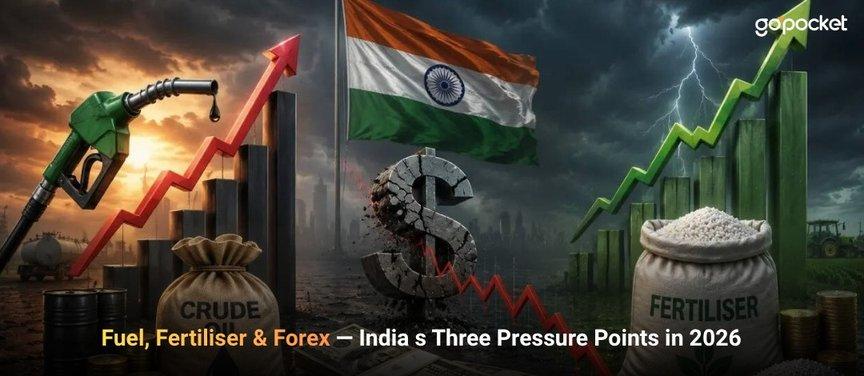
India's Silent Money Crisis: The 3F Problem Nobody's Talking About
Why your next coffee might cost more, your rupee is dying, and the government's biggest problem isn't in Delhi.
Here's the plot twist: India's economy is actually doing well. Growth is solid. Jobs are being created. Stock markets are hitting new highs.
So why did Finance Minister Nirmala Sitharaman recently issue what amounts to a quiet warning that made zero headlines?
She flagged something called the 3Fs: Fuel, Fertiliser, and Foreign Exchange. And here's the kicker—these three things are silently bleeding India's wallet dry. Most people have no idea it's happening.
This isn't a crisis yet. But it's becoming one. And unlike problems governments can control, these three are completely out of India's hands.
The Problem: We're Addicted to Imports We Can't Afford
Imagine earning ₹1 lakh monthly while your family thrives. Perfect, right? Except 85% of the cooking gas you use comes from your neighbour's supply line.
When the neighbour raises prices, you have two options: Pay more (everyone suffers) or use less (your family suffers). There is no third option.
That's India with oil. Except it's much worse.
The First F: Fuel-When Prices Become Weapons
India imports 85% of its crude oil. We're not talking about luxuries. We're talking about oil powering tractors, buses, trucks, factories, and power plants.
Right now? Global crude prices are high due to Middle East tensions, sanctions, and supply disruptions.
Here's the twist: The government slashed taxes on petrol and diesel to protect citizens. Noble, right?
The government lost roughly ₹1 lakh crore in annual revenue.
That's not just a number. That's:
• 10,000 primary schools that won't be built
• 50,000 km of rural roads unrepaired
• Thousands of hospital beds have not been added
All to keep fuel slightly cheaper.
The invisible part: Fuel doesn't just affect your car. It affects everything connected to movement—delivery charges for your online orders, restaurant prices, electricity bills, and juice costs. Everything that moves or requires energy becomes more expensive.
The Second F: Fertiliser—The Crisis Brewing Underground
Global fertiliser prices have exploded due to supply collapse, export restrictions, and supply chain disruptions. The FM literally described prices as reaching "unimaginable levels."
Here's what farmers face:
Last year: Fertiliser cost ₹40/kg. This year? ₹80-₹120/kg. But their crop's selling price increased only 10-15%, if lucky.
A farmer planning ₹50,000 profit now faces ₹60,000+ in fertiliser costs alone. They're looking at losses before planting anything.
Some just stop farming.
The government's expensive mercy: They subsidise fertiliser to keep farmers from going bankrupt. This sounds humane, but financially devastating.
The budget is already squeezed from fuel subsidies. Add fertiliser subsidies, and money meant for healthcare, education, and defence gets redirected to subsidies instead.
The hidden consequence: If fertiliser stays expensive and subsidies run out, food production drops → food prices skyrocket → chaos.
The Third F: Foreign Exchange—The Time Bomb
Every time India buys oil, fertiliser, or machinery from abroad, we pay in foreign currency (dollars, euros). The Reserve Bank maintains India's savings account in foreign currency and gold—called Forex Reserves.
This is supposed to be India's emergency fund.
But here's what's happening: We're withdrawing faster than we're adding.
Import bills are massive (expensive oil + expensive fertiliser = huge dollar outflow). Foreign investment is slowing (fewer dollars coming in). The RBI is buying gold to strengthen reserves (more dollars going out).
The math: Outflows > Inflows = Reserves shrinking = Rupee weakening.
Master The Markets With Gopocket
What this actually means:
An iPhone that cost ₹50,000 a year ago now costs ₹55,000-60,000. Same with medicines, electronics, and imported goods. The rupee lost value.
But there's more dangerous stuff happening.
When the RBI gets worried, it raises interest rates to attract foreign investment. This means:
• Your home loan becomes more expensive
• Your car loan's EMI increases
• Credit card interest spikes
• Businesses hire fewer people
A weakening rupee doesn't just make shopping costlier. It potentially costs people jobs.
Here's The Real Twist Everyone Missed
The Finance Minister can't do anything about any of this.
She can't control global crude prices. She can't force countries to export more fertiliser. She can't will foreign investors to invest in India.
These are external shocks happening to India, not because of India.
Then opposition leaders added a "4th F": Falling Private Investment—arguing that companies not investing in India is also a massive problem.
They might be right.
What's Actually Happening
India's economy is like a high-performance car with a weak fuel tank. Everything under the hood works great. But if fuel gets expensive and the tank leaks, the car stops moving—no matter how good the engine is.
Right now:
• Domestic growth is fine (engine works)
• External costs are rising (fuel's expensive)
• We're running out of foreign currency (tank's leaking)
The government can't fix the engine. It's desperately trying to plug the leak. And it's not working fast enough.
What Happens Next
This isn't a prediction. This is already happening:
Prices keep creeping up. Not dramatically, but consistently. Your monthly grocery bill inches higher every month.
The rupee keeps weakening. International purchases feel more expensive. Travel abroad costs more.
Government services deteriorate slightly. Road repairs slow. School infrastructure ages. Hospital waiting rooms get crowded.
Job security weakens. Not mass layoffs, but companies become cautious about hiring.
All of this is already baked in. It's not a future crisis. It's a present reality that hasn't fully registered yet.
The Uncomfortable Truth
India's biggest economic challenge isn't in Delhi. It's not even in India.
It's in Middle East geopolitics. It's in global fertiliser supply chains. It's in foreign investors' risk appetite.
We can't vote these problems away. We can't policy our way out. We can only manage them and hope global conditions improve.
That's the real story.
The Bottom Line
India's economy is healthy domestically but vulnerable externally. The 3F crisis is real, it's accelerating, and it will affect you—whether you realise it or not.
The question isn't if it impacts your life. The question is: Are you paying attention before it hits?
Because by the time most people notice, it'll be too late to prepare.
Investments are subject to market risks. This content is for educational purposes only and does not constitute investment advice. GoPocket is a SEBI-registered intermediary.