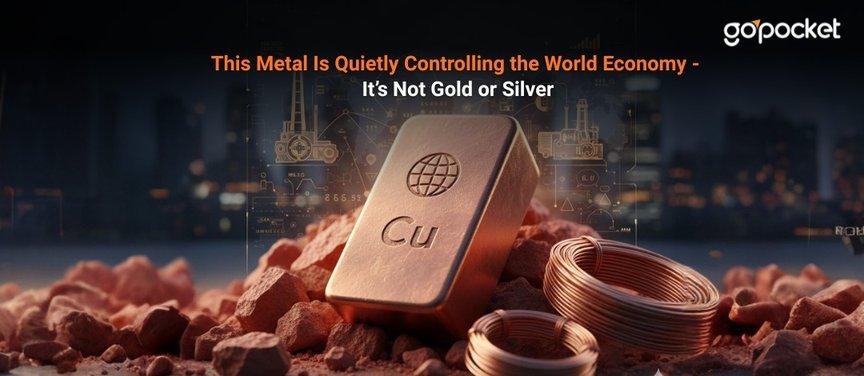
THIS METAL IS QUIETLY CONTROLLING THE WORLD ECONOMY – IT’S NOT GOLD OR SILVER
Every time markets turn uncertain, eyes instinctively move to gold.
When inflation whispers, silver starts trending in conversations.
But while everyone is busy watching these shining metals, one metal is silently shaping Copper and the global economy, influencing how fast the world moves, builds, and grows—without noise, hype, or glamour.
Most people don’t even notice it.
Yet governments, industries, power companies, and global manufacturers track it closely as part of long-term Industrial Metals Trend assessments.
This metal doesn’t protect wealth.
It powers progress.
And that metal is copper.
What makes this even more interesting is what’s happening behind the scenes right now.
In early 2026, global news reports revealed that some of the world’s largest mining companies resumed discussions around major mergers—largely driven by strategic copper assets, a key theme in Copper Market Trends 2026.
At the same time, global agencies warned that copper shortages could become a serious risk for economies pushing rapid electrification and infrastructure expansion.
In simple words, rising base metals demand is colliding with supply limitations.
WHY COPPER RARELY MAKES HEADLINES – YET MATTERS MORE THAN EVER
Copper is not emotional like gold.
It doesn’t symbolise safety or tradition.
Instead, copper shows up everywhere real work happens.
From electricity grids to mobile towers, electric vehicles, renewable energy plants, data centres, metros, factories, and charging stations—copper remains indispensable across energy transition metals infrastructure.
That’s why copper is often called a growth metal.
When the world is building, expanding, and modernising, copper demand rises—an important signal in the broader Commodities Market Outlook.
And right now, the world is doing all three.
WHAT CHANGED IN 2025 – AND WHY 2026 FEELS DIFFERENT
2025 became a turning point for copper.
Global copper price performance strengthened sharply as demand stayed firm while supply struggled to keep pace.
Mining disruptions, slower project expansions, and long approval timelines limited production growth, even as real industrial consumption increased.
This structural imbalance carried into early 2026, reinforcing Copper Market Trends 2026.
International copper benchmarks climbed steadily through 2025, reflecting tight supply and rising industrial demand.
By early 2026, copper traded at elevated levels—not driven by speculation, but by long-term consumption realities shaping the Industrial Metals Trend.
THE BIG FORCES DRIVING COPPER TODAY
Electrification Everywhere
Electric vehicles use significantly more copper than traditional vehicles.
Charging stations, power grids, and battery systems all require heavy copper usage, reinforcing copper’s role among key energy transition metals.
Renewable Energy Expansion
Solar and wind energy rely on strong transmission networks.
Copper forms the backbone of renewable energy infrastructure, quietly increasing consumption with every new project.
Data, AI, and Digital Infrastructure
AI-driven data centers require massive electrical capacity.
Despite the digital narrative, the physical foundation remains copper—critical for wiring, cooling, and power systems.
MCX COPPER: WHY IT MATTERS IN INDIA
In India, MCX copper analysis reflects how global trends influence domestic commodity markets.
MCX Copper captures global demand-supply dynamics, industrial growth signals, currency movements, and international benchmarks.
Movements in MCX Copper are shaped by manufacturing activity, infrastructure spending, and global economic signals, making it more than just a price chart.
Recent movements in Copper futures MCX reflect international supply concerns, currency volatility, and changing industrial demand patterns.
Rather than reacting to noise, MCX Copper mirrors India’s integration into global manufacturing cycles.
IS COPPER A SAFE HAVEN LIKE GOLD? NO – AND THAT’S THE POINT
Gold reacts to fear.
Silver reacts to both fear and industry.
Copper reacts to activity.
When economies expand, electrify, and invest, copper strengthens—accurately reflecting Copper and the global economy rather than emotion-driven sentiment.
WHY COPPER IS CALLED THE “METAL WITH NO NOISE”
Copper rarely trends on social media.
Yet governments budget infrastructure around it, manufacturers hedge it carefully, and energy companies track it closely.
Copper doesn’t shout.
It reflects reality.
WHAT 2026 SIGNALS FOR COPPER
• Base metals demand continues to rise
• Energy transition metals remain in focus
• Infrastructure spending stays strong
• Supply remains constrained
Copper’s relevance in 2026 isn’t about speculation.
It’s about necessity.
For a deeper understanding of how commodities reflect real economic signals beyond price movements, you can also read our detailed GoPocket blog on understanding market signals and global commodity trends:Commodities Aren’t Just Hedges Anymore – A Quiet Shift Every Investor Should Understand | GoPocket
UNDERSTANDING COPPER CHANGES HOW YOU SEE COMMODITIES
Understanding copper reshapes how investors view commodities—not merely as trading instruments, but as mirrors of real economic activity.
Copper doesn’t promise protection.
It represents participation in progress.
A QUIET FINAL THOUGHT
Gold shines when fear rises.
Silver shines when uncertainty meets industry.
Copper shines when the world is working.
And today, the world continues to build—quietly, electrically, and persistently—guided by copper’s steady presence.
WHY THIS BLOG WORKS FOR GOPOCKET
At GoPocket, commodities like copper are understood through education and real-world context rather than headline-driven reactions.
Knowing why copper matters is always more powerful than chasing short-term moves.
Disclaimer
This content is for educational purposes only and not investment or trading advice. Commodity markets carry risk—please do your own research or consult a financial advisor before investing.