
.jpeg)


COMMODITY TRADING FOR BEGINNERS: HOW TO START INVESTING IN MCX WITHOUT GETTING BURNED
"You already interact with commodities every single day."
Not through a trading terminal. Not through a market app. Not through charts.
But through life itself.
• The petrol you fill in your bike.
• The gold jewellery was bought for a wedding.
• The LPG cylinder was delivered to your home.
Commodities quietly influence everyday life.
Yet when people hear the words "commodity trading," the reaction is often very different. "It's risky." "That's not for beginners." "I only invest in stocks." "I've heard people lose money in crude oil."
If any of these thoughts sound familiar, you're not alone.
Meet Sanjay.
For nearly seven years, Sanjay actively followed the stock market. He tracked earnings, read company news, invested in equities, and occasionally participated in IPOs.
One evening, while scrolling through market updates, he noticed headlines about gold prices moving sharply higher. A few days later, crude oil became the centre of discussion due to global developments. Then silver started making news.
Sanjay understood stocks.
But commodities?
That felt like a completely different universe. So, he ignored it. Months turned into years.
And the interesting part? His fear wasn't caused by experience. Assumptions caused it. And that is where many investors find themselves today. Not because commodity trading is impossible to understand. But because nobody has explained it in a way that feels practical, relatable, and beginner-friendly.
Let's change that.
THE REAL REASON MOST BEGINNERS STAY AWAY FROM MCX
Most people assume the biggest obstacle is lack of capital. It isn't.
The biggest obstacle is fear.
Unlike equities, commodities often appear fast-moving and intimidating. News channels talk about gold surges, crude oil crashes, global tensions, supply disruptions, and price volatility.
For a beginner, it can feel overwhelming.
Many investors also hear stories like:
• "Someone lost money in crude oil."
• "Commodity markets move too quickly."
• "Only experts can trade there."
• "You need huge capital."
Over time, these stories create a mental barrier.
The result?
People avoid learning altogether.
Ironically, some of the same investors who spend hours researching stocks never spend even thirty minutes understanding how commodity markets actually work. Fear grows fastest where knowledge is absent. And that's exactly why commodity trading appears far more complicated than it really is.
THE BIGGEST COMMODITY MYTH NOBODY TALKS ABOUT
Let's address a common misconception. Commodity trading is not reserved for market veterans.
Think about it.
There was a time when stock market investing seemed complicated, mutual funds sounded confusing, and there was a time when online investing felt risky.
Today, millions of people comfortably use these financial products because they took the time to learn. Commodities are no different. The challenge is not intelligence. The challenge is unfamiliarity.
Most people are comfortable discussing companies because they encounter brands every day. But they don't spend much time discussing crude oil inventories, gold demand, industrial metals, or energy markets. The lack of exposure creates hesitation. The truth is simple: Every experienced commodity participant started as a beginner.
Nobody was born understanding MCX.
WHY COMMODITY MARKETS MATTER MORE THAN YOU THINK
Many investors unknowingly track commodities already. When gold prices rise, families discuss jewellery purchases. When crude oil prices move, fuel costs become a topic of conversation. When industrial metals fluctuate, manufacturing costs are affected. When global events disrupt supply chains, commodity markets often react quickly. In other words, commodities are not some distant financial concepts. They are deeply connected to economic activity.
This is one reason many market participants choose to learn about commodity markets. Not because they want excitement. But because they want a broader understanding of how different parts of the economy function.
SANJAY'S 90-DAY DISCOVERY JOURNEY
Let's return to Sanjay.
DAY 1
He still believed commodity trading was too risky. But instead of avoiding the subject, he decided to learn. Not trade. Learn.
That distinction changed everything.
FIRST 30 DAYS: OBSERVATION
Sanjay spent the first month simply observing.
He watched how gold prices moved. He noticed that crude oil often reacted to global developments. He learned that commodities had their own drivers and market behaviour. Most importantly, he realised he didn't need to trade immediately. He just needed to understand.
DAYS 31–60: EDUCATION
During the next phase, Sanjay attended educational sessions and followed market discussions. Concepts that once sounded complicated became easier to understand. He discovered that successful participation was not about predicting every move. It was about understanding risk. That realisation was powerful.
DAYS 61–90: BUILDING CONFIDENCE
By the third month, Sanjay was no longer intimidated by commodity markets.
Had he become an expert? No. But he had become informed. And informed decisions are usually better than fearful assumptions. This is an important lesson for beginners.
You don't need to master everything in one week. You simply need to start learning.
The Burned-Hand Problem: Why Beginners Lose Money
Let's address the elephant in the room. People do lose money in commodity markets.
But here's the question: Why?
Many beginners assume losses occur because commodity trading itself is dangerous. The reality is often different. Losses frequently happen because of avoidable mistakes.
COMMONBEGINNER MISTAKES
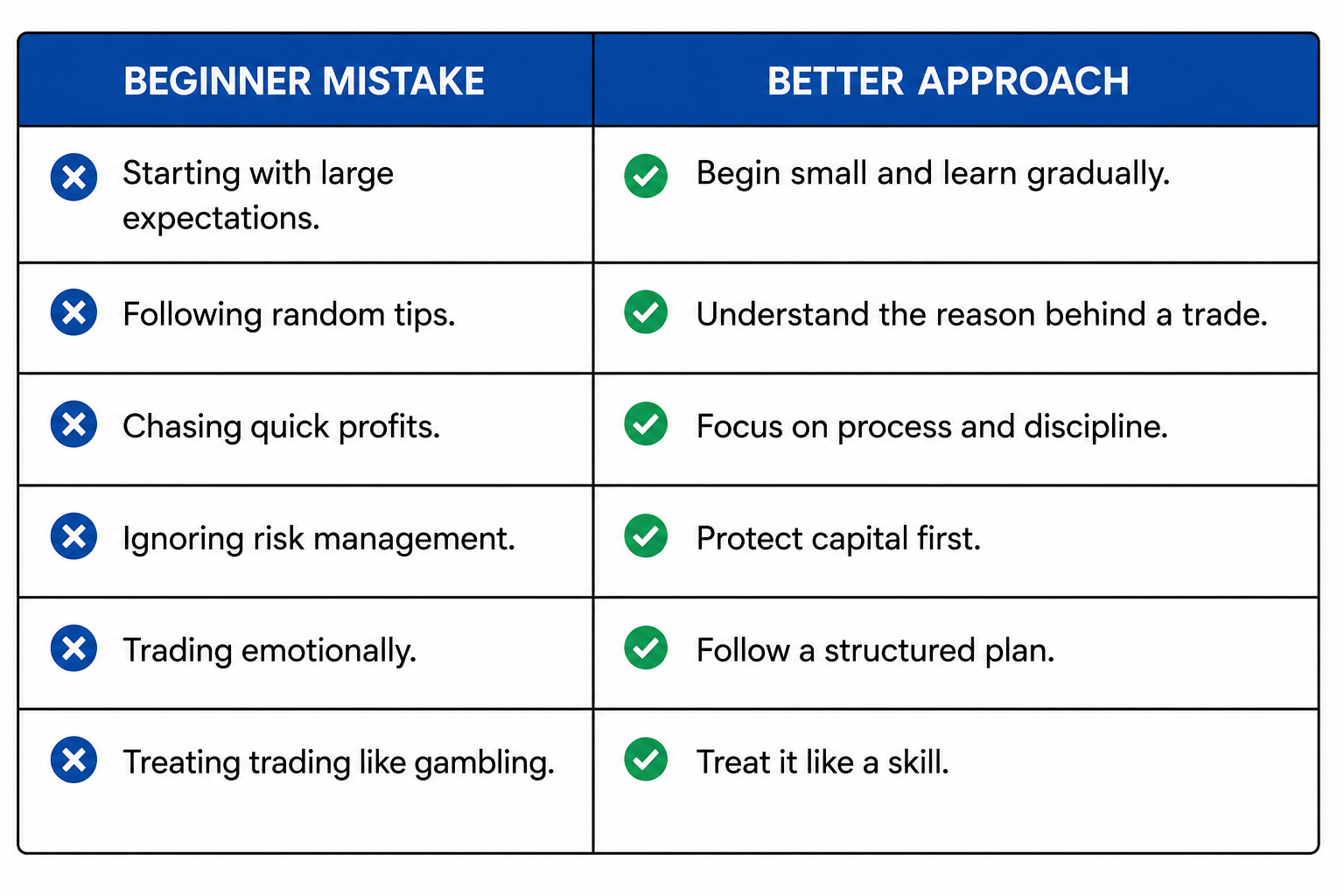
One of the most expensive habits in any market is impatience. Beginners often feel pressure to participate immediately. But markets reward preparation far more than urgency.
The goal is not to trade every opportunity. The goal is to survive, learn, and improve.
BEFORE YOUR FIRST COMMODITY TRADE
Take a moment and remember this.
Commodity trading is not:
A shortcut to instant wealth
A guaranteed income source
A replacement for financial planning
A place where every trade becomes successful
Commodity trading is:
A market that requires learning
A segment that rewards discipline
A space where risk management matters
An opportunity to build knowledge gradually
This mindset alone can save beginners from many avoidable mistakes.
HOW MUCH CAPITAL DO YOU NEED?
One of the most searched questions among beginners is: "Do I need lakhs of rupees to start commodity trading?"
Not necessarily. Commodity contracts vary. Requirements change based on market conditions, exchange regulations, and margin policies. The figures below are only approximate illustrations based on recent market conditions and may change over time.
APPROXIMATE CAPITAL REQUIREMENT (ILLUSTRATIVE ONLY)

*Approximate values only. Actual requirements vary depending on exchange margins, volatility, and broker policies.
The key takeaway?
Commodity trading is not exclusively for large institutions. However, affordability should never be confused with readiness. Just because you can participate does not mean you should rush.
Education comes first.
A BEGINNER-FRIENDLY ROADMAP TO GETTING STARTED
If you're completely new to MCX, here is a practical roadmap.
STEP 1: UNDERSTAND THE BASICS
Learn:
• What moves gold prices
• Why crude oil reacts to global events
• How industrial metals are influenced by demand and supply
• Basic contract specifications
Don't focus on trading yet. Focus on understanding.
STEP 2: WATCH THE MARKET
Spend time observing.
Look at:
• Gold
• Silver
• Crude Oil
• Natural Gas
• Copper
Notice patterns. Observe reactions to news. Develop familiarity.
STEP 3: LEARN RISK MANAGEMENT
Many beginners focus on opportunities. Successful participants focus on risk. Understanding how much risk you are taking is often more important than predicting market direction.
STEP 4: ATTEND EDUCATIONAL SESSIONS
Learning alone is possible. Learning with guidance is often faster. This is where structured education becomes valuable. You can ask questions. Clarify doubts. Understand practical aspects that books and videos may not explain clearly.
STEP 5: START SMALL
If and when you decide to participate, avoid the temptation to begin aggressively. Confidence should be built gradually. Experience compounds over time.
STEP 6: CONTINUE LEARNING
Markets evolve. New developments emerge. Economic conditions change. The learning process never truly ends. And that's perfectly normal.
COMMODITY TRADING IS NOT ONLY FOR FULL-TIME TRADERS
Today, interest in commodity markets comes from equity investors, working professionals, business owners, and individuals who want a broader understanding of economic trends.
THE ROLE OF GUIDANCE IN A BEGINNER'S JOURNEY
The internet offers endless information, but beginners often struggle to identify what is reliable. The right guidance can help reduce confusion and avoid unnecessary mistakes.
LEARNING BEFORE TRADING: A SMARTER APPROACH
At Go Pocket, we've noticed that many people are curious about commodities but hesitate because they don't know where to begin. That's exactly why education matters.
Through free commodity learning sessions, beginner-friendly market discussions, and live market exposure programs, individuals can understand how commodity markets work before making decisions. The focus is not on rushing people into trading. The focus is on helping them learn.
For someone who has spent years believing commodities are too complicated, that guidance can make a meaningful difference.
THE FINAL THOUGHT
Sanjay's biggest mistake wasn't avoiding commodity trading. His biggest mistake was assuming he already knew enough to avoid it. The moment he replaced assumptions with learning, everything changed.
Commodity trading is neither a magic opportunity nor a market to fear blindly. It is simply another segment of the financial markets, one that rewards preparation, discipline, and continuous learning.
You do not need to become a commodity trader tomorrow. But if commodity markets have always felt confusing, intimidating, or out of reach, perhaps the first step isn't trading. Perhaps the first step is learning. Because the biggest risk in commodity trading is not volatility. It is entering a market you never took the time to understand.
And every experienced market participant you admire today once stood exactly where you are now, curious, cautious, and wondering where to begin.
Disclaimer
What's Trending
Recent Blog
.jpeg)

Blog
Recent Blogs




Open your GoPocket Account within 5 minutes.
Have any queries?
Get support

Investing and trading is made simple, affordable and accessible for every Indian.



© Made with ❤️ in Coimbatore, India | Copyright © 2023 onwards, GoPocket.