


The email that just... stopped working
Confession before we start: this blog was probably typed on a laptop running American software, saved to American cloud storage, and will reach you through an American-owned app. We got mildly uncomfortable a few paragraphs in. Good. Keep that feeling.
On a Tuesday morning in Gujarat, a finance team logged into work email like any other day. Nothing loaded. Not a glitch. Not an expired password. The account wasn't theirs anymore.
No hacker did this. A government 7,000 kilometres away sanctioned the company's Russian shareholder, and an American software giant cut off its email, cloud storage and files within hours, for an Indian company, operating entirely in India.
Here's the twist nobody saw coming: the company hadn't broken a single Indian law. It got switched off anyway, because the rules that mattered weren't India's.
That's the real story behind Nayara Energy in 2025. And it isn't really about Nayara. It's about the wiring underneath almost every Indian company that runs on rented infrastructure, and it's the cleanest case study India has for what's now called India's digital sovereignty.
What “digital sovereignty” actually means
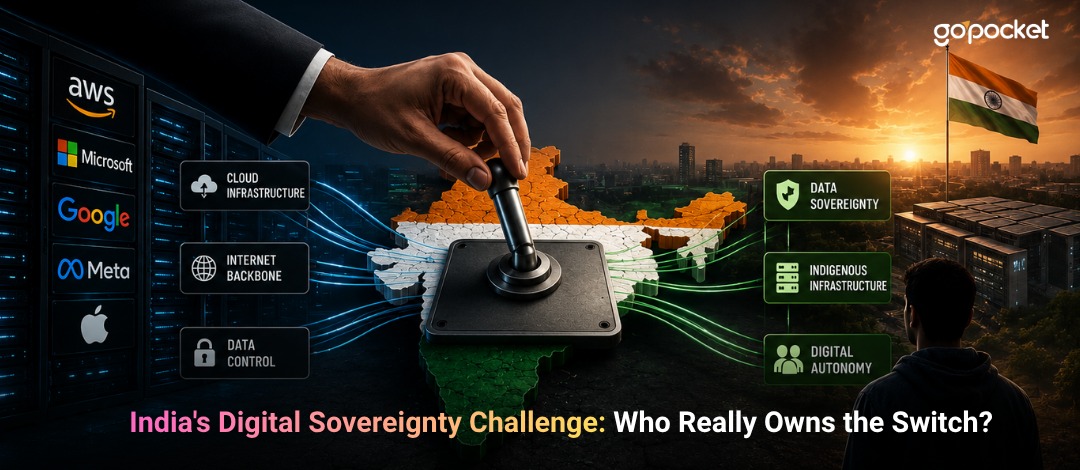
Strip away the jargon, and it's one line: a country's ability to run its own systems without needing anyone else's permission to keep them switched on.
India has mostly treated this as a storage problem. Keep the servers on Indian soil, the data stays safe. That's the thinking behind the Digital Personal Data Protection Act.
But here's the part most people miss. Storage location is the easy half of the test. The harder half is who holds the keys, who can push an update, who can flip the switch off.
Think of it like a locker. You can rent the most secure locker room in the city. But if the bank holds the only master key, were your belongings ever really yours? Or were you just leasing peace of mind?
Be honest, you've probably never asked that question about your own company's cloud setup either.
And here's the uncomfortable upgrade to that thought: it doesn't even take a government order. A vendor's terms-of-service update, a compliance policy changed at 2 a.m. in California, an algorithm flagging your account for “review”- any of these can lock you out just as fast as a sanction did. Nobody needs to declare war on you. Someone just needs to push an update.
The numbers nobody talks about
A few numbers make this real, and they're the part most coverage skips past. About 80% of India's cloud computing runs through three American companies. Over 95% of India's chips are imported, mostly from Taiwan, South Korea, China and Singapore.
That's not cloud dependence as a buzzword. That's a line item sitting inside your own company's server bill.
None of this is anyone's fault. Foreign cloud and chip firms simply built faster, cheaper products. The risk just stays invisible until friction shows up, exactly like it did for Nayara.
When dependence costs more than a headline
Now for the part that should genuinely unsettle you. India saw a sharper version of this in defence, decades ago, and it cost more than downtime. Fighter jets run on software written by companies based abroad, answerable to their own governments first.
During the 1999 Kargil war, India was denied precise GPS access at the exact moment soldiers needed it most, navigating brutal mountain terrain with no satellite eyes overhead.
That's why India built its own satellite navigation system afterwards. Dependence has a habit of showing up at the worst possible time. Never the convenient one.
Plot twist: It took a war to expose the GPS problem. It only took an ordinary Tuesday to expose the email one. The threshold for getting locked out has gotten a lot lower since 1999, and almost nobody noticed.
It's not just India's worry.
India isn't the only country having this realisation, and watching who else is rattled tells you where the money is heading next.
France is moving government departments off foreign software by 2027. Germany, Denmark and the Netherlands are piloting local alternatives to American cloud tools. The EU is funding its own independent cloud backbone. None of them is disconnecting from the world. They just want the off switch in their own hands.
And here's a twist India can actually be proud of: it has pulled this off before. Twenty years ago, foreign card networks assumed they'd always own Indian payments. Then UPI happened. Today India processes transaction volumes those same networks never saw coming, built almost entirely on home-grown rails.
Now picture that same instinct applied a decade earlier to chips or cloud. Would it have guaranteed semiconductor self-reliance overnight? Probably not. But it's the only proof India has that “we built it ourselves” works at scale, which is why the current push into chips, cloud and defence deserves more attention than it's getting.
Why this isn't just Delhi's problem
Every business running payroll on foreign cloud, every fintech storing data on rented servers, carries a smaller version of what Nayara discovered. Sanctions and platform policy changes don't send a warning email first.
Here's the investor angle this blog has been building toward: the same gap that worries security planners is exactly where capital tends to collect. Countries cutting foreign-tech dependence don't fund it quietly; they build entire new industries to plug the gap. That's where defence tech investing themes quietly start to take shape.
A few things are already moving:
● Chip assembly and testing has started in Gujarat's Sanand, through a tie-up with a major American chipmaker. Not the design and fabrication stage yet, but the one right next to it. Real production, not a press release.
● In defence, private companies are now being invited into fighter jet development instead of leaving it only to public sector units.
None of this closes overnight, and India still spends far less on R&D than its global peers. But the direction, in both policy and private capital, is unmistakable: build it at home, stop renting it.
So what should you actually do with this?
● If you invest for the long term: sectors tied to indigenous manufacturing- think semiconductors, defence, domestic cloud- now have sustained government backing behind them, not just a one-off headline.
● If you run a business: the Nayara story is your homework, due tonight. Know where your critical data sits, who holds the access keys, and what your backup plan looks like if access disappears overnight. That costs nothing to check.
And the next time atmanirbhar Bharat shows up in a policy speech, this is what it actually means: not shutting India off from the world, but making sure India doesn't need anyone's permission to keep the lights on when it matters most. India built the world's largest digital network for over a billion people, and somehow still doesn't fully control what that network runs on underneath. The harder work- chips, cloud, code- is only just beginning.
So here's a closing question, not a statement: if your company's cloud account vanished tomorrow the way Nayara's email did, would you know who to call before lunch? If the honest answer is no, that's your sign to go find out. Today, not someday.
Stay alert. Stay invested in the right places. Because the next Nayara moment won't send a warning email either.
Investments are subject to market risk. Please read all scheme-related documents carefully before investing. This blog is for educational purposes only and does not constitute investment advice. GoPocket is a SEBI-registered intermediary.
Disclaimer
What's Trending
Recent Blog


.jpeg)

Blog
Recent Blogs





Open your GoPocket Account within 5 minutes.
Have any queries?
Get support

Investing and trading is made simple, affordable and accessible for every Indian.



© Made with ❤️ in Coimbatore, India | Copyright © 2023 onwards, GoPocket.