
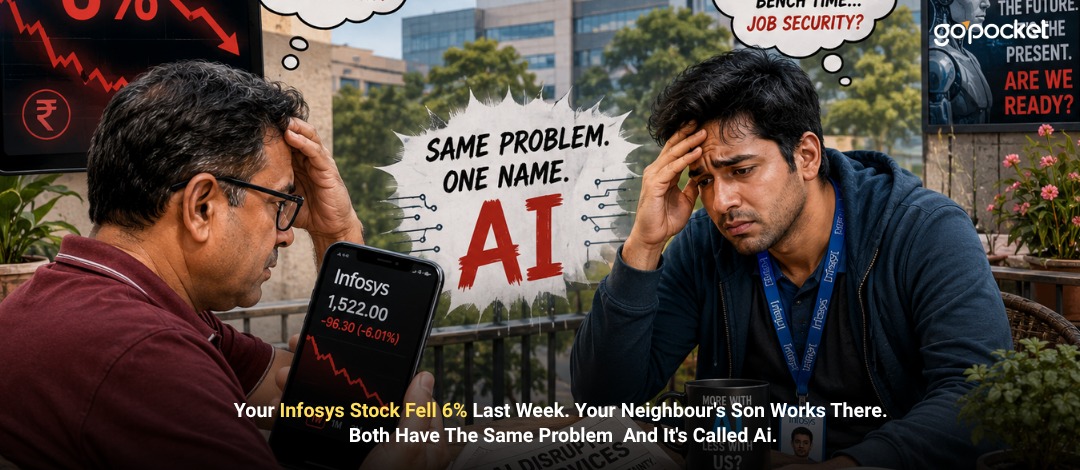


Picture this. It is a Friday morning. You check your portfolio before your first cup of chai. Your Infosys shares are bleeding – down over 7% in a single session. You switch to the news. Your neighbour knocks on the door, visibly worried. His son, a software engineer at a mid-sized IT firm in Bengaluru, just forwarded him a news article: his company is cutting fresh hiring by 40%. Neither you nor your neighbour did anything wrong. Nobody in India did.
A company called Accenture, sitting thousands of kilometres away in America, trimmed its revenue forecast by one percentage point – and sent shockwaves straight into the heart of India's most beloved sector.
This is the story of what happened last week, why it happened, and what it truly means for your money and for millions of Indian families whose lives are built around IT.
ONE NUMBER FROM AMERICA THAT MOVED INDIA'S MARKETS
On June 19, 2026, Accenture – one of the world's largest technology consulting companies – quietly revised its annual revenue growth forecast. The new range: 3% to 4%. The old range: 3% to 5%. One percentage point. That is all it took.
Accenture's stock crashed nearly 18% in US trading – its steepest single-day fall ever recorded. By the next morning in India, the damage had already arrived. The Nifty IT index, which tracks India's biggest software companies, sank 6% – hitting a more than three-year low.
Infosys crashed 8.19% to Rs. 1,034, a five-year low. TCS fell 6.52% to Rs. 2,060, close to a six-year low. HCL Tech, Wipro, Tech Mahindra – all fell between 3% and 7%. In a single trading session, Indian IT stocks wiped out over Rs. 1.35 lakh crore in market value. Gone. In one day.
Why does one American company's forecast hit Bengaluru, Hyderabad, and Pune this hard? Because Accenture serves the same global clients – the same banks, retailers, and manufacturers in the US and Europe – that Indian IT companies depend on for their revenues. When Accenture says those clients are spending less on technology, it is effectively a weather forecast for the entire Indian IT industry. And last week, the forecast was stormy.
BUT WHY ARE CLIENTS SPENDING LESS?
HERE IS THE PART THAT SHOULD WORRY YOU MORE
Here is where it gets uncomfortable. The slowdown in tech spending is not a temporary blip caused by the economy. There is something structural happening underneath – and its name is Artificial Intelligence.
For decades, Indian IT companies built an incredibly successful business model. The formula was simple: hire thousands of engineers, train them quickly, and deploy them to write code, test software, and maintain systems for large global companies. More people meant more revenue. India's top five IT firms alone employed hundreds of thousands of engineers.
The sector employed between 10 and 15 million Indians directly and indirectly, and those relatively high salaries fuelled a consumption boom – home loans, car purchases, school fees, and entire neighbourhoods built around the IT professional's monthly salary.
AI is now quietly dismantling that formula. Software that previously required a team of ten engineers to write and maintain can increasingly be produced and checked by AI tools in a fraction of the time and cost.
Global companies that used to outsource this work to Indian IT firms are now asking themselves: why pay for ten engineers when an AI tool does most of it? The result is that demand for the traditional, people-heavy outsourcing work that India specialised in is shrinking. Accenture's order book fell 14.7% year on year – a direct signal that clients are committing less money to the kind of large IT contracts that Indian companies depend on.
The TCS chairman recently said at their annual general meeting that within three years, TCS expects to have as many AI agents as human employees. That is not a boast. It is a warning about the direction of the industry.
THE JOBS PICTURE – WHAT THE NUMBERS ARE ALREADY SHOWING
This is not speculation about the future. It is already visible in the data today.
India's top five IT companies – TCS, Infosys, HCL Tech, Wipro, and Tech Mahindra – collectively reduced their headcount by around 7,000 employees in the financial year ending March 2026. That may sound small at first. But consider this: in the previous year, those same companies had added over 12,000 employees.
The trend has reversed sharply and decisively. TCS, which laid off 12,000 employees last year, plans to hire just 25,000 fresh graduates this year – compared to an average of 40,000 per year over the previous three years. Across the top five firms combined, gross hiring in FY26 dropped to around 170,000 – down from an average of 230,000 in the five years before that.
These are not small rounding errors. They represent real people – engineering graduates who expected campus placements, mid-career professionals who counted on promotions, families who built five-year financial plans around a steady IT salary.
Global research firm Bernstein went so far as to write an open letter to the Prime Minister warning of a deepening employment crisis, specifically calling out AI as a threat to the quality jobs that built India's aspirational middle class. For two decades, IT salaries funded home loans in Pune, funded children's IIT coaching in Chennai, and funded the kind of upward mobility that turned India's cities into engines of consumption.
The concern is simple: if that engine slows, the ripple effects do not stay inside the IT sector. They spread into real estate, retail, education, and services – touching every corner of the Indian middle-class economy.
IS THIS THE END OF INDIAN IT? NOT QUITE – BUT THE MODEL MUST CHANGE
Here is the honest answer: the Indian IT industry is not dying. It is being forced to grow up.
AI does not eliminate the need for technology. It changes what kind of technology work is needed. Routine coding and software maintenance, which made up a huge chunk of Indian IT revenues, will increasingly be automated. But building, implementing, integrating, and managing AI systems at scale inside large global companies – that requires human expertise, domain knowledge, and the kind of trusted client relationships Indian firms have spent decades building.
India already has over 1,800 Global Capability Centres – offices where multinational companies build their own in-house tech teams in India. More than 500 of these are already focused on AI. The Indian IT industry's strength was never in inventing the next technology. It was in making technology work at massive scale for real businesses. That strength remains.
AI needs plumbing. It needs someone to connect the model to the company's supply chain, customer database, and legacy systems. That is work India can do – and is already doing. But the transition requires retraining, repositioning, and a willingness to move away from the old volume-based model.
The companies that make this shift will thrive. Those that cling to the old playbook risk becoming the next chapter in a cautionary tale.

WHAT DOES THIS MEAN FOR YOU AS AN INVESTOR HOLDING IT STOCKS?
If you hold TCS, Infosys, Wipro, or any IT fund in your portfolio, here is what the current moment actually means – stripped of all the noise.
Short-term pain is real. The sector is facing genuine earnings pressure as global tech budgets tighten and AI reduces demand for traditional services. The next two to three quarters of quarterly results may continue to disappoint. Do not be surprised if volatility continues.
But the long-term story is not over. Indian IT has faced disruptions before – the dot-com crash, the 2008 financial crisis, the pandemic – and each time it adapted and came back stronger. The companies that are aggressively investing in AI capabilities, upskilling their workforce, and chasing AI-led transformation deals are positioning themselves for the next decade of growth.
The worst thing an investor can do right now is panic-sell after a crash. The second worst thing is to ignore the structural shift and assume prices will automatically recover without the business model changing. Watch the companies' order books and hiring trends in the coming quarters. Those numbers will tell you which firms are genuinely adapting and which are still hoping the storm passes.
THE BIGGER PICTURE FOR EVERY INDIAN HOUSEHOLD
This moment is bigger than a stock market correction. It is a signal that the economic model India relied on for a generation is evolving – and evolving fast. Millions of young Indians studying engineering, millions of families whose financial plans are built around an IT salary, millions of investors who bought IT mutual funds as a safe bet – all of them are watching the same shift unfold simultaneously.
The answer is not fear. The answer is awareness and adaptation. An engineer who upskills in AI, cloud architecture, or data engineering is not a victim of this disruption – they are positioned to benefit from the next wave. An investor who understands why the sector fell and what recovery actually requires is far better placed than one who either panics or pretends nothing has changed. The disruption is real, but so is the opportunity on the other side of it.
STAY AHEAD OF WHAT MOVES YOUR MONEY
The Accenture story, the Nifty IT crash, the AI disruption – these are not events happening to someone else. They are happening to India's economy, India's jobs market, and very likely your own portfolio.
Staying informed is the first step to staying in control. GoPocket brings you exactly this – what is happening in markets, what it actually means for your money, and what you should be thinking about next. In plain language. Every single day.
DISCLAIMER
This blog (article) is for educational and informational purposes only. It does not constitute investment advice or a recommendation to buy or sell any securities. All data referenced is based on publicly available information as of June 2026. Investors are advised to consult a SEBI-registered financial advisor before making investment decisions. Gopocket is not responsible for any investment decisions made based on this content.
Disclaimer
What's Trending
Interim Budget 2024: Highlights
February 8, 2024
Recent Blog


.jpeg)

Blog
Recent Blogs





Open your GoPocket Account within 5 minutes.
Have any queries?
Get support

Investing and trading is made simple, affordable and accessible for every Indian.



© Made with ❤️ in Coimbatore, India | Copyright © 2023 onwards, GoPocket.