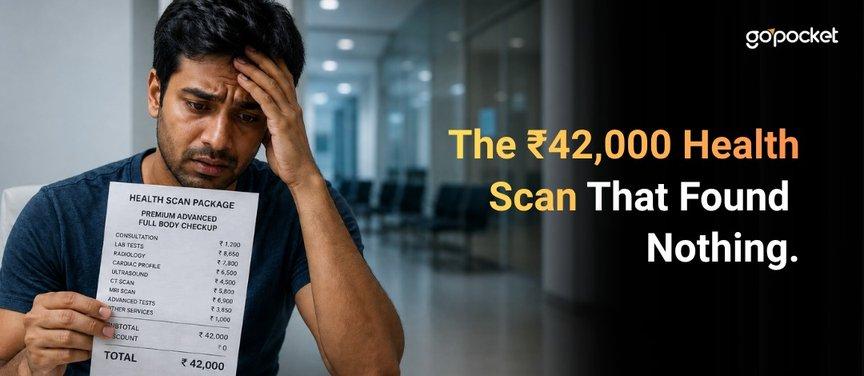
The ₹42,000 Scan That Made Me Rethink My Stocks
How the full-body scan craze connects to your health — and the Indian stock market
Think about this: What if your biggest stock market risk isn’t a recession or a war… but a health scan?
Here’s what happened.
Raj, a 28-year-old software engineer from Pune, invests in the Indian stock market. Like many of us, he puts some money in healthcare stocks because “healthcare will always grow in India.”
Last Tuesday, his flatmate Priya came home upset. She’d spent ₹18,000 on a “preventive full-body health scan” at a private clinic. No doctor asked her to do it. She just saw an Instagram ad: “Find problems before they find you.”
Two hours in a whole-body MRI machine. Then a 22-page report. One line scared her: “Uncertain significance — further investigation recommended.”
What followed? 11 days of stress. Two specialist visits. More tests. ₹24,000 gone.
Final result: She was perfectly fine. That “spot” was harmless. It would never have affected her.
She walked in healthy. Walked out ₹42,000 poorer and mentally exhausted.
Plot twist: Raj checked his stock app that night. He owned shares of Indian diagnostic companies — the same kind of firms that sell these premium scan packages.
His portfolio and Priya’s panic were now connected.
1. Why the Indian Stock Market Loves Your Health Anxiety
Let’s keep this simple.
In the Indian stock market, we have something called the Nifty 50. It’s like the “top 50 students” of Indian companies. On average, investors pay ₹22 to ₹24 for every ₹1 of profit these companies make. That’s called the P/E ratio. Think of it as the “price tag” for profit.
Now, look at many diagnostic companies in India. Their P/E ratio is 45 to 60. That means investors are paying ₹45 to ₹60 for every ₹1 of profit.
Why so expensive? Because the market expects huge growth. And a lot of that growth is coming from healthy, worried Indians buying full-body health scans.
So when you see the Nifty Healthcare Index going up — it closed at ₹15,704 on May 25, 2026, up from ₹13,536 last year — remember: part of that rise is built on scans like Priya’s.
2. The Business Model: Simple, but Nobody Explains It
Here’s how it works:
1. Clinic runs ads: “One scan. Full peace of mind.”
2. You pay ₹15,000–₹50,000. No doctor referral needed.
3. You get a whole-body MRI.
4. Report flags “abnormalities.” Most are “uncertain.”
5. You panic. You book more tests.
The problem? No major medical body in the world says healthy people should get a whole-body MRI.
JAMA reality check: In May 2026, JAMA — one of the world’s most respected medical journals — published a paper. The finding was blunt: For healthy people with no symptoms, these scans have zero proven benefit. And they can cause harm.
The industry’s main scorecard isn’t “lives saved.” It’s “Abnormalities Identified.” That’s a sales target wearing a lab coat.
From Savings to Wealth Creation
3. Three Things That Affect Both Your Body and the Bombay Stock Exchange
• The Scan Creates Patients, Not Just Reports
About 3 in 10 people get told “needs further investigation.” Most turn out fine. But the fear is real. It hits your mental health and your wallet.
For the Indian stock market: This “fear demand” is what’s driving revenue growth for many diagnostic firms. If people stop being scared, growth slows. Stock prices react fast.
• Wide Scan ≠ Right Scan
A whole-body MRI is like taking a drone photo of your entire city to find a leak in your bathroom. A doctor-ordered MRI is like a plumber checking the exact pipe.
There are real court cases where a “clean” full-body scan missed serious issues that showed up months later. The scan wasn’t detailed enough.
For investors: If one such case goes viral, public trust drops. In India, one bad news cycle can wipe crores off a stock in hours.
• Finding Too Much Is a Problem
Doctors found tiny thyroid lumps in 36% of people after death, people who died of other causes. In one country, routine thyroid scans made diagnoses jump 15x. Deaths? No change. But thousands got unnecessary surgery.
For the Indian stock market: This is called “overdiagnosis.” If regulators or doctors start calling it out, the whole “preventive package” business gets questioned. That’s a direct hit to earnings.
4. Three Risks Indian Investors Should Know
• Risk 1: Regulators Are Watching
Global medical guidelines drive Indian policy. That JAMA paper came out in May 2026. Indian health authorities usually follow within 12–24 months. If they say “stop elective whole-body scanning,” revenue drops overnight.
• Risk 2: Insurance Companies Do Math
Health insurers in India cover these scans now to attract customers. But if their data shows these scans cause more follow-up claims than actual savings, they’ll stop covering them. No insurance = fewer buyers = lower growth.
• Risk 3: It’s a Fear-Based Business
Uncertain scan → specialist → more tests → maybe biopsy. Everyone makes money. The clinic is just the entry gate.
In the stock market, we call this “unsustainable revenue.” It depends on keeping people worried. One strong news report or social media thread exposing this can trigger a sell-off. We’ve seen it happen in other sectors.
5. Where Real Healthcare Investing in India Actually Works
Screening is good — when it’s targeted. The science is clear:
• Low-dose CT scans cut lung cancer deaths by 20%, but only for long-term heavy smokers. That’s specific.
• Cardiac calcium scoring helps doctors treat people at medium heart risk. That’s useful.
• Genetic tests for families with a history of certain diseases? Life-saving.
The Indian diagnostic companies that focus on these doctor-recommended tests are building real, long-term businesses. The ones relying on “full-body health scan” marketing to healthy people? That’s shakier.
The Indian stock market hasn’t fully separated the two yet. Stocks trading at 50x earnings on hype carry more risk than those growing on real medical need.
That difference is where smart investing happens.
From Beginner to Informed Investor
6. Two Simple Questions Before You Swipe Your Card or Buy the Stock
For your health:
1. What exact disease are we looking for? If the answer is “everything,” that’s not medicine.
2. If we find something, what will we do differently? If the plan is “wait and watch,” you’re paying for stress.
For your Indian stock portfolio:
1. How much of this company’s revenue comes from real, doctor-prescribed tests vs. wellness marketing? That ratio matters more than total growth.
2. What happens if insurance stops covering these packages? A 50x stock can become a 20x stock quickly.
The Ending Raj Learned
Raj sold half his diagnostic stocks.
Not because healthcare in India is a bad sector. It’s not. India needs better healthcare.
He sold because he realised he owned stocks priced on fear, not fundamentals. And in the Indian stock market, fear is a terrible long-term business model.
He kept the other half. The winners will be companies that shift to real medical needs before they’re forced to.
Bottom line: A scan that says “nothing” can still cost your peace of mind. A stock built on that scan can cost your portfolio.
In India, the stock market and your health are more connected than you think. Invest in companies that heal people — not just worry them.
Investments are subject to market risks. This is for educational purposes only and not investment advice. Stock market investments can result in loss. Always consult a SEBI-registered advisor before investing.