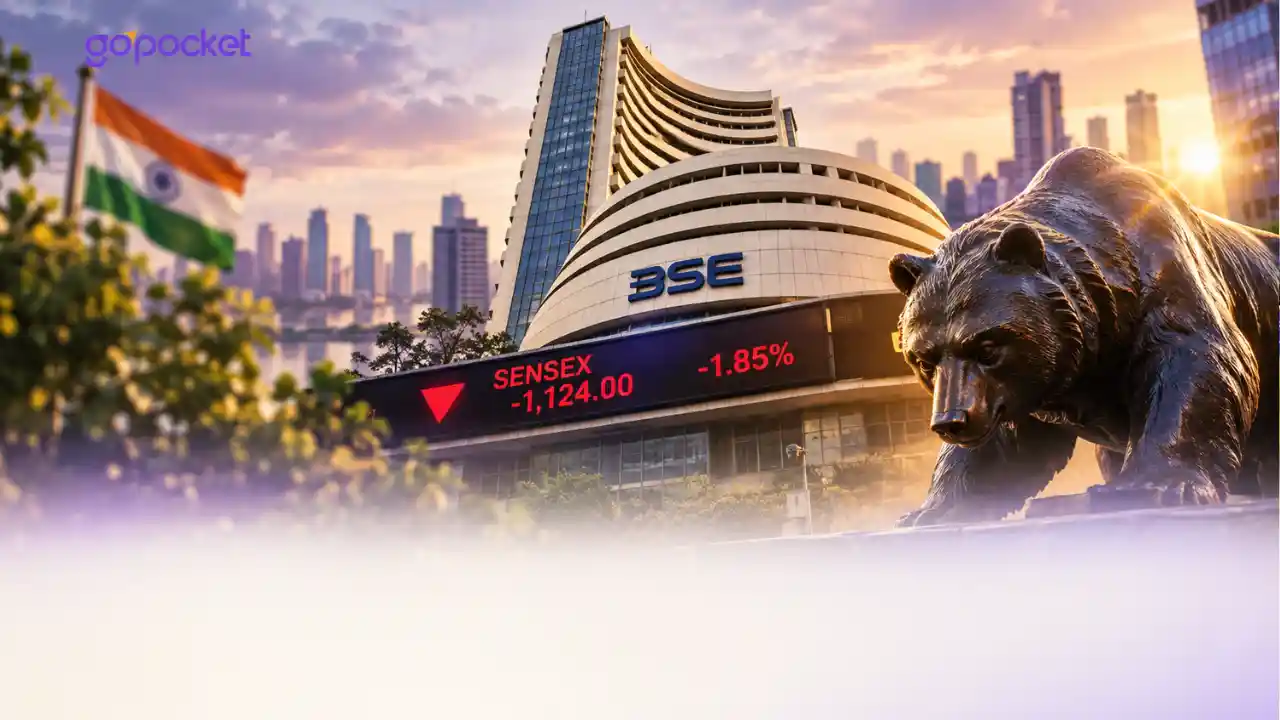

Why Is the Stock Market Down Today? Sensex Crashes 1,124 Points, Nifty Slips Below 22,800
If you opened your portfolio on Monday evening and felt a knot in your stomach, you had plenty of company. Dalal Street went through one of its toughest sessions in months on September 28, 2026, and that nervousness spilled straight into Tuesday morning. The BSE Sensex lost 1,124.02 points (1.52%) to close at 72,771.72, while the Nifty 50 dropped 360.25 points (1.56%) to settle at 22,780.25. Both benchmarks are now hovering close to their six-month lows.
So what actually went wrong? It was not one single trigger. It was several pressures landing on the market at the same time. Let us break it down in plain language.
1. Crude Oil Jumped After US-Iran Talks Hit a Wall
The biggest spark came from the oil market. Peace talks between the US and Iran reached a deadlock, and US President Donald Trump said he had turned down an Iranian proposal to reopen the Strait of Hormuz, one of the world's most important oil shipping routes. Traders immediately worried about supply disruptions, and Brent crude futures climbed as much as 3.7% to around $108 a barrel during the day.
For India, this matters more than for most countries. We import close to 90% of the crude oil we use, so every jump in oil prices raises the import bill, puts pressure on inflation and squeezes the margins of companies that depend on fuel and petrochemicals.
2. Foreign Investors Continued to Sell
Foreign Institutional Investors (FIIs) have been steady sellers of Indian equities this month. On September 28 alone, they offloaded shares worth ₹5,353.22 crore. Domestic Institutional Investors (DIIs) stepped in with purchases of ₹5,189.02 crore, which cushioned the blow but could not fully absorb the selling.
3. A Weak Rupee and High US Bond Yields
The rupee has been hovering near the 96-per-dollar mark, and US Treasury yields remain elevated. When US bonds offer attractive returns and the rupee keeps weakening, global funds find less reason to stay invested in emerging markets like India. That combination has been weighing on sentiment for weeks.
How Bad Was the Damage? A Sector-by-Sector Look
This was not a fall limited to a handful of heavyweights. Every sectoral index closed in the red on Monday. The Nifty PSU Bank index was the worst hit, falling around 3%, while the Telecom index lost about 2%. Energy, infrastructure, FMCG, realty, private banks, metals and oil and gas indices each declined by more than 1%.
Smaller companies were not spared either. The Nifty Midcap 100 slipped 1.32% and the Nifty Smallcap 100 fell 1.45%. Market breadth told the real story: on the NSE, only 1,214 shares advanced while 2,905 declined. Reports estimated that roughly ₹6 lakh crore of investor wealth was wiped out during the session.
Stock Market Today (September 29): Another Cautious Start
Tuesday did not bring immediate relief. Gift Nifty signalled a weak start, and the Sensex and Nifty opened in the red. In early trade, 1,637 stocks were declining against just 807 advancing on the NSE. The Nifty was testing the 22,700 zone, with Brent crude near $107 and the rupee weaker than 96 against the dollar. Whether the index can hold this level is now the key question for traders.
Key Things to Watch This Week
- US-Iran developments: Any credible sign of the Strait of Hormuz reopening could cool oil prices quickly, and that would likely ease pressure on Indian equities.
- Crude oil price: Brent staying above $105 keeps inflation and fiscal worries alive.
- Rupee movement: A sustained move beyond 96 per dollar may add to foreign outflows.
- FII vs DII flows: Continued domestic buying has been the market's safety net so far.
- RBI policy: The Monetary Policy Committee meets from October 5 to 7, 2026, and its tone on inflation and the rupee will be closely watched.
What Should Regular Investors Keep in Mind?
Sharp one-day falls feel scary, but they are a normal part of equity investing. Markets have gone through oil shocks, currency pressure and global sell-offs many times before. Instead of reacting to a single red day, it helps to revisit your goals, check whether your asset allocation still matches your risk comfort, and avoid making decisions purely out of fear or excitement. If you invest through SIPs, remember that they are designed for exactly these kinds of phases.
You can track live Sensex and Nifty levels, sector moves and market news on the GoPocket app, so you stay informed rather than anxious.
Disclaimer: This article is for information and education only. It is not investment advice or a recommendation to buy or sell any security. Please do your own research or consult a SEBI-registered adviser before investing.