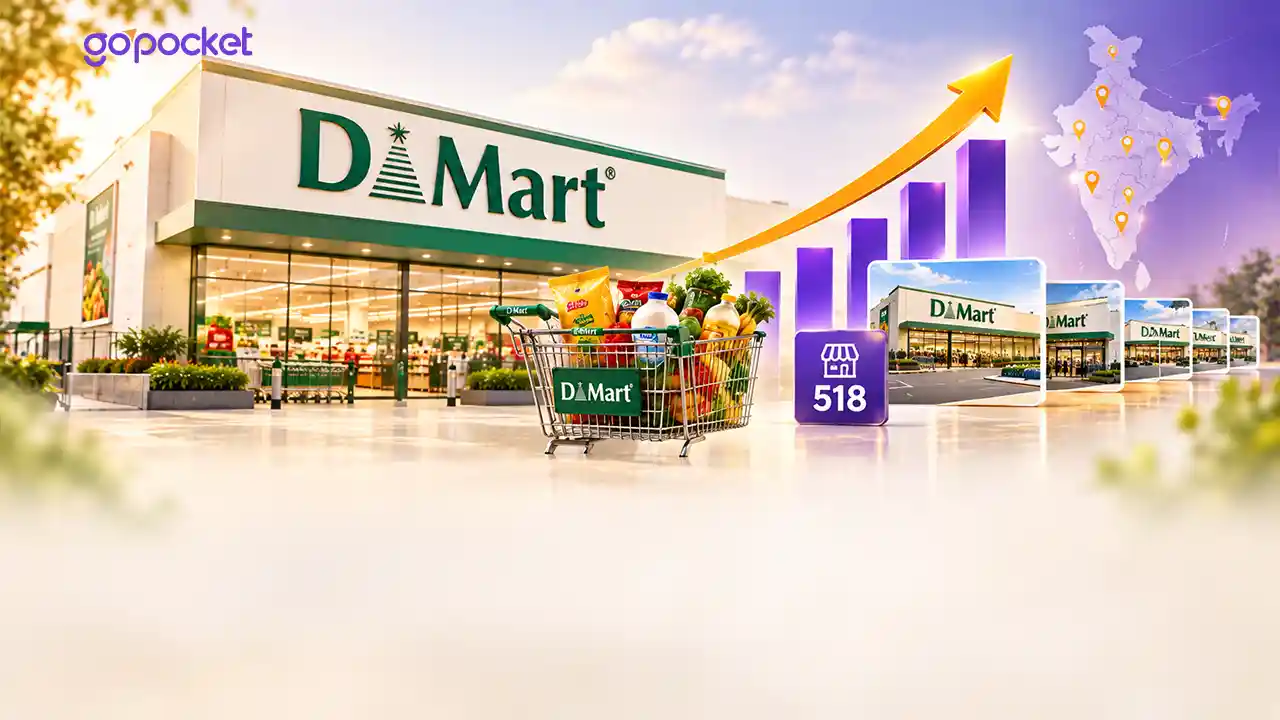

DMart Share News: Q2 Revenue Rises 18.4% to ₹19,206 Crore as Store Count Hits 518
Every quarter, DMart gives the market an early peek at its performance with a short update: one revenue number and one store count. It's only two figures, but investors read them closely. This time, Avenue Supermarts, the company behind DMart, reported its fastest September-quarter revenue growth in three years and its quickest pace of store openings in a long while.
Here's what the update showed, what the numbers suggest when you dig into them, and what's still missing until the full results arrive. For the live price, chart and ratios, see the DMart (Avenue Supermarts) stock page on GoPocket.
Key Takeaways
- Standalone revenue rose 18.4% year-on-year to ₹19,206.18 crore in Q2 FY27, and 4.7% over the June quarter.
- DMart ended September with 518 stores, adding 15 in the quarter and 86 over the past year.
- Revenue growth is now running slightly behind store growth, so like-for-like sales in the full results will be key.
Where Is DMart's Share Price Now?
Avenue Supermarts closed at ₹3,813 on the NSE on October 1, 2026, up 0.31% for the day, according to NSE bhavcopy data. Its 52-week range is ₹3,600 (February 2, 2026) to ₹4,644 (April 17, 2026). That puts the stock about 18% below its high and only about 6% above its low.
The update came out on Saturday, October 3, and markets were shut on October 2, so Monday's session is the first to react. Check the live DMart share price for the latest move.
What Did DMart Report for Q2 FY27?
According to Business Standard, Avenue Supermarts said in a regulatory filing that:
- Standalone revenue from operations for the quarter ended September 30, 2026 was ₹19,206.18 crore, up 18.4% from ₹16,218.79 crore a year earlier.
- Sequential growth: revenue rose 4.7% from ₹18,343.49 crore in the June quarter.
- Store count: 518 stores as of September 30, including the Sanpada store in Navi Mumbai, which remains closed for reconstruction.
The revenue figure is still subject to a limited review by the company's statutory auditors, as Free Press Journal noted.
How Does This Compare With Previous Years?
The company's filings give a neat four-year view of September-quarter revenue. Here's how it stacks up, with year-on-year growth calculated from the reported figures:
| Quarter | Standalone revenue (₹ crore) | YoY growth |
|---|---|---|
| Q2 FY23 (Sep 2022) | 10,384.66 | – |
| Q2 FY24 (Sep 2023) | 12,307.72 | 18.5% |
| Q2 FY25 (Sep 2024) | 14,050.32 | 14.2% |
| Q2 FY26 (Sep 2025) | 16,218.79 | 15.4% |
| Q2 FY27 (Sep 2026) | 19,206.18 | 18.4% |
The trend is clear. After two years of mid-teens growth, the September quarter has bounced back to the high-teens pace last seen in 2023. In four years, quarterly revenue has grown by about 85%.
Why Is DMart Opening Stores So Quickly?
The bigger story may be the store count. DMart had 432 stores at the end of September 2025, as reported by Outlook Business. It now has 518. That's 86 net new stores in twelve months, or about 20% growth in the network.
Compare that with the pace a year ago. In the September 2025 quarter, the company opened just eight stores. In the September 2026 quarter, it added 15, going from 503 to 518. And back in September 2022, Business Standard reported a store count of 302, so the network has grown by more than 70% in four years.
Why does this matter? DMart owns most of its stores rather than renting them. That keeps long-term costs low but makes expansion capital-intensive. A faster rollout signals management confidence in demand, and it also means more money tied up in new stores that take time to reach full productivity.
Reading Between the Lines: Revenue per Store
Here's a quick calculation that adds useful context. Dividing quarterly revenue by the closing store count gives a rough revenue-per-store figure:
- Q2 FY26: ₹16,218.79 crore across 432 stores works out to about ₹37.5 crore per store.
- Q2 FY27: ₹19,206.18 crore across 518 stores works out to about ₹37.1 crore per store.
So revenue grew 18.4%, but the store base grew nearly 20%. Revenue per store slipped about 1%. That isn't necessarily a red flag. Dozens of the new stores opened only in the last few months and haven't built up a full customer base yet, so they drag down the average. It does mean most of this quarter's growth came from new stores rather than from older stores selling more.
The number that settles this is like-for-like (LFL) growth, which measures sales at stores that are at least two years old. A year ago, LFL growth was 6.8% in Q2 FY26, according to Business Standard. That figure will only come with the full results.
What About Margins?
The quarterly update says nothing about profitability, and that's where last year's results raised questions. In Q2 FY26, standalone EBITDA grew 11.3% to ₹1,230 crore, slower than revenue growth of 15.4%, and analysts flagged margin pressure, Business Standard reported. That works out to an EBITDA margin of roughly 7.6% on standalone revenue.
DMart competes on low prices, and it has passed on GST rate cuts to customers wherever applicable. Rising competition from quick-commerce apps adds more pressure. So whether margins hold up alongside faster store openings is the key question for the full Q2 FY27 results.
What Factors Move DMart's Share Price?
- Revenue and LFL growth: Growth at older stores shows the health of the core business.
- Store additions: The pace of new openings drives long-term revenue but needs heavy upfront spending.
- Margins: DMart's low-price model leaves thin margins, so small changes matter.
- Consumer demand: Inflation, rural spending and festive-season sales affect footfall and basket size.
- Competition: Quick-commerce players and other retailers are fighting for the same grocery and household spend.
- Leadership: Anshul Asawa took over as CEO in January 2026 after Neville Noronha, who had led the company since 2007, stepped down, as reported by Outlook Business.
For the broader market mood, read our stock market update.
What Should DMart Watchers Track Next?
- Full Q2 FY27 results: Last year, the board met on October 11 to approve the September-quarter results, so a similar mid-October timeline is likely.
- LFL growth: Whether two-year-old stores grew faster or slower than last year's 6.8%.
- EBITDA margin: Whether profitability kept pace with revenue.
- Festive season trading: October and November usually bring the strongest footfall of the year.
Follow the DMart share price, chart and financials on GoPocket.
Sources
- Business Standard, D-Mart Q2FY27: Revenue rises 18.4% to ₹19,206 crore; store count at 518, October 3, 2026
- Free Press Journal, Avenue Supermarts reports ₹19,206.18 crore standalone revenue in Q2 FY27; store count reaches 518, October 2026
- Outlook Business, D-Mart Q2 revenue rises 15.4% to ₹16,219 crore, October 2025
- Outlook Business, D-Mart's Q2 profit up 3.8% to ₹685 crore, October 2025
- Business Standard, DMart Q2 show: Analysts flag margin strain despite steady revenue growth, October 13, 2025
- Business Standard (PTI), Retail chain D-Mart's Q2 revenue jumps 35.7% to Rs 10,384.66 crore, October 5, 2022
- NSE bhavcopy data for DMART, October 1, 2026
Disclaimer: This article is for information and educational purposes only. It is not a recommendation to buy, sell or hold Avenue Supermarts (DMart) or any other security. Q2 FY27 revenue is provisional and subject to limited review by the company's auditors. Please do your own research or consult a SEBI-registered investment adviser before investing.