Somewhere in India right now, a bank account is quietly holding money nobody has touched in over a decade. A share certificate from a company your grandfather invested in back in the 1990s is sitting unclaimed. A life insurance policy matured years ago, and the payout is still waiting for someone to ask for it.
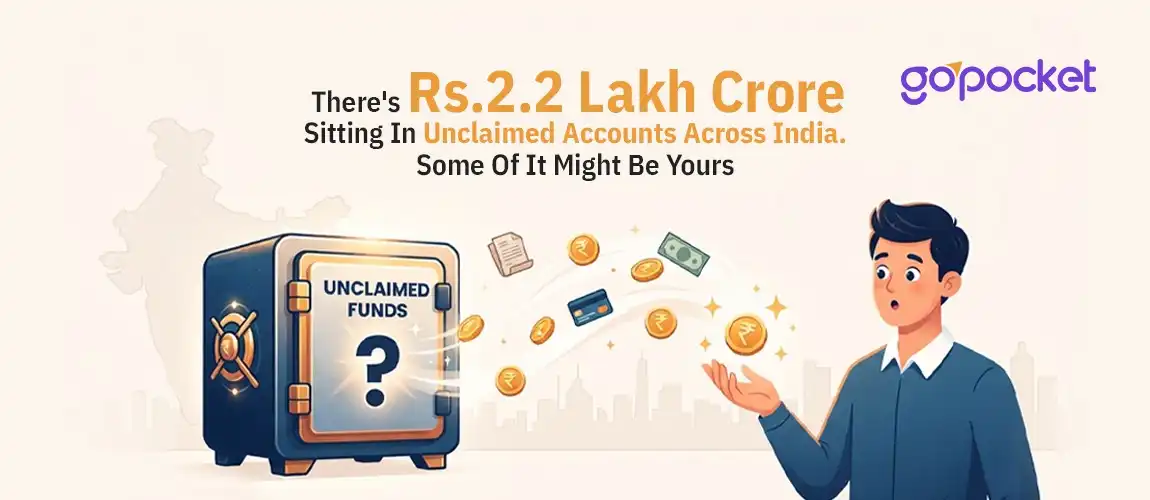
This isn't a rare, isolated story. As of April 2026, government-consolidated data shows Rs.2.2 lakh crore is currently unclaimed across Indian banks, insurance companies, provident fund accounts, mutual funds, and shareholding records. That's not a typo. That's roughly the size of a mid-sized state's entire annual budget, just sitting there, waiting for the rightful owner to show up.
Some of it could genuinely belong to you or your family. Here's exactly how to check.
WHY MONEY ACTUALLY BECOMES "UNCLAIMED"
This isn't fraud, and it isn't the institutions trying to keep your money. It happens for painfully ordinary human reasons.
Nominee details never get updated after a marriage, a house move, or simply because it felt like a task for "someday." Bank accounts opened decades ago get forgotten entirely once a person switches jobs or cities. Physical share certificates from the pre-demat era, when everything was still paper based, sit in old files that nobody remembers to check. And in the saddest cases, an account holder passes away, and their family has no idea the account, policy, or investment ever existed in the first place. Multiply these ordinary human oversights across a country of 1.4 billion people and several decades of financial history, and you get a number as large as Rs.2.2 lakh crore.
WHERE EXACTLY IS THIS MONEY SITTING?
| CATEGORY | AMOUNT UNCLAIMED | WHAT IT TYPICALLY COMES FROM |
| Equity Shares & Dividends | Rs.89,004 crore | Old shares, unclaimed dividends transferred after prolonged inactivity |
| Insurance Policies | Rs.20,062 crore | Matured policies, unpaid claims never collected |
| EPF Accounts | Rs.10,915 crore | Provident fund balances left inactive, often from old jobs |
| Mutual Funds | Rs.3,452 crore | Unclaimed redemptions and dividend payouts |
| REITs, InvITs, NCDs | Rs.764 crore | Smaller but growing as these newer instruments expand |
| Bank Deposits (separately, RBI) | Rs.67,270 crore | Inactive savings, current, and term deposits |
Bank deposits and equities together make up nearly 85% of this entire unclaimed pool, a direct reflection of how much of India's savings history still lives in traditional banking and early, paper-based stock ownership.
WHY THIS MATTERS EVEN MORE FOR YOUR PARENTS AND GRANDPARENTS
If you're under 40, there's a good chance this doesn't touch your own accounts much. But it very likely touches your family's.
Anyone who worked a job in the 1980s, 90s, or early 2000s may have a PF account they never withdrew from after switching companies. Anyone who bought shares through a physical broker before demat accounts became standard may be holding certificates that were never digitised or transferred. Anyone with an old LIC policy that matured quietly, without a follow-up call, may have a payout sitting untouched right now.
This is exactly the kind of conversation worth having at the dinner table this week, not because it's urgent in a scary way, but because ten minutes of checking could genuinely surface money your family didn't know it had.
HOW TO ACTUALLY CHECK, PORTAL BY PORTAL
The good news is that the government has built dedicated portals for exactly this, and checking takes far less time than most people assume.
For bank deposits, visit the RBI's UDGAM portal. It lets you search across multiple participating banks in one place using your name, PAN, or account details, rather than having to check with each bank individually.
For shares and dividends, the IEPF portal, run by the Investor Education and Protection Fund Authority, lets you search by your name or folio number to see if any shares or dividends were transferred there after years of inactivity.
For insurance, Bima Bharosa is the official portal where you can check for unclaimed policy proceeds or unpaid claims across insurers.
For mutual funds, MF Central lets you check and consolidate unclaimed redemptions and dividends across fund houses in a single search.
For provident fund, the EPFO portal itself lets you check your own account status. Worth knowing here: EPFO doesn't officially use the word "unclaimed." It calls these "inoperative accounts," specifically ones with no contribution for 36 consecutive months, but the process to claim them back is the same.
WHAT TO ACTUALLY EXPECT ONCE YOU FIND SOMETHING
Be honest with yourself about timelines here. This isn't instant.
If the account or policy belongs to you directly, you'll typically need your PAN, Aadhaar, and basic KYC documents, and the process can take anywhere from a few weeks to a couple of months depending on the institution. If you're claiming on behalf of a deceased family member, expect to need a death certificate, a legal heir or succession certificate for larger amounts, and proof of your relationship to the account holder. It's more paperwork, but it's a well-established, government-backed process, not a maze with no exit.
The reward, when it comes through, is real money that was already legally yours, simply waiting to be asked for.
Take ten minutes this week. Check one portal. It might turn out to be the most valuable ten minutes you spend all month.
GoPocket has spent over 14 years helping Indian families make sense of their money, not just where to invest it next, but making sure nothing that's already theirs gets left behind.