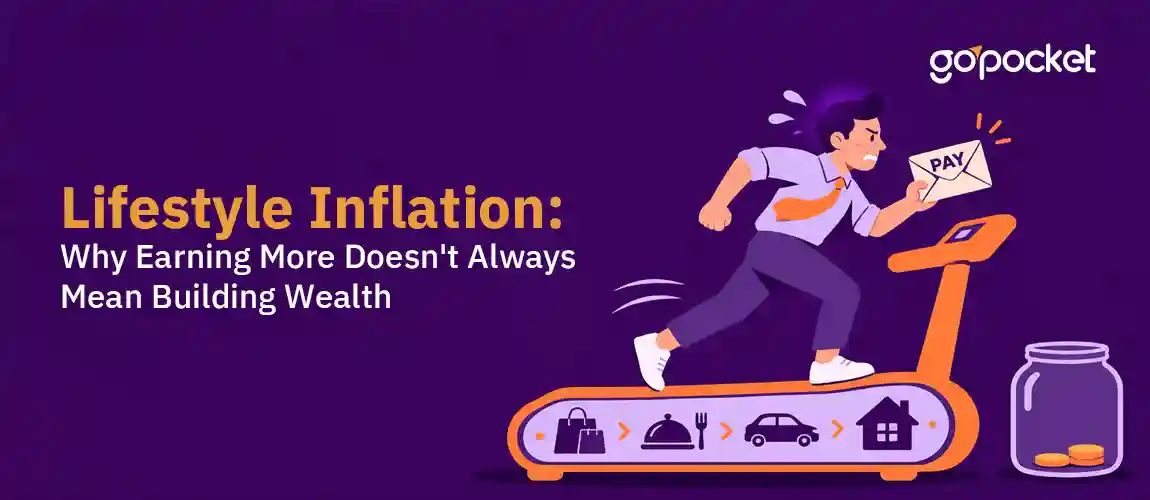
LIFESTYLE INFLATION:
WHY EARNING MORE DOESN'T ALWAYS MEAN BUILDING WEALTH
Rohit got his first big hike at 24. A 10,000-rupee bike became a 90,000-rupee one within the month. At 27, another promotion arrived, and so did a bigger flat, a new phone on EMI and weekend trips that used to be once-a-year treats. By 30, Rohit was earning nearly four times his first salary. His bank balance, though, told a different story: barely more than what he'd had at 24.
Nothing about Rohit's story is rare. It's so common that economists gave it a name decades before social media made it visible: lifestyle inflation, the quiet habit of spending rising in step with income, until the raise disappears before it ever becomes wealth.
WHAT IS LIFESTYLE INFLATION?
Lifestyle inflation, also called lifestyle creep, is the tendency to increase spending as income rises, so that a bigger salary buys a bigger lifestyle instead of a bigger net worth. The British historian C. Northcote Parkinson described this pattern in 1960 with a line that still holds: "Expenditure rises to meet income." He was writing about government budgets, but the same law plays out in personal finances across every income bracket, from a first job to a corner office.
Here's the part that catches most people off guard. Lifestyle inflation isn't really about overspending in the obvious sense. Rohit never felt reckless. Each individual upgrade, a nicer phone, a better flat, a well-earned trip, felt completely reasonable at the time. That's exactly how it works. It's not one big decision. It's dozens of small, justified ones that quietly add up to the same destination: a bigger income with nothing extra to show for it.
LOOKING WEALTHY VS BEING WEALTHY
This is the question that matters, and it's worth sitting with. Looking wealthy means your spending signals success: the car, the watch, the address, the vacations people see on social media. Being wealthy means your assets, investments, savings and income-generating resources are quietly growing, whether anyone else notices.
The two can look identical from the outside and be completely different on a balance sheet. A person earning Rs. 15 lakh a year who invests Rs. 3 lakhs of it is building wealth. A person earning Rs. 25 lakh a year who spends all of it, plus a little on EMIs, is not, no matter how their lifestyle looks in photos. Net worth, not income, is the real scoreboard, and net worth is built by the gap between what you earn and what you keep, not by the number on your salary slip.
THE NUMBERS BEHIND THE PATTERN
This isn't just a personal finance cliche. It shows up clearly in how India is saving and borrowing right now. Net household financial savings fell to 6.2% of GDP in FY26, down from 7.0% the year before, even as incomes across the country kept rising. At the same time, household debt climbed to 45.5% of GDP, and within that debt, loans for consumption purposes, personal loans, credit cards and consumer durables, made up 49.7% of all household borrowings by March 2026.
Put plainly: as a country, we are earning more and borrowing more to spend more, while keeping less. That's lifestyle inflation playing out at a national scale, one household at a time.
| WHAT ROSE | THE NUMBER | WHAT IT TELLS US |
| Non-housing retail loans (personal loans, credit cards, consumer durables, auto) | 58.4% of household debt by March 2026, up from about 50% in 2019-20 | A growing share of borrowing funds lifestyle, not assets |
| Consumption loans specifically | 49.7% of household borrowings by March 2026 | Nearly half of what households borrow pays for spending, not appreciating assets |
| Net household financial savings | Fell to 6.2% of GDP in FY26, from 7.0% in FY25 | Savings are shrinking even as the economy, and incomes, keep growing |
WHY SMART, SUCCESSFUL PEOPLE FALL FOR IT
Lifestyle inflation isn't a discipline problem reserved for careless spenders. It targets high earners precisely because they have the most room to justify it. A quick answer, if you're wondering why this happens even to financially literate people: each raise arrives attached to a reasonable-sounding upgrade, and no single upgrade feels like the mistake, so the pattern never triggers an alarm.
There's also a social layer to it. Status spending, buying visible things to signal success, works because humans compare themselves to the people around them, not to their past selves. The moment your income crosses into a new circle of friends or colleagues, your sense of "normal" spending quietly resets to match theirs. You're no longer competing with who you were last year. You're competing with everyone around you right now, and that race has no finish line.
FOUR HONEST SIGNS LIFESTYLE INFLATION HAS CAUGHT YOU
- Your savings rate hasn't moved with your salary. If your income has grown 50% over two years but you're investing roughly the same rupee amount as before, the raise has already been absorbed.
- Upgrades happen before milestones, not after them. A new phone the week of a hike, rather than after a planned goal is funded, is the clearest early signal.
- EMIs quietly multiply. Each one feels manageable alone. Added up, they often eat a growing share of take-home pay, which matches exactly what the national data on consumption loans shows.
- You couldn't say, right now, what percentage of this month's income you saved. If the number isn't top of mind, it's probably smaller than you'd guess.
BREAKING THE PATTERN WITHOUT FEELING DEPRIVED
The fix isn't refusing every upgrade. It's sequencing them correctly. A practical rule that works across income levels: for every raise, decide the investable portion before deciding the lifestyle portion. If a hike adds Rs. 20,000 a month, commit a fixed share, say 50%, to a SIP or investment first, and only then let the rest fund lifestyle choices. The upgrade still happens. It just happens after wealth-building gets its share first, not after everything else is accounted for.
This single sequencing change is what separates people who earn more and stay the same from people who earn more and genuinely move forward. It doesn't require earning less or living smaller. It requires deciding, in advance, which raise is for building and which is for living, instead of letting the entire raise quietly default to spending because that's always the path of least resistance.
THE REAL QUESTION TO ASK AT EVERY RAISE
The next time a raise, bonus or windfall lands, the single most useful question isn't "What can I finally afford?" It's "What percentage of this am I investing before I spend any of it?" Answer that question first, every time, and lifestyle inflation loses its grip. Skip it, and even a fourfold salary like Rohit's can leave you standing exactly where you started.
Wealth isn't built by what you earn. It's built by what survives the month after you earn it, and that is a decision you get to make with every single raise.
Whenever you're ready to put a raise to work instead of letting it quietly disappear, the GoPocket mobile app is right there to help you invest it, so your next hike builds your future and not just your lifestyle.